Abdelhakim Yamani,
Institute for Geopolitical Horizons
April 23, 2025
ENGLISH TRANSLATION
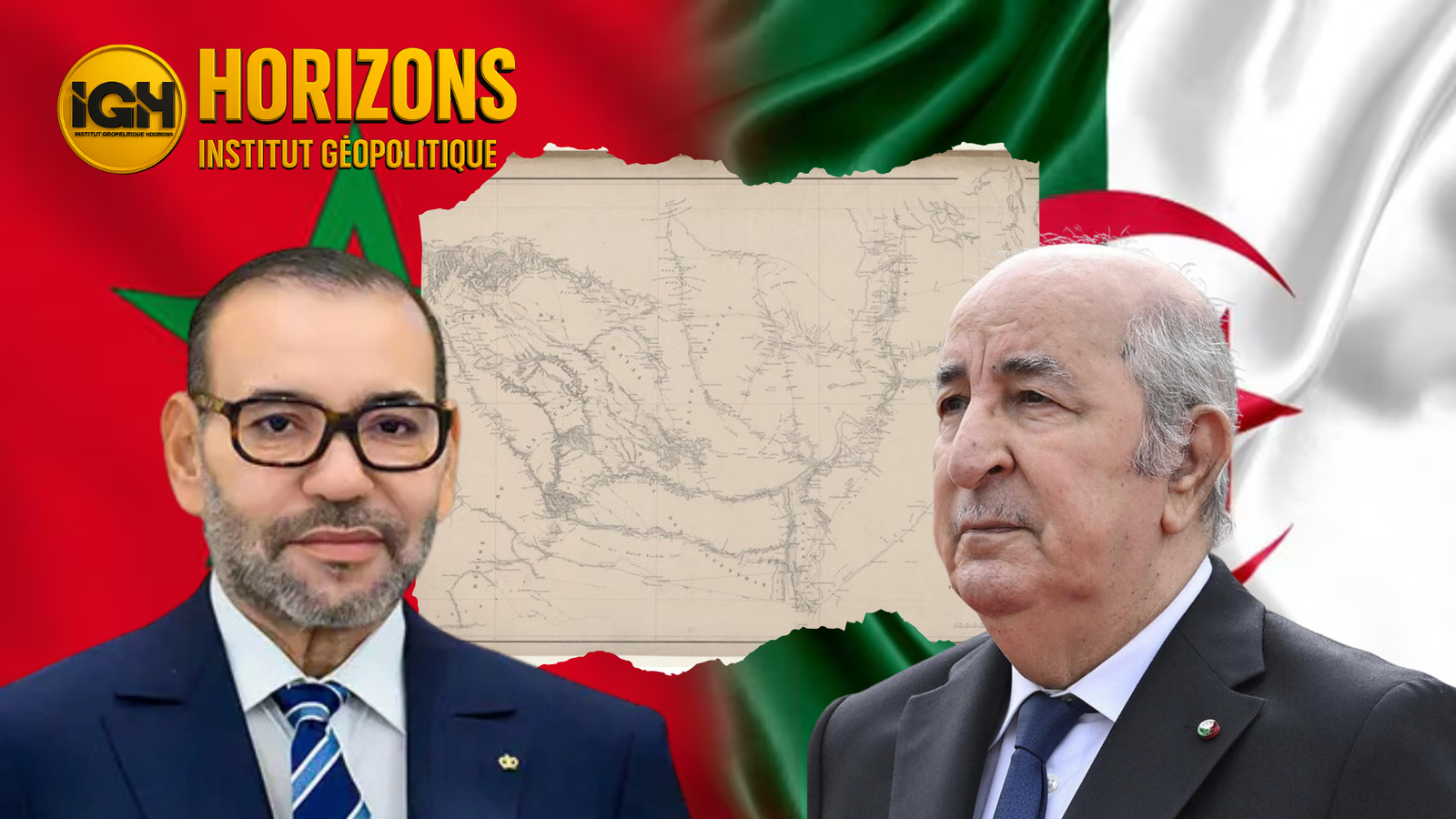
An Analysis of Strategic Collaborations Aimed at Destabilizing Morocco on Two Fronts
EXECUTIVE SUMMARY
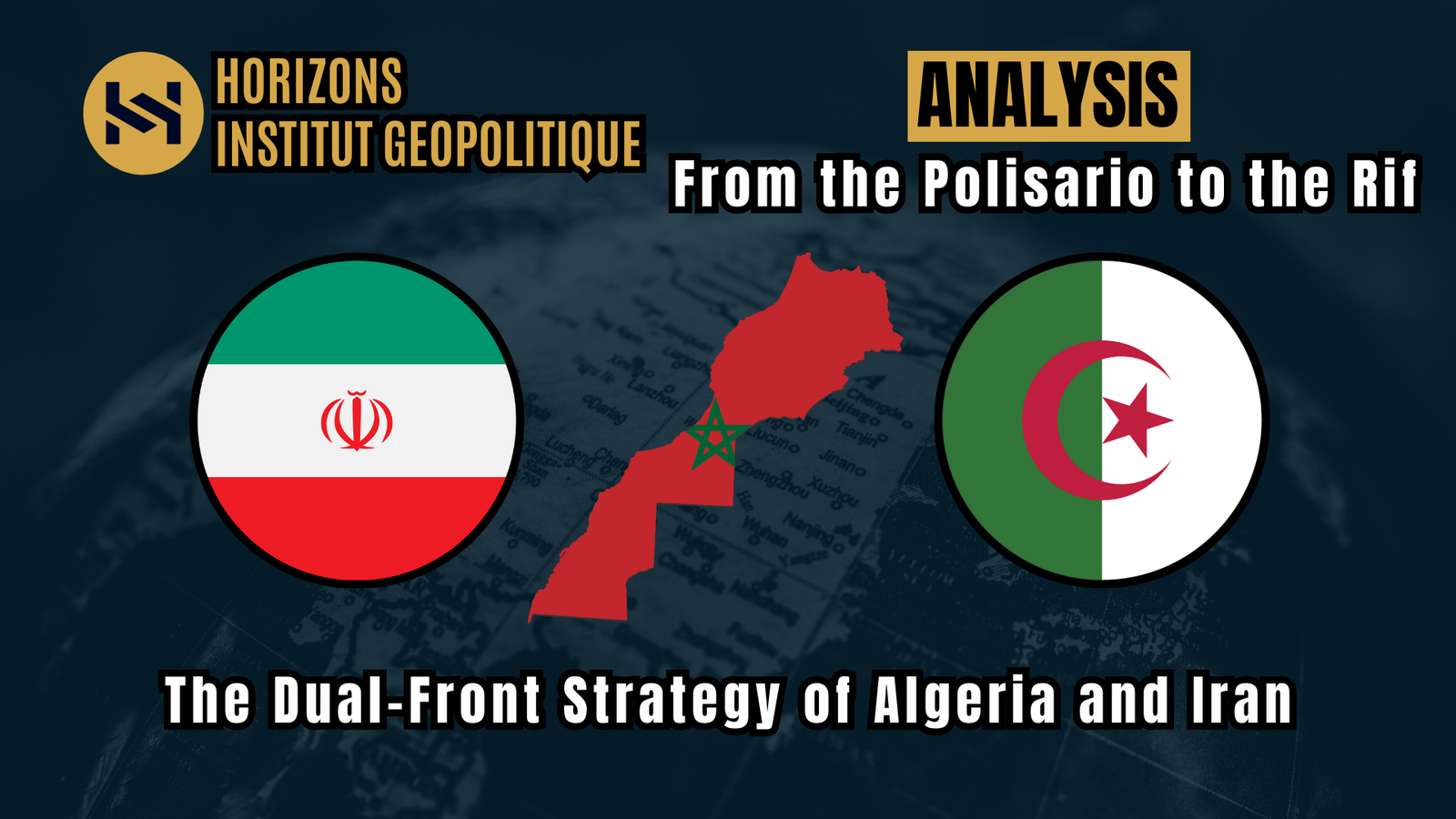
This report analyzes a coordinated strategy between Algeria and Iran aimed at destabilizing the Kingdom of Morocco on two distinct but complementary fronts: the Sahara in the south via the Polisario Front and the Rif in the north via a new separatist movement. Drawing on exclusive information provided by a former high-ranking Algerian intelligence officer now ideologically at odds with the Algiers regime, our analysis demonstrates how this collaboration has developed in two phases:
- Southern Front: Historical support for the Polisario Front in Western Sahara, more recently complemented (mid-2010s) by Iranian military assistance including weapons and training by the Revolutionary Guards.
- Northern Front: A new strategy targeting the Rif region with official support for the Rif National Party (RNP), financed to the tune of 10 million euros by Algeria, coupled with the deployment of long-term Shiite religious influence among the Rifian diaspora in Europe, particularly in Belgium, where the Moroccan Shiite community is estimated at between 200,000 and 250,000 people.
This convergence potentially aims to establish a Shiite-influenced political entity near the Strait of Gibraltar, reproducing in the western Mediterranean the Iranian strategy of controlling strategic straits already observed at Hormuz or on the Yemeni shores of Bab al-Mandeb. Amir Moussaoui, a former Pasdaran general now retired and living in Belgium where he has family ties (twin sisters), has played and continues to play a central role in this strategy.
It should be noted that the various Moroccan sources consulted for this study have refused to officially confirm or deny the existence of this Algerian-Iranian collaboration. Nevertheless, these interlocutors did not appear surprised by these revelations, suggesting that such an alliance could be part of the logical continuation of maneuvers already observed in the region.
The rise of Shiism in Morocco itself, with regular reports of discreet Husseiniyat celebrations (Shiite commemorations), constitutes an indicator of the partial effectiveness of this Iranian proselytizing strategy initiated in the 1980s, justifying increased vigilance by Moroccan and European authorities.
1. ALGERIAN SUPPORT FOR RIF SEPARATISM: CHRONOLOGY AND OBJECTIVES
1.1 Emergence of a New Destabilization Strategy
Algerian support for separatism in the Rif has intensified considerably since 2023-2024, marking a significant evolution in Algeria’s regional strategy. In March 2024, Algeria officially welcomed and financed the Rif National Party (RNP), a separatist movement founded in 2021 in Europe, offering it official representation in Algiers.
This approach intensified notably in November 2024, with Algiers organizing a « Rif Day » and providing substantial financial support (approximately 10 million euros) to the RNP, provoking strong international reaction, including from the Arab League. This support aims to exploit internal tensions in Morocco, particularly in the Rif region, to weaken the Moroccan central government and divert attention from Algeria’s own internal problems, such as separatist claims in Kabylia.
1.2 Multidimensional Strategic Objectives
Algerian support for Rif separatism pursues several simultaneous objectives:
- Destabilizing Morocco by exploiting internal divisions, particularly in a region (the Rif) marked by social movements such as the 2016 Hirak.
- Countering Morocco’s regional influence and asserting Algeria’s position as the dominant power in the Maghreb by creating new hotbeds of tension beyond the Western Sahara.
- Diverting attention from Algeria’s internal problems, particularly separatist claims in Kabylia, by focusing pressure on Morocco.
- Internationalizing the Rifian cause to obtain diplomatic support, particularly from the African Union and certain African countries, to legitimize the claim for Rif independence.
- Responding to Algerian diplomatic defeats on Western Sahara by using the Rif as a new lever against Morocco after the decline of its support for the Polisario on the international stage.
2. THE IRANIAN DIMENSION: A TARGETED SHIITE PROSELYTISM STRATEGY
2.1 Shiite Influence in the Rifian Diaspora in Belgium
According to reliable information, Iran has been conducting a methodical strategy of Shiite proselytism since the early 1980s, specifically targeting the Moroccan diaspora in Europe, with a particular focus on Rifian communities in Belgium. This strategy has achieved significant success: Moroccan authorities now estimate that between 200,000 and 250,000 Moroccans in Belgium have converted to Shiism, representing a considerable proportion of the Moroccan community in that country.
This penetration of Shiism is observed through the transformation of several traditionally Moroccan mosques in Belgium, which now display Shiite symbols, such as the Arrahmane mosque in Anderlecht, where worshippers, often from the Rif, practice distinctive Shiite rituals.
Journalistic sources have recently documented the intensification of this strategy. According to the Moroccan daily Assabah, a « new plan to convert Moroccan women to Shiism » has been launched in Belgium, directly financed by Iran. This plan specifically targets Moroccan women from « cities in the north of the Kingdom and the Rif mountains, » and consists of arranging marriages with Shiite men according to « Shiite rites » considered « bizarre » and « totally foreign to Moroccan customs » by witnesses. These ceremonies, which are multiplying in Brussels, Liège, Charleroi, and Antwerp, are « financed by foreign sources » according to Belgian authorities cited by the newspaper.
The recruitment operation is methodical: women are generally approached in mosques and places of worship they regularly frequent. After these unions, they are often invited to stay in Iran and Shiite regions of Iraq to receive in-depth religious training. According to sources cited by Assabah, at least a hundred women are already involved in this phenomenon, which seems to be accelerating and becoming institutionalized.
2.2 Recruitment and Implantation Methods
The identified Shiite proselytism strategies include:
- Marriages according to Shiite rites: Organized operations arrange for Sunni Moroccan women to marry Shiite men, often linked to Iran.
- Training and travel to Iran or Iraq: Recruits are invited to stay in these countries to receive in-depth Shiite religious education.
- Financing small businesses: Iran finances the establishment of snack bars and other small businesses serving as community anchors and discreet ideological dissemination points.
- Use of mosques and creation of Shiite study centers: These places serve as bases for organizing religious and cultural activities promoting Shiism.
2.3 The Progression of Shiism in Morocco Itself
The Iranian proselytism strategy initiated in the 1980s has also begun to bear fruit in Morocco itself. Our analyses confirm the existence of a growing number of Moroccan Shiites and the regular, albeit discreet, organization of Husseiniyat ceremonies (Shiite commemorations of the martyrdom of Imam Hussein). These activities are closely monitored by Moroccan security services, aware of the geopolitical implications of this religious penetration.
3. STRATEGIC CONVERGENCE AND BACKGROUND: FROM THE POLISARIO TO RIF SEPARATISM
3.1 The Precedent of Iranian Support for the Polisario
While Shiite proselytism among Moroccan populations began in the 1980s, Iran’s direct involvement in supporting the Polisario Front is a much more recent phenomenon, dating back to the mid-2010s. This strategy of destabilizing Morocco was officially exposed in 2018, when Rabat broke diplomatic relations with Tehran after discovering that Hezbollah, under Iranian direction, was supplying weapons and providing military training to Polisario fighters.
As confirmed by our source, a former high-ranking Algerian official now at odds with the regime: « Iranian support for the Polisario has never ceased despite public denials. Arms deliveries and training have simply become more discreet, now transiting through third countries such as Mali and Mauritania. Algeria has served as a permanent facilitator in this relationship, providing logistics, territory, and necessary diplomatic cover. »
He also reveals that « officers from the Revolutionary Guards trained hundreds of Polisario fighters between 2016 and 2023 in the use of attack drones and asymmetric warfare tactics, in training camps located in the Algerian desert, far from prying eyes. »
This triangular collaboration between Algeria, Iran, and the Polisario Front has served as an operational model for the new strategy targeting the Rif, with similar methods but adapted to the specific context of northern Morocco and its European diaspora.
3.2 A Key Actor at the Interface of Iranian-Algerian Interests: Amir Moussaoui
Amir Moussaoui, a former Pasdaran brigadier general and ex-member of Iranian intelligence, constitutes a central figure in this joint Iranian-Algerian strategy. Officially retired, he currently resides in Belgium where he has long-standing family ties, notably twin sisters. His presence in this country, strategic for the Rifian diaspora, is not coincidental and continues his previous role.
Formerly a cultural attaché at the Iranian Embassy in Algiers, Moussaoui played a key role as an intermediary between Iran, Hezbollah, and the Polisario Front, particularly in supplying weapons to the Sahrawi separatist movement. His activism caused major diplomatic tensions, leading to the rupture of relations between Morocco and Iran in 2018.
According to our informed source: « Moussaoui never really retired. His installation in Belgium was planned long ago to oversee the second phase of Iran’s strategy in the Maghreb: after supporting the Polisario, he now coordinates influence operations among the Rifian diaspora. It is he who identifies potential leaders for the separatist movement and validates funding for businesses and associations serving as cover. »
3.3 The Revelation of Strategic Collusion
The information about strategic collusion between Algeria and Iran regarding support for Rif separatism was revealed to us by a senior officer close to Algerian intelligence services who is ideologically at odds with the current regime. This high-level source confirms the existence of deliberate coordination between Algiers and Tehran, aimed at instrumentalizing Rifian identity claims as part of a broader regional destabilization strategy.
According to the revelations of this senior officer: « The joint Algerian-Iranian plan for the Rif is not a simple tactical opportunity, but a meticulously elaborated strategy in the closed offices of Algiers’ military headquarters in the presence of Iranian emissaries. » He adds that « this strategy was validated at the highest level of the Algerian state, with an initial financial envelope of 50 million dollars over five years to support the emergence of a structured separatist movement in the Rif. »
Our source also describes the deep motivations for this alliance: « The objective is not simply to create a new front against Morocco, but to establish a relay of Shiite influence at the gates of Europe, reproducing the model that Iran has successfully deployed in Yemen. Algerian generals were convinced by the Iranian argument that a pro-Shiite entity in the Rif would serve our common interests: for Algeria, permanently weakening Morocco; for Iran, establishing a strategic foothold on the Strait of Gibraltar. »
According to this source, Algeria’s overt strategy of supporting the RNP is articulated with Iran’s more discreet strategy of religious penetration, both converging toward the common goal of weakening Morocco and creating a potentially hostile center of influence near the Strait of Gibraltar.
3.4 Historical Links Between the Rif Hirak and External Influence
An additional dimension of this destabilization strategy emerged as early as 2017, during the Hirak social protest movement in the Rif. Several media sources reported Algerian involvement in this protest movement.
According to the Hespress information site in an article dated February 2024, « Algeria seeks to exploit existing social and identity fault lines to create a new focus of tension that would divert attention from Morocco’s diplomatic successes on the Sahara. » The same source specifies that « the Algerian military regime, via its intelligence services, attempted to exploit the Rif Hirak to stir up tensions in this region of Morocco. »
Le360.ma, in an opinion piece published in December 2023, indicated that « Algeria is playing with the fire of separatism » by supporting the Rif’s independence claims, as part of a broader regional destabilization strategy. This support was officially concretized in March 2024, as reported by L’Orient Le Jour, with the opening of a Rif National Party (RNP) office in Algiers, « exacerbating tensions between Algiers and Rabat. »
Abdelkrim Chadili, a former prisoner with Salafist tendencies, had warned as early as June 2017 that « several of his comrades, some of whom are still in prison for terrorism, are unanimous that there are Shiite hands behind the Rif protest movement, » as reported by the daily Assabah. While distinguishing the legitimate socio-economic demands of Rif inhabitants, he specifically pointed to certain leaders of the movement as serving « external agendas. »
It is important to note that, according to consulted sources, while political involvement and Algerian support for Rif separatists are documented, particularly via the RNP and diplomatic actions, public evidence of direct involvement in the Hirak demonstrations themselves remains limited. Moroccan authorities have accused the movement of being manipulated by foreign hands, but these accusations have not been accompanied by documentary evidence accessible to the public.
Our Algerian source confirms this reading of events: « The Rif Hirak was an ideal opportunity to test the receptivity of the terrain to external influence. Iranian and Algerian services meticulously studied the dynamics of this movement, identified potential leaders, and evaluated weaknesses in the Moroccan authorities’ response. These lessons have directly fed into the current strategy, which is more sophisticated and better coordinated. »
4. THE STRATEGIC DIMENSION OF CONTROLLING MARITIME STRAITS
4.1 Iran’s Maritime Chokepoint Strategy
Iran has for several years adopted a hybrid warfare strategy aimed at establishing control points in the main straits and maritime passages worldwide, particularly the Strait of Hormuz. Tehran uses a maritime denial strategy combining direct military threat and the use of proxies.
This strategy manifested concretely in December 2023, when an Iranian Revolutionary Guard Corps general explicitly threatened to block the Strait of Gibraltar if attacks against Gaza did not cease, highlighting Tehran’s strategic interest in this crucial maritime passage connecting the Mediterranean to the Atlantic.
4.2 The Strait of Gibraltar: Next Strategic Objective?
Analysis of the various data suggests that Iran could seek to reproduce near the Strait of Gibraltar a strategy similar to that deployed in the Strait of Hormuz. The potential creation of a political entity under Shiite influence in the Rif, at the gates of this strategic maritime passage, would fit into this global vision.
Such positioning would allow Iran to establish a « lock » on a second vital strait for world trade, completing its strategic apparatus and considerably strengthening its geopolitical weight against Western powers.
5. IMPLICATIONS AND CRITICAL ANALYSIS OF ALGERIAN POLICY
5.1 Potential Threats to Regional Stability
The convergence of Algerian and Iranian strategies in the Rif presents several major risks:
- Destabilization of a region already weakened by socio-economic tensions, with the risk of an uprising similar to the 2016 Hirak.
- Exportation of Shiite religious influence to a historically Sunni region, creating conditions for unprecedented confessional tensions.
- Emergence of a potential threat to the Strait of Gibraltar, a strategic passage for world trade and European security.
- Internationalization of a localized conflict, with the risk of extending regional tensions.
As our source emphasized: « It is no coincidence that Iranian services target the Rif region. They have studied its history of rebellion against central power, its ethnic and linguistic particularities, and its sense of economic abandonment. They apply the same method as in Yemen with the Houthis, seeking vulnerable populations to implant their confessional and ideological influence, then transform them into levers of geopolitical power. »
5.2 An Algerian Strategy Prioritizing Nuisance Over Development
It should be emphasized that Algeria, in its struggle for influence against Morocco, has deliberately opted for a strategy of developing a strong capacity for nuisance, sometimes at the expense of its own development interests. This approach is characterized by considerable investments in separatist movements (Polisario and now RNP) that could be redirected toward internal economic and social development.
The mobilization of significant diplomatic, financial, and security resources to fuel conflicts at Morocco’s borders testifies to a priority given to weakening its neighbor rather than strengthening national capacities. This strategic orientation is all the more paradoxical as Algeria faces major socio-economic challenges that would require a concentration of resources on internal needs.
By associating with Iran in this destabilization strategy, Algeria also takes the risk of importing confessional issues onto its own territory that could, in time, weaken its own national cohesion, particularly in a context where Shiism remains very minor in the Maghrebian religious landscape.
CONCLUSION
The strategic alliance between Algeria and Iran aimed at instrumentalizing Rif separatism represents a significant evolution in the regional geopolitical landscape. This collaboration goes beyond the simple framework of traditional bilateral rivalries to fit into a more global vision of reconfiguring power balances in the western Mediterranean.
The religious dimension of this strategy, materialized by Shiite proselytism specifically targeting the Rifian diaspora, adds additional complexity to this geopolitical equation. The relative success of this strategy, attested by the progression of Shiism both in Belgium and in Morocco itself, demonstrates its coherence and perseverance over the long term.
To conclude with the prophetic words of the Algerian officer who confided this information to us: « What we observe today is only the tip of the iceberg. The Algerian-Iranian plan for the Rif is part of a twenty-year vision, not a two-year one. If the West and Morocco do not become fully aware of this hybrid threat, they could wake up within a decade to find a highly radicalized separatist entity at the gates of Europe, serving as an outpost for Iranian influence in a crucial maritime corridor. »
Faced with this multidimensional threat, a coordinated response involving not only Morocco but also its European partners is essential to preserve regional stability and the security of a maritime axis vital to the world economy.
Document prepared by Horizons Geopolitical Institute
Analysis: Abdelhakim Yamani
April 2025
© Institute for Geopolitical Horizons – All rights reserved