EXCLUSIVE
Abdelhakim Yamani,
Horizons Geopolitical Institute
May 6, 2025
Explosive Revelations on the Algeria-UAE Crisis
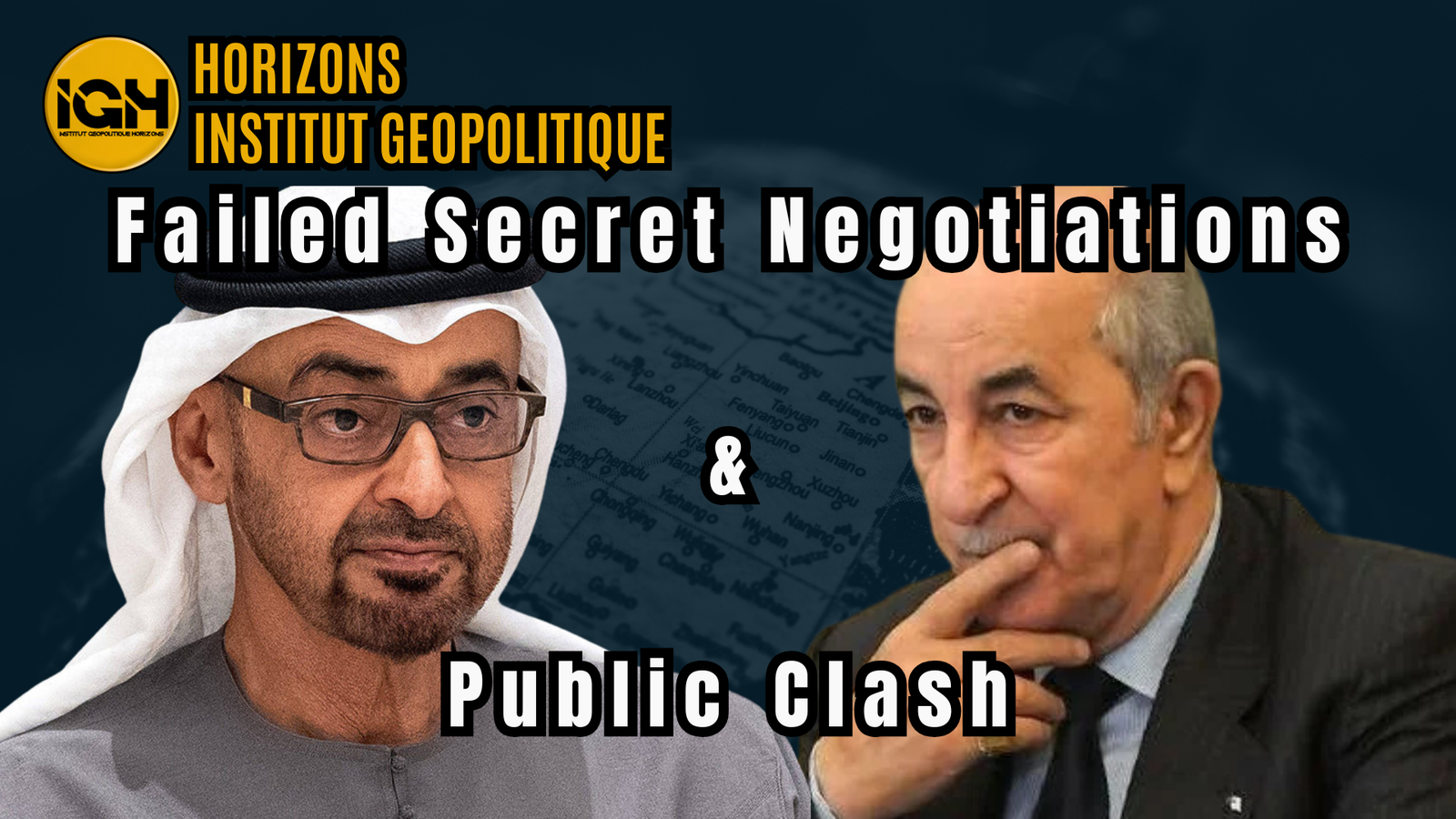
Exclusive information obtained by the Institut Géopolitique Horizons reveals a completely new dimension to the crisis between Algeria and the United Arab Emirates. Our investigation unveils for the first time the existence of high-level secret negotiations held in Abu Dhabi in March 2025, whose spectacular failure explains the brutal deterioration of relations between the two powers.
These confidential talks, whose very existence had never been reported until now, provide the key to understanding the extreme tensions observed since early April and the unusual intensity of Algerian media attacks against the Emirates.
Tense Negotiations That Abruptly Ended
According to our source, these negotiations took place in an extremely tense atmosphere. The Emiratis left the Algerian delegation « practically no room for maneuver, » adopting an uncompromising stance on all the issues discussed. The two parties eventually separated « on bad terms, » without further details on the exact circumstances of this rupture.
This atmosphere of confrontation, rather than negotiation, explains the exceptional virulence of the Algerian reaction in the weeks that followed. The incredibly aggressive tone of the video clip recently broadcast by Algerian television against the Emirates is proportional to the anger and deep concerns of Algerian leaders regarding the Emirati attitude.
Among the issues that contributed to this extreme tension were:
– Algerian offer : Restructuring of Sonatrach with opening of its capital for direct Emirati investments; proposal for joint exploitation of the strategic Gara Jbilet deposit
– Algerian demand: Revision of the Emirati position in the Sahel, particularly regarding support for the Alliance of Sahel States (AES)
– Emirati requirement: Dismantling of the Tindouf camps, where Sahrawi refugees supported by Algiers are located
– The particular case of Tunisia: According to our sources, the Algerians would have approved the principle of overthrowing Tunisian President Kaïs Saïed in exchange for the withdrawal of Emirati support for Marshal Haftar in Libya
These proposals of exceptional magnitude demonstrate the gravity of the stakes between the two countries and explain the extreme confidentiality of the discussions.
The Sky News Arabia Incident: A « Controlled Explosion »
In light of our revelations, the affair of historian Mohammed El Amin Belghit’s interview on Sky News Arabia appears in a new light. What was presented as the trigger for the crisis is in reality a carefully orchestrated « controlled explosion » by the Algerian authorities.
This maneuver allowed Algiers to invent an acceptable excuse to reveal to Algerian public opinion the existence of a very deep crisis with Abu Dhabi, without having to expose the real reasons – the humiliating failure of secret negotiations. Historian Belghit, who is now languishing in prison, was merely the unfortunate expiatory victim of this communication strategy.
The Complete Failure and Its Immediate Consequences
By the end of March, the negotiations had reached a complete impasse, with no agreement, even partial, being found. Faced with this failure and with no prospect of resuming discussions, both parties immediately activated hostile alternative strategies.
Our investigation reveals that:
1. The Emirates immediately reactivated their contacts with the Movement for the Self-Determination of Kabylie (MAK), classified as a terrorist organization by Algiers. These contacts, already established previously, intensified significantly after the failure of the negotiations.
2. Algeria launched a large-scale media campaign in early April to get ahead of the Emirati media machine, while preparing its public opinion for a period of tension.
3. The Algerian government accelerated the updating of general mobilization laws, anticipating possible internal tensions indirectly fomented by the UAE.
Algeria’s Military Response and Strengthened Support for the Polisario
The nervousness of the Algerian authorities manifested itself on several fronts simultaneously:
Large-Scale Military Exercises
On April 29, 2025, the Algerian National Popular Army (ANP) organized military exercises of exceptional scale in In Amenas, in the extreme southeast of the country, near the Libyan border.
These live-fire exercises, personally supervised by Army General Saïd Chanegriha, mobilized significant land and air resources: helicopters, fighter aircraft, tanks, artillery, and multiple rocket launchers. The location of these maneuvers, at the Libyan border, constitutes a barely veiled message: Algeria is preparing for a possible confrontation with Marshal Haftar’s forces, supported by the Emirates.
The Tense Staged Support for the Polisario
The day after the military maneuvers, on April 30, 2025, a highly symbolic and mediatized meeting took place at the El Mouradia Palace in Algiers: President Tebboune received Brahim Ghali, leader of the Polisario Front, with a protocol worthy of a head of state.
This reception, particularly atypical in its timing and staging, was perceived as a « thumbing of the nose » at the international community. A revealing fact of the ambient tension: despite the customary smiles, the two men had visibly strained features during their appearance on the steps of Al Mouradia. This meeting also took place without the participation of the Algerian Chief of Staff, which is unusual for this type of event.
This coordinated sequence – military maneuvers followed by an ostentatious reception of the Polisario leader – demonstrates Algiers’ multidimensional response strategy in the face of the failure of negotiations with Abu Dhabi and increasing Emirati pressure.
Rapprochement with Iran: A Strategic Coordination
The chronology of events reveals a manifest coordination between Algiers and Tehran. The visit of Iranian Foreign Minister Abbas Araghchi to Algiers on April 8, 2025, takes on a special significance: it coincided exactly with the visit of Moroccan Foreign Minister Nasser Bourita to Washington, and practically the day after the failure of bilateral Algerian-Emirati negotiations.
This timing is not coincidental and signals strategic coordination between the two capitals. President Tebboune’s upcoming state visit to Iran, confirmed during this meeting, prefigures a deepening of this alliance in the face of pressure from the Emirates and their allies.
Iran is practically the only significant ally that Algiers can currently claim, following tensions with Gulf countries and deteriorating relations with several African countries. This Algerian-Iranian alliance, documented in our previous analyses, has already manifested itself through strategic cooperation aimed notably at destabilizing Morocco on two fronts: in the south via support for the Polisario and in the north via increasing influence in the Rif.
The Emirati Post-Negotiation Strategy Revealed
According to our sources, the United Arab Emirates is now implementing a strategy developed on the basis of Strategic Orientation Notes (SON) and consultations provided by two think tanks – one Western, the other Emirati.
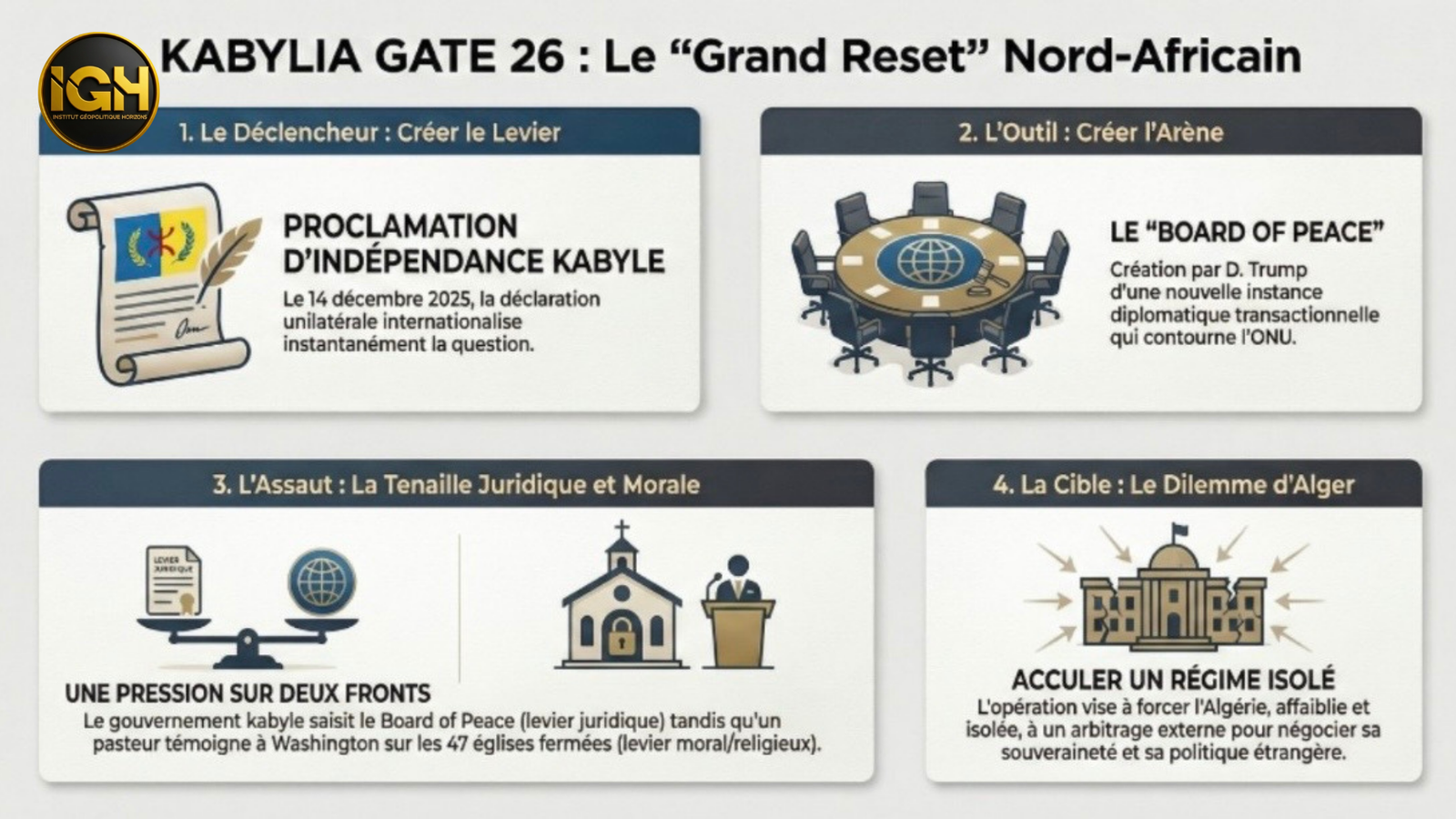
At the heart of this strategy: exploiting the Kabyle question as maximum leverage on Algiers. Our investigation confirms not only the existence of contacts between Emirati representatives and MAK leaders but also reveals that these relations have reached an unprecedented level of coordination.
Omani Mediation Virtually Secured
The official visit of the Sultan of Oman to Algiers last Sunday fits directly into this context of heightened tensions. According to several concordant sources, although we have not been able to obtain formal confirmation, Omani mediation between Algiers and Abu Dhabi is virtually secured.
Oman, known for its role as a discreet and respected mediator in several regional crises, has the neutrality and credibility necessary to try to defuse this conflict. This mediation comes at a critical moment when the risks of escalation have never been higher.
The Kabyle Equation: A Strategic Weapon
The intensification of contacts between Abu Dhabi and the MAK constitutes a deliberate provocation targeting a particularly sensitive point for the Algerian authorities. For Algiers, any foreign support for this movement touches on the territorial integrity of the country and constitutes an absolute red line.
This Emirati approach strikes precisely where Algeria is most vulnerable, exploiting the fundamental contradiction in its foreign policy: ardently defending the principle of self-determination in Western Sahara while categorically refusing it to Kabylie.
Perspectives on a Crisis That Is Just Beginning
The failure of secret negotiations in Abu Dhabi has triggered a chain of reactions: Algerian military mobilization, intensification of Emirati contacts with the MAK, staged support for the Polisario, coordinated rapprochement with Iran. These developments mark the beginning of a phase of acute tensions between these two regional powers, with potential repercussions on all sensitive issues in the region.
The emerging Omani mediation represents a first attempt at appeasement, but the complexity of the issues and the depth of antagonisms suggest a long and uncertain process.
Conclusion
These exclusive revelations about the failure of secret negotiations in Abu Dhabi offer for the first time a coherent explanation for the tumultuous diplomatic and military events observed since early April. The brutality of the Algerian reaction, the intensity of media attacks, military maneuvers at the Libyan border, the tense reception of the Polisario leader, and the acceleration of general mobilization preparations all fit into the context of a major strategic confrontation whose outcome remains uncertain.
The crisis between Algeria and the United Arab Emirates, now multidimensional, simultaneously touches on the Kabyle question, the balance of power in Libya, the future of Tunisia, the Western Sahara issue, and influence in the Sahel. Its evolution could profoundly redraw alliances and power relationships throughout North Africa.