Abdelhakim Yamani,
with the Strategic Watch and Digital Analysis Department,
Horizons Geopolitical Institute April
22nd 2025
A direct maritime connection between the Algerian port of Bejaia and the Israeli port of Ashdod reveals a striking discrepancy between Algiers’ official rhetoric and its economic practices. This observation raises fundamental questions about Algeria’s stance toward Israel, particularly at a time when Morocco is being strongly criticized for its normalization with the Jewish state.
Algeria’s double discourse exposed
The maritime data is clear: a bulk carrier vessel completed a direct crossing from Bejaia to Ashdod from April 11 to 18, 2025, covering 1,579.78 nautical miles. This tangible fact contrasts with Algeria’s official rhetoric that systematically condemns any relationship with Israel and severely criticizes its neighbors who normalize relations with Tel Aviv.
President Abdelmadjid Tebboune stated in July 2020, during an interview with France 24: « Palestine is a sacred cause for us and it is enshrined in our constitution. Algeria’s position is constant: we are against normalization. » This position has been reaffirmed multiple times, notably during his speech at the UN General Assembly in September 2023, where he described the Palestinian cause as « central » to Algerian foreign policy.
Consistent criticism of Morocco for its diplomatic choices
Since the normalization of relations between Morocco and Israel in December 2020, Algerian authorities have continuously denounced this decision. Algerian Foreign Minister Ramtane Lamamra notably declared in August 2021: « The introduction of the Zionist entity in North Africa is a serious threat that undermines Algeria’s national security » (APS, Algeria’s official news agency, August 24, 2021).
The diplomatic rupture between Algeria and Morocco, officially announced on August 24, 2021, explicitly mentioned « the establishment of relations with Israel » among the grievances formulated by Algiers against Rabat.
Contradictions in foreign policy
This inconsistency between discourse and practice can be explained by several factors:
1. The primacy of economic interests over ideological positioning in the context of Algeria’s fragile economy.
2. The search for diversification of commercial partners in the face of post-oil challenges.
3. The need to access certain technologies and markets, regardless of official diplomatic considerations.
According to UNCTAD’s 2024 annual report on Mediterranean trade: « Despite the absence of official diplomatic relations, indirect exchanges between Algeria and Israel via third countries have increased by 15% between 2021 and 2024, mainly in the technological and agricultural sectors. »
Morocco criticized for what Algeria discreetly practices
Moroccan-Israeli normalization, formalized under the Abraham Accords with American mediation, allowed Morocco to obtain recognition of its sovereignty over Western Sahara by the United States. This move triggered a wave of condemnation from Algiers.
In its official statement of December 10, 2020, the Algerian Ministry of Foreign Affairs asserted: « Foreign maneuvers aimed at undermining the stability of the region have intensified with the desire to make the Maghreb a new terrain for regional expansion for the Zionist entity. »
Exchanges that defy official rhetoric
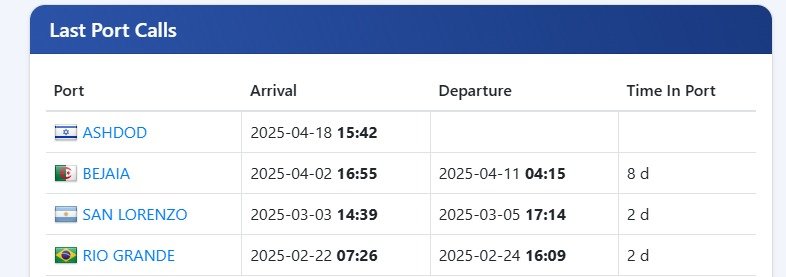
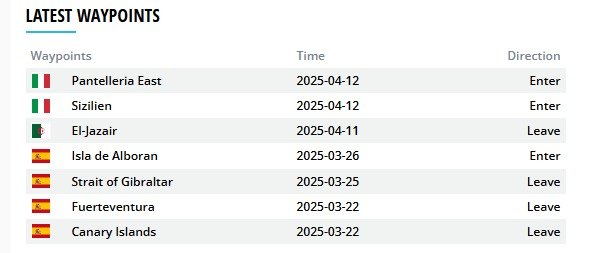
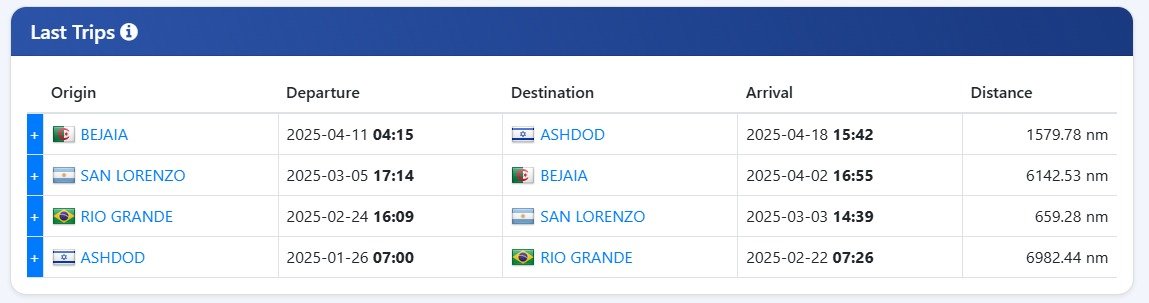 Analysis of the bulk carrier’s navigation data also reveals interesting elements about the potential nature of the exchanges:
– The vessel previously called at South American ports (Rio Grande in Brazil, San Lorenzo in Argentina), suggesting triangular trade flows involving Latin America.
– Its moderate draft (5.9 meters) indicates the transport of raw materials or agricultural products rather than hydrocarbons.
– The route including passage points such as El-Jazair, the Strait of Gibraltar, and the Canary Islands suggests a carefully planned itinerary.
According to the International Maritime Organization (IMO) monthly bulletin of March 2025: « Persistent disruptions in the Red Sea have led to a significant reorganization of maritime routes in the Mediterranean, with a 22% increase in direct links between ports traditionally not connected for political rather than logistical reasons. »
An economic reality that imposes itself
International trade specialists emphasize that this maritime connection is part of a broader trend of reorganizing commercial flows in the Mediterranean:
1. The crisis in the Red Sea has forced many shipping companies to rethink their routes, favoring direct links across the Mediterranean.
2. Post-COVID economic imperatives have accelerated the regionalization of supply chains.
3. Common security and energy challenges create converging interests that transcend traditional diplomatic divisions.
According to the Mediterranean Energy Observatory in its February 2025 report: « The search for energy autonomy is pushing Mediterranean countries to develop pragmatic cooperation, sometimes contradicting their official diplomatic positions, particularly in the green technology sector where Israel has recognized expertise. »
Perspectives: towards a discreet but inevitable evolution?
This maritime connection between Bejaia and Ashdod raises several questions for the future of regional relations:
– Does it signal a progressive and discreet evolution of Algeria’s position, similar to what other Arab countries have experienced?
– Is this a temporary anomaly or the beginning of a regular commercial flow?
– How will Algeria justify this growing contradiction between its anti-normalization rhetoric and its commercial practices?
Political scientist Hasni Abidi, director of the Center for Studies and Research on the Arab and Mediterranean World (CERMAM) in Geneva, observed in an article published by Le Monde Diplomatique in January 2025: « The gap between political positions and economic realities in the Maghreb is widening, leading to forms of cooperation that do not declare themselves as such, particularly in strategic sectors. »
Conclusion: will pragmatism prevail over ideology?
The Bejaia-Ashdod maritime connection highlights the limits of Algeria’s position on the Israeli question and reveals the contradictions of a diplomacy that condemns in its Moroccan neighbor what it discreetly practices. This situation illustrates the complexity of international relations in the Maghreb, where official positions often mask more nuanced economic realities.
At a time when Morocco fully embraces its normalization with Israel and derives tangible diplomatic and economic benefits from it, Algeria seems forced into a form of institutionalized hypocrisy: maintaining an uncompromising discourse while creating spaces for discreet cooperation with the Hebrew state.
This contradiction, now visible through maritime navigation data, could eventually undermine the credibility of Algeria’s position on the regional and international stage.