Horizons Geopolitical Institute,
Abdelhakim Yamani
May 16, 2025
I. INTRODUCTION: THE CURRENT CRISIS
On May 15, 2025, the Ministry of Foreign Affairs and International Cooperation of the Libyan government based in Benghazi issued a directive communiqué inviting diplomatic missions established in Tripoli to take exceptional security measures, even suggesting their evacuation to Benghazi. This official document comes in the context of violent clashes that have shaken the Libyan capital for the past three days.
As « Le Monde » indicates, « Libya is experiencing a phase of major security instability in Tripoli with fighting between armed groups, a persistent political division, and a concerning humanitarian situation »[1]. These clashes, which have killed at least six people, have led to the closure of schools, the university, Mitiga airport, and numerous businesses in the city[1].
The UN and the International Organization for Migration (IOM) have expressed deep concern about this escalation of violence and the risk of massive civilian displacement, calling for an immediate ceasefire and the protection of populations[1][2][8].
This new crisis is part of the continuing chronic instability that has characterized Libya since the fall of Muammar Gaddafi’s regime in 2011, despite some attempts at rapprochement between rival factions in recent years.
II. HISTORICAL CONTEXT: FROM GADDAFI TO FRAGMENTATION
Gaddafi’s Libya (1969-2011)
For more than four decades, Libya was ruled with an iron fist by Muammar Gaddafi. Coming to power through a military coup in 1969, Gaddafi established an authoritarian regime based on his ideology, the « Third Universal Theory, » outlined in his « Green Book. » This political system, called Jamahiriya (« State of the Masses »), officially rejected Western multiparty systems and representative democracy.
Under Gaddafi, the Libyan state was characterized by extremely centralized power, where traditional tribal structures were both repressed and instrumentalized. The regime relied on a complex clientelist system, distributing oil resources according to political and tribal allegiance logic.
Economically, Libya, rich in oil, experienced a period of relative prosperity, but wealth was unequally distributed. On the international scene, after a period of isolation due to its alleged support for terrorism, the regime had begun a rapprochement with the West in the 2000s.
The 2011 Revolution and Its Consequences
In February 2011, in the wake of the Arab Spring, a popular uprising broke out in Libya. Quickly, the conflict militarized and led to the intervention of an international coalition under the aegis of NATO. In October 2011, Gaddafi was captured and killed by insurgents near Sirte, his hometown.
The fall of the regime, far from bringing the hoped-for stability, opened the way to an institutional vacuum that the new authorities failed to fill. From 2014, the country plunged into a civil war opposing two rival governments:
– The Government of National Accord (GNA), established in Tripoli and recognized by the international community
– The Tobruk government, supported by Marshal Khalifa Haftar and his Libyan National Army (LNA)
The Skhirat Agreements and Reconciliation Attempts (2015-2024)
The Skhirat Agreements, signed on December 17, 2015, in Morocco, constitute a major political agreement aimed at ending the division and conflict in Libya. They were concluded between representatives of the General National Congress (Tripoli) and the House of Representatives (Tobruk) under the auspices of the UN. These agreements provided for the formation of a Government of National Accord (GNA) led by Fayez el-Sarraj, as well as the establishment of a Presidential Council and a High Council of State to unify Libyan institutions[3][4].
The Skhirat Agreement is internationally recognized as the legitimate political framework for resolving the Libyan crisis. It received the support of the UN Security Council and major Western powers and remains the reference for political negotiations and efforts to stabilize the country[5][7].
However, several major obstacles have hindered the implementation of the Skhirat Agreements:
– Internal contestation and lack of consensus : Several political components and armed groups did not participate in the elaboration of the agreement or contest it, notably General Khalifa Haftar and his supporters who denounced the agreement in 2017, considering it had expired[3][5].
– Institutional weaknesses : The Government of National Accord (GNA) resulting from the agreement was invested without a vote of confidence, which weakened its legitimacy. The House of Representatives never officially granted it its confidence, and Prime Minister Fayez el-Sarraj remained dependent on local armed militias, limiting his political and military authority[1][3].
– Unresolved security issues : The agreement sidestepped the question of armed groups, which remain powerful and autonomous, controlling key territories and infrastructure, particularly in Tripoli. This has prevented unified control of forces and the restoration of the rule of law[3].
– Persistent political polarization : The creation of the High Council of State, under the influence of former members of the General National Congress and the Muslim Brotherhood movement, complicated the institutional landscape, creating a kind of « second parliamentary chamber » and accentuating divisions[3].
Despite these difficulties, from 2020 onwards, several reconciliation initiatives emerged under the aegis of the United Nations, notably:
– The October 2020 ceasefire, which ended Haftar’s offensive on Tripoli
– The Libyan Political Dialogue Forum, which led to the establishment of the Government of National Unity (GNU) led by Abdel Hamid Dbeibah
– The Berlin Conference, aimed at bringing together international actors for a political solution
These efforts resulted in a period of relative calm, but they did not resolve the country’s fundamental divisions. In 2024, the hope for general elections vanished once again, giving way to new tensions.
Despite the recent clashes and persistent divisions, the Skhirat Agreements are not considered definitively buried. They remain the internationally recognized political framework and the main reference for attempting to resolve the Libyan crisis. The UN Security Council, the Arab League, the African Union, and several countries still insist on the application of the agreement as the only viable framework for political transition, holding elections, and unifying Libyan institutions[16][17].
III. FORCES PRESENT IN TRIPOLI
The current clashes in Tripoli illustrate the complexity of the Libyan security landscape, characterized by a constellation of armed groups with fluctuating allegiances. According to available information, the main forces involved in the recent fighting are:
Actors in the Current Conflict
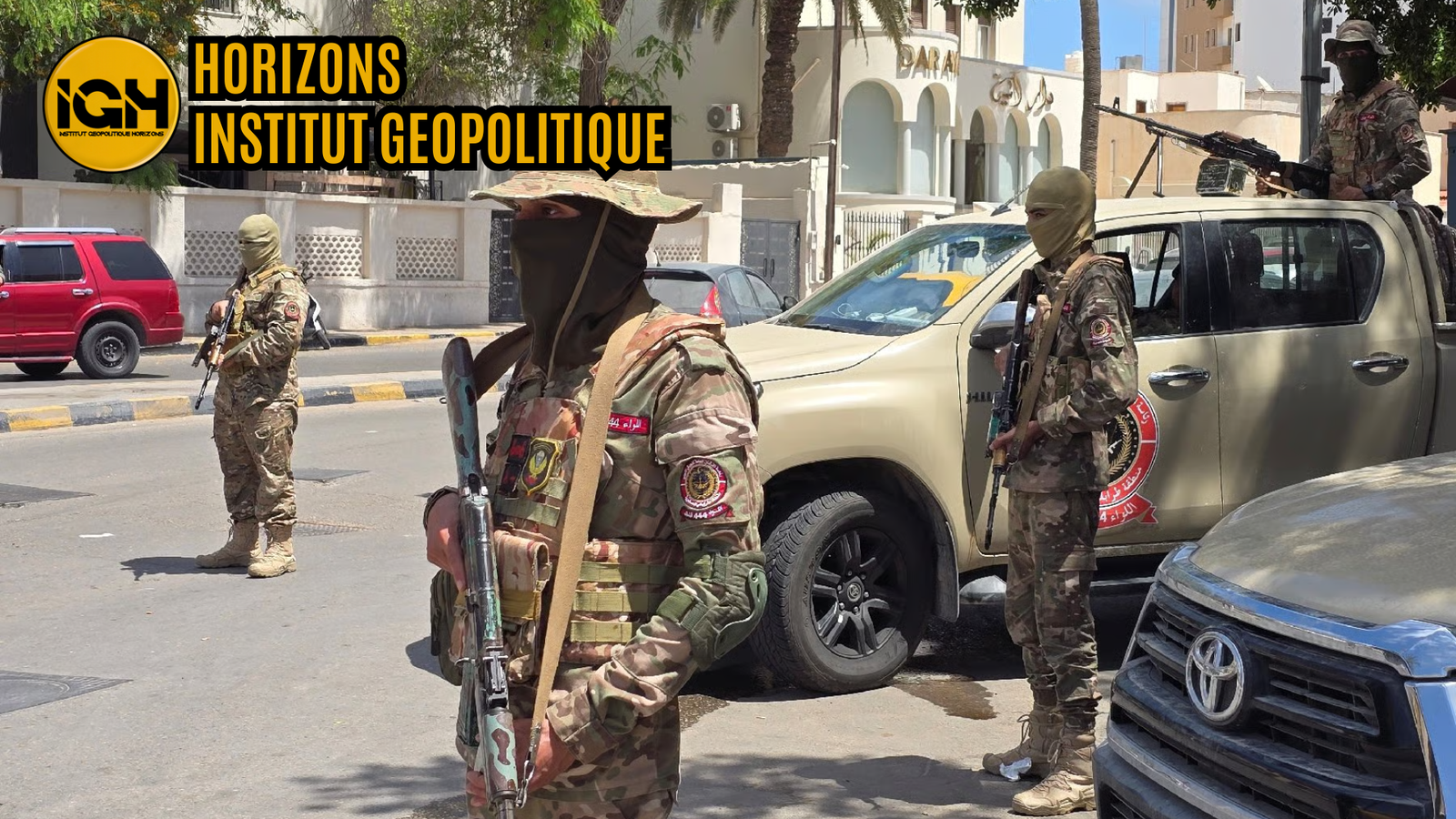
– Brigade 444 (or 444th Infantry Brigade) : This armed unit based in Tripoli supports Abdel Hamid Dbeibah’s government. It recently distinguished itself by attacking the offices of the Stability Support Authority (SSA) following the assassination of its leader[2][3].
– Stability Support Authority (SSA) : Influential armed group based in the Abu Salim district, whose leader Abdel Ghani al-Kikli was killed during recent fighting. This assassination, which occurred during a mediation meeting at Tekbali military camp, was the triggering element of the current crisis[4][5].
– Radaa Force : Hostile to the Tripoli government, it opposes Brigade 444 and other forces loyal to Dbeibah[2].
– Government of National Unity (GNU) forces : The Ministries of Defense and Interior are trying to assert their authority and restore order in Tripoli, but their effective control on the ground remains limited[6].
Regional Forces Gravitating Around Tripoli
– Misrata Brigades : Notably the Al-Mahjoub Brigade, the Al-Halbous Brigade, and the 166th Brigade. These powerful, well-armed, and autonomous militias have deployed toward Tripoli in response to recent events. Historically, they played a crucial role in defending Tripoli against Haftar’s offensives[4][7].
– Allied brigades from Zawiya and Zintan : Also mobilized toward Tripoli, these forces are traditional allies of Misrata but are marked by internal rivalries. Their positioning in the current crisis remains fluctuating[7].
The Trigger for Recent Clashes
The triggering element of this new wave of violence was the assassination of Abdel Ghani al-Kikli, leader of the Stability Support Authority (SSA), during a mediation meeting between rival armed groups at Tekbali military camp. Following this event, Brigade 444 attacked the SSA offices, seizing their facilities and arresting several fighters[3][4].
These tensions are part of a broader context of struggle for political and security control of the capital, with rivalries between pro- and anti-government militias, particularly around Prime Minister Abdel Hamid Dbeibah, whom some groups seek to weaken or overthrow[3].
IV. FOREIGN POWERS AND THEIR INTERESTS
Since 2011, Libya has become a ground for geopolitical rivalries where various regional and international powers confront each other by proxy. This internationalization of the conflict constitutes one of the main obstacles to its resolution.
Russia: Support for Haftar and Power Projection
Russia has established itself as one of the major players in the Libyan conflict by supporting Marshal Khalifa Haftar and his Libyan National Army (LNA). This support materializes through:
– The presence of the Wagner Group, composed of Russian and Syrian mercenaries
– A significant military deployment including aircraft, vehicles, and anti-aircraft systems
– Diplomatic support on the international scene[1][4][6]
For Moscow, Libya represents a major strategic issue allowing it to strengthen its influence in the Mediterranean and Africa, while establishing itself as an essential actor for any future political solution[4].
Turkey: Defense of the Tripoli Government
Turkey has resolutely committed itself in favor of the Government of National Unity (GNU) based in Tripoli. Its decisive military intervention in 2020 repelled Haftar’s forces that threatened the capital[5]. Turkish support translates into:
– Sending military advisors and equipment
– Deploying drones that changed the balance of forces
– A controversial maritime agreement delimiting exclusive economic zones in the Eastern Mediterranean
Ankara’s commitment can be explained by geopolitical considerations (rivalry with the Emirates and Egypt), economic interests (reconstruction contracts, energy resources), and ideological factors (support for forces close to the Muslim Brotherhood)[5].
The United States: Strategic Repositioning
The United States, after a period of relative disengagement under the Trump administration, has recently strengthened its relations with Khalifa Haftar to counter Russian influence, marking a strategic repositioning in the region[4]. This evolution demonstrates the American will to limit Russian influence in the Mediterranean while preserving their energy and security interests.
The Pro-Haftar Coalition: United Arab Emirates, Egypt, and Saudi Arabia
These three Sunni powers firmly support Marshal Haftar, motivated by:
– Their opposition to Turkey and its regional expansionism
– Their hostility toward the Muslim Brotherhood and Islamist movements
– The desire to control migration flows to Europe (for Egypt)
– Economic and energy interests[5]
Support for the Government of National Unity: Qatar and Italy
Qatar, due to its antagonism with the Emirates and Saudi Arabia, provides financial and political support to the Tripoli government. Italy, the former colonial power, also maintains privileged links with Tripoli, motivated by the preservation of its economic interests (notably through the ENI company) and by the desire to limit migration flows transiting through Libya[5].
Assessment of Foreign Interference
These foreign interventions have considerably complicated the resolution of the Libyan conflict by:
– Militarily strengthening rival factions
– Encouraging the intransigence of belligerents
– Transforming a civil conflict into a proxy war
– Compromising the arms embargo imposed by the UN
As an expert quoted by Deutsche Welle summarizes: « Libya has become a confrontation ground where regional and international rivalries are played out that go far beyond strictly Libyan issues »[5].
V. THE TRIBAL FACTOR IN LIBYAN POLITICS
The tribal dimension constitutes an essential key to understanding Libyan politics. Since Gaddafi’s fall, there has been a retribalisation of the country, with traditional clan structures resuming a central place in social and political organization.
Mapping of Main Tribes and Their Alliances
– The Warfalla (or Ouarfalla) : Considered the largest tribe with about one million members, it is based mainly in Benghazi and the East. It predominantly supports Marshal Khalifa Haftar and the Libyan National Army (LNA)[1][2].
– The Ouled Slimane, Fezzana, Zouaya, Abid, and Awaghir : These tribes from the East and South are also aligned with Haftar and opposed to the Turkish presence and Islamist militias. They often demand a federalist distribution of power and oil wealth[6].
– The Toubou : Present mainly in the South (Fezzan), they are divided between Haftar supporters and opponents, which crystallizes tribal tensions in this strategic region, particularly around control of oil resources and migration routes[1][6].
– The Tuareg : Also established in the South, they are rather aligned with the Libya Dawn coalition, linked to Misrata and Islamists, thus generally opposed to Haftar[6].
– Western Tribes : In this region, tribal alliances are more fluid and pragmatic, marked by historical rivalries between cities like Misrata, Zintan, and Tripoli, and by pro- or anti-Dbeibah groupings within the tribes themselves[3].
Mechanisms of Influence of Tribal Structures
Tribes maintain their political influence in Libya through several complementary strategies:
– Control of intertribal and political alliances : They form flexible coalitions with other tribes or political actors, often relying on interpersonal relationships and common interests, which allows them to weigh in negotiations and elections[5].
– Mediation and conflict resolution : Tribal chiefs play a traditional mediator role in local conflicts, which reinforces their legitimacy and power within communities and vis-à-vis the state[5].
– Matrimonial strategies : Endogamous marriages or marriages between members of allied tribes serve to consolidate social and political ties, ensuring the continuity of power within tribal lineages[6].
– Armed mobilization : Tribes often maintain armed groups or militias that they can mobilize to defend their interests or weigh in power struggles, which gives them significant leverage in a weak state context[5].
– Adaptation to modern institutions : Some tribes actively participate in formal political life (elections, parties), while using their tribal network to guarantee electoral support and local control[5].
– Use of federalism or tribal assemblies : They often advocate for a decentralized political organization, based on the recognition of tribes as political entities, which allows them to preserve their autonomy and resources[5].
Impact of Tribal Structure on Conflict Resolution
The tribal dimension considerably complicates the resolution of the Libyan conflict for several reasons:
– It fragments the political landscape by multiplying centers of power and logics of allegiance
– It reinforces local and regional dynamics at the expense of a national vision
– It introduces historical rivalries that transcend contemporary political divides
– Nevertheless, it constitutes an unavoidable level of mediation for any lasting solution
As the Fondazione Oasis states: « Any attempt at political reconstruction in Libya that would ignore the tribal dimension would be doomed to failure. Tribes are not only a heritage of the past but contemporary political actors with whom one must deal »[6].
VI. THE STRATEGIC ISSUE OF HYDROCARBONS
The Contested Institutional Framework
Currently, hydrocarbon resources in Libya are officially controlled by the National Oil Corporation (NOC), based in Tripoli, which is the only entity authorized to export oil and manage oil revenues. These revenues must be deposited with the Central Bank of Libya, an institution internationally recognized as the repository of oil receipts[2][3].
The NOC plays a key role in stabilizing and reviving the Libyan energy sector, with an ambitious strategy aimed at increasing oil production to 2 million barrels per day and natural gas production to 4 billion cubic feet per day within five years. This plan relies on a series of development and rehabilitation projects for oil fields, as well as a new exploration campaign planned for 2025[15][16].
The Reality of Fragmented Control
The reality, however, is much more complex than this institutional framework suggests:
– A large part of the oil fields is under the effective control of the forces of the Eastern government, notably Khalifa Haftar’s Libyan National Army (LNA), which sometimes blocks production or exports to exert political pressure[3]. In August 2024, the Eastern authorities announced the closure of oil fields and the suspension of exports, as part of a power struggle with the Tripoli government over the appointment of the Central Bank’s governor[15].
– Armed groups and militias established in Tripoli and Zawiya control certain economic sectors linked to oil, fostering trafficking and smuggling that fuel the country’s division and undermine the authority of central institutions[4].
– The NOC itself has experienced internal divisions, with the emergence of a parallel structure in the East, reflecting the political fragmentation of the country, even though unification efforts have been undertaken recently[16].
A Central Economic and Political Issue
The issue is crucial for Libya’s future:
– Hydrocarbons represent about 90% of the Libyan state’s revenues and more than 95% of exports, making oil the pillar of the national economy[3][11].
– Control of these resources directly conditions political power and the ability to finance institutions, public services, and armed militias[6].
– The struggle for control of oil revenues constantly fuels the rivalry between East and West, weakening stabilization attempts and complicating political reconciliation[7].
– Blockages or suspensions of production, as recently decided by the Eastern government, have not only a disastrous national impact but can also influence oil prices on the world market[2][3].
Development Prospects Conditioned by Stability
Despite these difficulties, initiatives are underway to revive the sector:
– The Libya Energy & Economic Summit 2025 in Tripoli aims to attract new international investments in the energy sector[15].
– The first public call for tenders for hydrocarbon exploration since 2008 was launched at the beginning of 2025, marking an attempt to revive exploration activities[13].
– International companies such as TotalEnergies, Eni, Repsol, Equinor, BP, and Sonatrach continue to collaborate with the NOC despite instability, a sign of an economic potential that remains attractive[15][16].
However, as the International Monetary Fund points out, without structural reforms and without lasting political stability, Libya’s economic recovery, even driven by the oil sector, will remain fragile and vulnerable to shocks[10].
In summary, the NOC in Tripoli is the official holder of hydrocarbons, but effective control is fragmented between rival factions, making oil resources not only the main national wealth but also the central issue of the Libyan conflict and an indispensable key to its resolution.
VII. CHALLENGES AND PERSPECTIVES
Stabilization Challenges
Libya faces several major challenges for its stabilization:
– Security fragmentation : The multiplication of autonomous armed groups makes it impossible for the state to emerge with a legitimate monopoly on violence.
– Political polarization : The persistent division between East and West, embodied by rival governments, prevents the emergence of unified institutions.
– Foreign interference : The involvement of regional and international powers with contradictory interests complicates the search for a political solution.
– Resource distribution issue : Control of oil resources and their equitable distribution between regions remains a central issue.
– Expansion of terrorist groups : In areas of security vacuum, organizations like the Islamic State or Al-Qaeda in the Islamic Maghreb are trying to establish themselves.
Short-term Evolution Scenarios
In light of recent events, three main scenarios seem to be emerging for the coming months:
1. Conflict escalation : Clashes in Tripoli could intensify and spread to other regions, causing a new open civil war. This scenario would be favored by the failure of the current truce and a strengthening of foreign interference.
2. Precarious stabilization : The current truce could hold, allowing a gradual return to relative normality in Tripoli, without resolving the root causes of the conflict. This fragile status quo would maintain the country’s division but avoid direct confrontation.
3. Diplomatic breakthrough : Recent events could paradoxically accelerate international mediation efforts and favor a rapprochement between rival factions, aware of the risks of a new escalation. This scenario, although optimistic, cannot be excluded given the weariness of populations and certain recent diplomatic developments.
The Judicial Dimension: An Emerging Factor
A notable and potentially decisive development is Libya’s recent recognition of the authority of the International Criminal Court (ICC) to investigate serious crimes committed since 2011[3]. This legal evolution could:
– Encourage militia leaders to show more restraint for fear of international prosecution
– Create tensions within armed groups, with some fearing being delivered to international justice
– Offer an additional lever to the international community to promote political transition
VIII. CONCLUSION
As of May 16, 2025, Libya finds itself at a critical crossroads in its post-Gaddafi history. The recent clashes in Tripoli illustrate the persistence of structural challenges facing the country: security fragmentation, political polarization, foreign interference, and tribal tensions.
The communiqué from the Ministry of Foreign Affairs based in Benghazi, inviting diplomatic missions to evacuate Tripoli, testifies to the seriousness of the situation and the persistence of the country’s institutional divisions.
Despite these tensions, the Skhirat Agreements are not considered definitively buried. They remain the internationally recognized political framework for resolving the Libyan crisis. Even in 2024-2025, Libyan and international officials call for keeping « the spirit of Skhirat » at the center of negotiations, emphasizing its importance for stability and reconciliation[18][21].
However, implementation remains fragile, undermined by local rivalries, the weight of unarmed militias, and the lack of consensus on certain institutions created by the agreement. The current clashes illustrate these practical limitations but do not signify a definitive rejection of the agreement itself.
In this volatile context, Libya’s future will largely depend on three key factors:
– The ability of Libyan actors to overcome their divisions to prioritize the national interest
– The evolution of the positions of foreign powers involved in the conflict
– The effectiveness of international mediation mechanisms, particularly those piloted by the UN
The international community, while recognizing the complexity of the Libyan situation, must intensify its efforts to encourage an inclusive political process that takes into account the tribal and regional realities of the country, while working to limit destabilizing external interference.
As an analyst recently quoted by La Croix stated: « No mechanism seems able to stop the fighting » in Libya as long as fragmented governance persists where loyalties are directed more toward armed groups, tribes, or foreign powers than toward the Libyan state itself[5].
The lasting stabilization of Libya thus remains an uncertain horizon, but the weariness of populations and the increasing costs of the conflict for all parties could, paradoxically, create an opportunity for significant diplomatic advances in the coming months.
—
SOURCES AND REFERENCES
[1] « In Libya, fragile truce after three days of violent fighting in Tripoli, » Le Monde, May 15, 2025.
[2] « Libya: violent fighting in Tripoli, capital of a still divided country, » Le Monde, May 14, 2025.
[3] « Libya recognizes the authority of the ICC for crimes against humanity since 2011, » L’Orient-Le Jour, 2025.
[4] « How oil trafficking maintains the division of Libya? » Kapitalis, March 24, 2025.
[5] « Libya: ‘No mechanism seems able to stop the fighting’, » La Croix, May 15, 2025.
[6] « Tribal power, State and political transition in Libya, » Fondazione Oasis, consulted on May 16, 2025.
[7] « 2025 Tripoli clashes, » Wikipedia, consulted on May 16, 2025.
[8] « Libya: UN very concerned after three days of violent fighting, » Yahoo News, May 2025.
[9] « Due to a conflict over the choice of the Central Bank governor, suspension of oil production in Libya, » El Watan, 2025.
[10] « Libya: IMF anticipates recovery thanks to oil, threatened without reforms, » Agence Ecofin, April 2025.
[11] « Libya wants to increase its oil production while geopolitical risks increase, » Atalayar, January 21, 2025.
[12] « Libya: Crisis intensifies around the Central Bank, » Energy News, 2025.
[13] « Libya: the first public call for tenders for hydrocarbon exploration since 2008, » Agenzia Nova, 2025.
[14] « Libya: the East shuts off oil taps in a power struggle with the West, » L’Orient-Le Jour, 2025.
[15] « In Libya, Eastern authorities announce the closure of oil fields and the suspension of exports, » Le Monde, August 26, 2024.
[16] « Energy issues in Africa. Algeria, Libya, Egypt, » IRIS, September 2021.
[17] « Skhirat Agreements, » Wikipedia, consulted on May 16, 2025.
[18] « UN Security Council welcomes signing of Libyan Political Agreement, » UN Press, December 2015.
[19] « Will the Skhirat peace agreement be sufficient against Daesh – Libya, » IRSEM, March 2025.
[20] « Libya: two years after its signing in Skhirat, the Political Agreement remains crucial, » UN Press, December 2017.
[21] « Morocco’s FM calls to keep ‘the spirit’ of Skhirat Agreement at the center of negotiations, » TelQuel, December 2024.
[22] « Arab League: Skhirat Agreement remains the general political framework for resolving the crisis in Libya, » Moroccan Ministry of Foreign Affairs, 2025.