Institute for Geopolitical Horizons (IGH)
IGH-NS-Maghreb-20250702
Abdelhakim Yamani, Geopolitical Analyst
Executive Summary
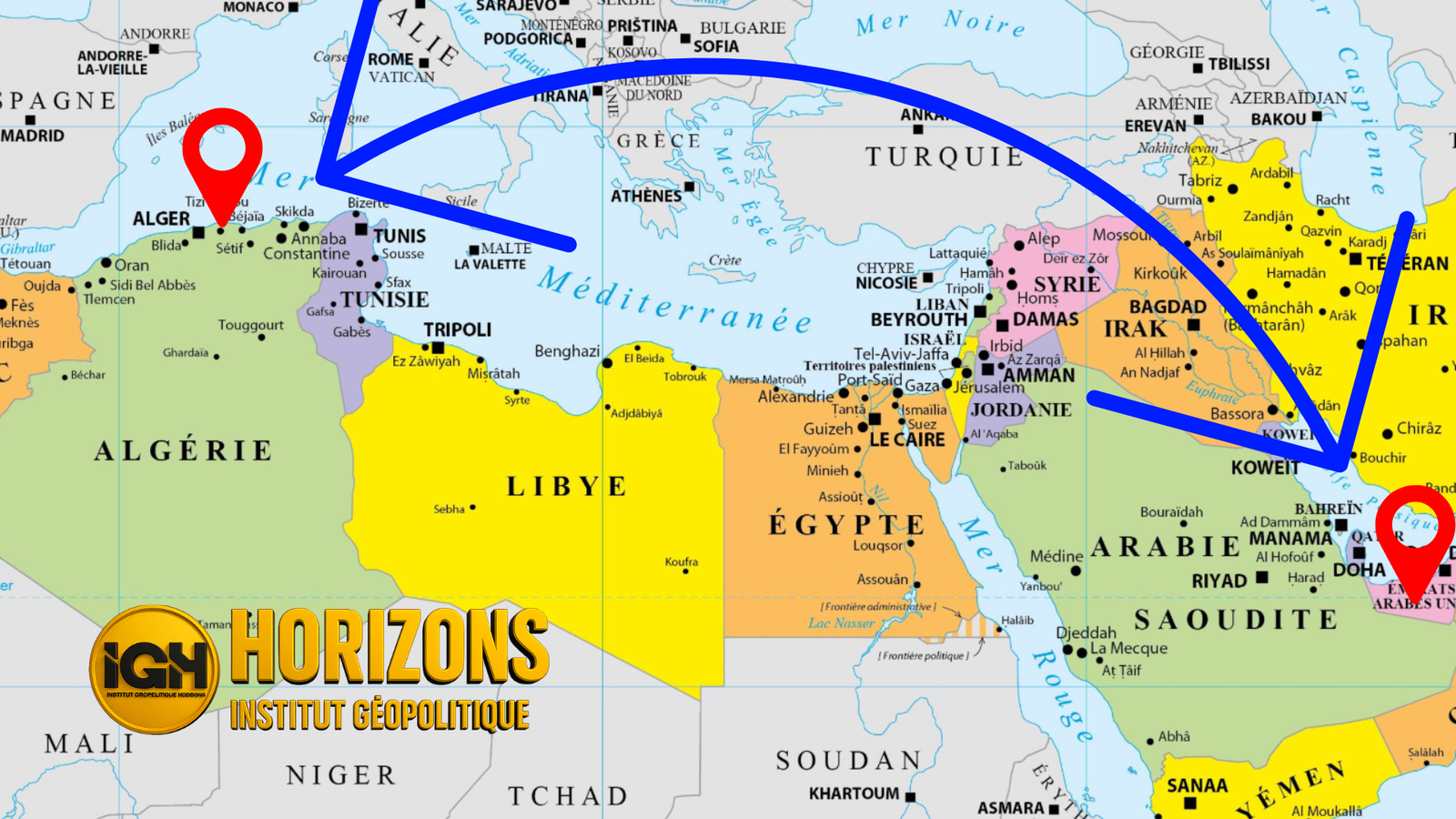
The interactions between the United Arab Emirates (UAE) and the Movement for the Self-Determination of Kabylia (MAK) reveal the emergence of new geopolitical dynamics in the Maghreb. These relations, structured since March 2025 and facilitated by informal diplomatic networks, are part of a pragmatic Emirati approach to diversifying regional partnerships. Supported by a sophisticated intellectual ecosystem, these interactions illustrate Abu Dhabi’s diplomatic adaptability in the face of regional geopolitical transformations, while raising questions about the stability of traditional balances in the Maghreb.
Introduction
The emergence of structured contacts between the United Arab Emirates and the Movement for the Self-Determination of Kabylia constitutes a significant geopolitical development that reflects the evolution of regional diplomatic strategies. These relations, initiated according to our sources around March 2025 and facilitated by influential personalities from the Emirati leadership’s inner circle, illustrate a pragmatic approach to partnership diversification that characterizes Abu Dhabi’s contemporary diplomacy.
This dynamic fits into a broader context of geopolitical balance reshaping in the Maghreb, where state and non-state actors are redefining their influence strategies and alliance networks. The analysis of these interactions provides insight into ongoing transformations in the Maghreb space and their implications for regional stability.
I. Geopolitical Context and Actors
1.1 The United Arab Emirates: An Expanding Regional Diplomacy
The United Arab Emirates has developed over recent decades a regional diplomacy characterized by its flexibility and pragmatism. This approach manifests notably through an ability to establish relations with a diversity of actors, both state and non-state, within the framework of an influence strategy extended beyond the Persian Gulf.
The expansion of Emirati presence in North Africa and the Sahel responds to several strategic objectives: geographical diversification of influence, securing commercial routes, and positioning within regional transformation dynamics. This approach benefits from the support of a sophisticated intellectual ecosystem, particularly through certain academic institutions specialized in regional public policy analysis and governance, which contribute to the conceptual development of these strategies.
1.2 The MAK: Non-State Actor Seeking Recognition
The Movement for the Self-Determination of Kabylia, founded in 2001 by Ferhat Mehenni, has progressively structured itself as a political actor claiming self-determination for the Kabyle region. Based in exile, primarily in Europe, the movement relies on an active diaspora and has developed for several years a strategy of internationalizing its cause.
This internationalization approach follows a logic of seeking diplomatic support and legitimization on the international stage. The MAK has thus multiplied contacts with various regional and international actors, with the objective of obtaining recognition of its political claims.
II. Architecture of UAE-MAK Relations
2.1 Genesis and Facilitation of Contacts
The first contacts between Emirati representatives and MAK officials were facilitated by British parliamentarians favorable to the Kabyle cause, making London an informal diplomatic hub for these exchanges. This configuration reveals the importance of diasporic networks and third-party facilitators in establishing non-conventional diplomatic relations.
The exchanges, initiated around March 2025, explore several potential collaboration avenues, notably regarding discreet diplomatic support and international awareness-raising on issues related to ethnic and religious minorities. These discussions, while compartmentalized, demonstrate a structured approach from both sides.
💡 IGH Note
IGH sources indicate that these contacts are conducted by a highly influential personality from Mohammed bin Zayed Al Nahyan’s inner circle, underlining the strategic level of these interactions.
2.2 Operational Dimensions
UAE-MAK relations are structured around several complementary axes. On one hand, an international awareness component on minority issues, particularly concerning the situation of Kabyle Christian communities in Kabylia. On the other hand, support in terms of communication and international visibility for the movement’s claims.
This approach fits into the Emirati diplomatic tradition of supporting causes perceived as legitimate under international law, while reflecting particular sensitivity to minority rights issues. It also demonstrates the MAK’s ability to diversify its support beyond its traditional bases.
III. Regional Geopolitical Implications
3.1 Algerian Reactions and Bilateral Tensions
Algiers’ awareness of these interactions generated a firm reaction from Algerian authorities, who view them as interference in their internal affairs. This reaction fits into a broader context of tensions between Algeria and the United Arab Emirates, fueled by divergences on several regional issues.
Algerian authorities accuse the UAE of conducting a destabilizing policy in the region, particularly in the Sahel and Libya. These tensions have translated into a series of diplomatic and economic measures from both sides, illustrating the progressive deterioration of bilateral relations since 2019.
3.2 Impact on Regional Balances
UAE-MAK relations fit into a broader dynamic of alliance reshaping in the Maghreb. They demonstrate the emergence of new actors and new diplomatic configurations that challenge the region’s traditional balances.
This evolution raises questions about the long-term stability of the Maghreb space, particularly in a context where identity and minority issues take on growing geopolitical dimensions. It also illustrates the challenges posed by the internationalization of issues internal to regional states.
IV. Intellectual and Strategic Infrastructure
4.1 The Emirati Policy Formulation Ecosystem
The sophistication of the Emirati approach in its relations with the MAK demonstrates the existence of a developed intellectual ecosystem within Abu Dhabi and Dubai’s governmental research institutions. These think tanks specialized in regional governance issues contribute to developing nuanced diplomatic strategies adapted to local specificities.
This intellectual infrastructure enables the UAE to develop a refined understanding of regional dynamics and identify partnership opportunities with non-conventional actors. It reflects a methodical approach to regional diplomacy, based on prospective analysis and risk assessment.
4.2 Information Warfare and Competing Narratives
UAE-MAK relations are accompanied by a significant informational dimension, with each party developing its own narratives. On the Emirati side, emphasis is placed on supporting minority rights and self-determination, but this communication is expressed indirectly through foreign media relays rather than direct official channels. On the Algerian side, denouncing foreign interference and defending territorial integrity dominate official discourse.
This indirect communication strategy allows the UAE to maintain a certain diplomatic distance while supporting their positions through third-party channels. This battle of narratives illustrates the growing importance of the informational dimension in contemporary geopolitical relations, where international legitimization of positions becomes a major strategic stake.
Strategic Cross-Analysis Conclusion
Relations between the United Arab Emirates and the Movement for the Self-Determination of Kabylia reveal the emergence of new geopolitical dynamics in the Maghreb, characterized by actor diversification and alliance complexification. This evolution demonstrates the adaptability of diplomatic strategies facing regional transformations, but also raises questions about the stability of traditional balances.
The UAE’s pragmatic approach, supported by a sophisticated intellectual ecosystem, illustrates a new form of regional diplomacy that prioritizes flexibility and strategic opportunism. However, this dynamic generates tensions with traditional state actors, particularly Algeria, which sees it as a challenge to their sovereign prerogatives.
Sources and References
- Exclusive sources Institute for Geopolitical Horizons (IGH), March-July 2025
- Middle East Eye, « Why Algeria accuses the UAE of hostile acts, » February 2024
- Relations between Algeria and the United Arab Emirates, Wikipedia, March 2025
- French Institute of Geopolitics, « Algeria in the UAE’s trap, » Ali Bensaad
- IRIS, « Exacerbation of tensions between Algeria and the United Arab Emirates, » June 2024
- Mondafrique, « All is not well between the United Arab Emirates and Algeria, » May 2025
- Unrepresented Nations and Peoples Organization (UNPO), profiles and publications on Kabylia
- Movement for the Self-Determination of Kabylie, official documents and public statements
Institute for Geopolitical Horizons (IGH) | Independent analysis center specialized in the Maghreb, Sahel-West Africa and Atlantic Africa
Analysis based on verified sources and exclusive information collected by IGH teams