Moroccan doctrinal, security and geopolitical requirements facing Shia expansionism in Africa
Strategic Note IGH-NS-Maghreb-20250708 | Classification: Public
EXECUTIVE SUMMARY
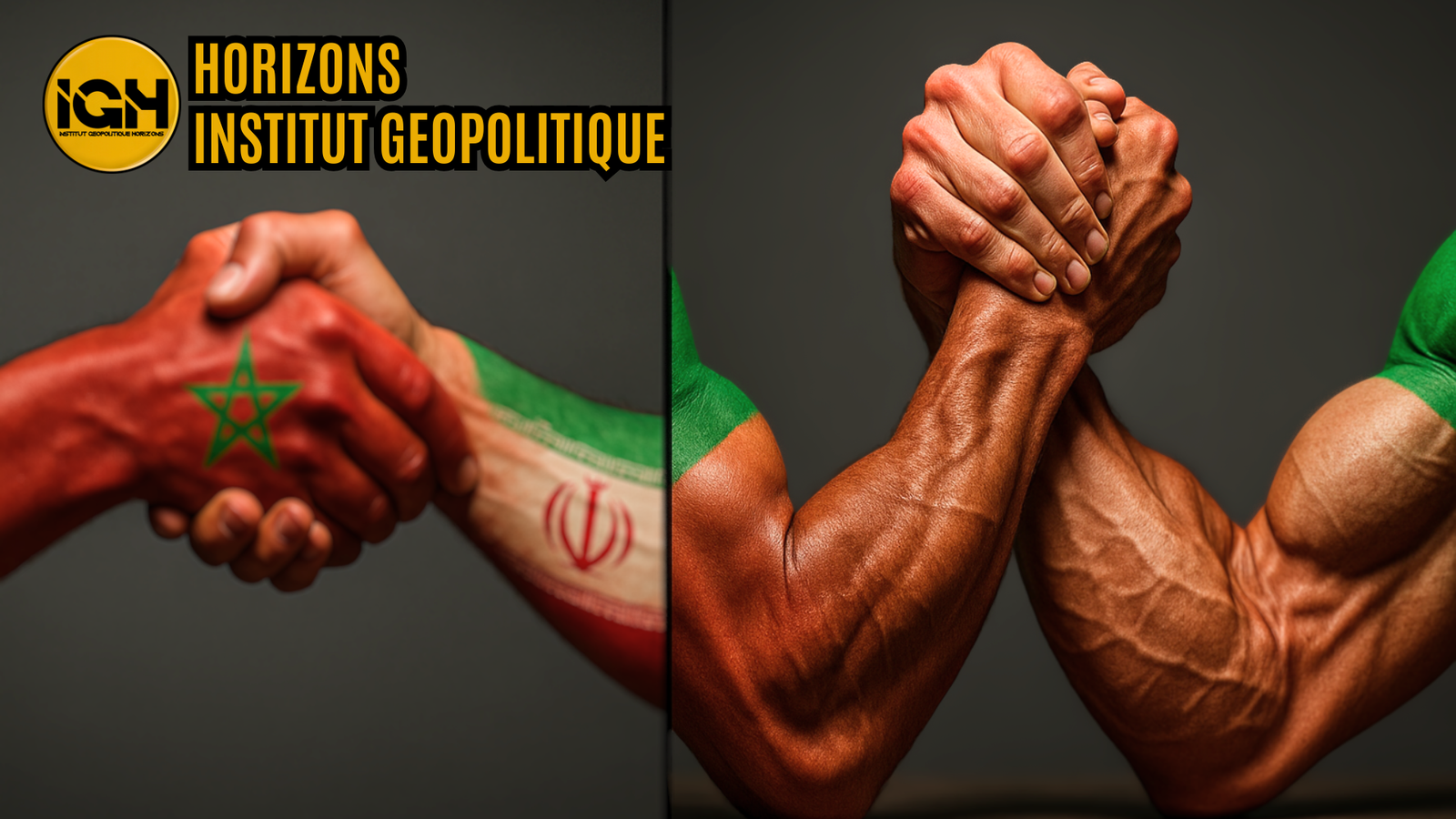
Iran and Morocco are exploring a possible diplomatic normalization after six years of rupture. This note identifies the unbreachable doctrinal red lines and minimal strategic requirements for any dialogue. The Kingdom’s spiritual security and religious sovereignty constitute non-negotiable prerequisites for any resumption of relations.
I. INTRODUCTION – STRATEGIC VIGILANCE AS A DUTY OF SOVEREIGNTY
In autumn 2024, the Institut Géopolitique Horizons exclusively revealed that a high-ranking Iranian security official had conducted an unpublicized visit to Morocco, accompanied by two Gulf mediators: one Saudi, the other Emirati1. Two confidential working meetings were held in Rabat in late October 2024. Morocco formulated a set of reservations, doctrinal requirements and security red lines.
These contacts mark a potential turning point in Moroccan-Iranian relations, broken since May 2018 due to Iranian support for the Polisario Front2. The issue, however, goes beyond the Sahrawi question alone: Iran has been developing for several years a strategy of Shia proselytism targeting the Moroccan diaspora in Europe, particularly active in Belgium, the Netherlands and Germany3. This ideological infiltration constitutes a direct threat to the spiritual cohesion of Moroccan communities in Europe and the religious authority of the Commander of the Faithful.
Several weak signals observed since early 2025 — relaxation of certain diplomatic tensions, apparent reduction in propagandist activity of certain Iranian channels regarding Morocco, and multiplication of indirect contacts in multilateral forums — suggest that an unofficial channel remains active.
It is in this uncertain but potentially decisive context that the Institut Géopolitique Horizons, in its capacity as an independent center for strategic analysis, wishes to publicly and argumentatively recall what falls within the realm of possibility — and what constitutes an impassable boundary for any Moroccan sovereignty.
II. WHAT CANNOT BE NEGOTIATED: THE KINGDOM’S SPIRITUAL SECURITY
Morocco cannot engage in any diplomatic normalization with Iran without strict guarantees regarding absolute respect for its religious and institutional model. Three pillars constitute its foundation:
1. The Maliki-Asharite doctrinal framework recognized throughout the Kingdom;
2. The religious status of King Mohammed VI, Commander of the Faithful (Amir al-Mouminine), source of unity and legitimacy;
3. The spiritual cohesion of the Moroccan people, foundation of its social and political stability.
Faced with the Iranian doctrine of Wilayat al-Faqih, which promotes a competing religious hierarchy, any form of doctrinal interference represents an existential threat to Morocco’s sovereignty4.
III. WHAT CAN BE EXCHANGED: FOUR AXES OF STRATEGIC REQUIREMENTS
Axis 1. Internal spiritual security
• Immediate cessation of all clandestine activity in Morocco.
• Strict prohibition of any direct or indirect financing of non-accredited NGOs or religious structures.
• Reinforced surveillance of foreign preachers or those trained in Iran.
• Written commitment from Tehran to no longer finance or disseminate Shia religious content targeting Morocco, whether via satellites, social networks or associative press.
Axis 2. Ideological demilitarization and neutralization of European proselytism
• Definitive cessation of scholarship grants to Moroccan students for religious studies in Qom or Mashhad.
• Suspension of all Iranian cultural or charitable action in Moroccan territory (NGOs, social aid, etc.).
• Dismantling of the Iranian proselyte network in Europe: closure of Shia centers specifically targeting the Moroccan diaspora in Belgium, Netherlands, France and Germany.
• End of financing for dissident mosques: immediate cessation of Iranian financial support to European places of worship attempting to divert Moroccan faithful from the Maliki framework.
• Iranian commitment not to exploit the socio-economic vulnerabilities of the Moroccan diaspora in Europe for confessional conversions.
Axis 3. Geopolitical neutralization (Tehran – Algiers – Polisario axis)
• Immediate cessation of all forms of direct or indirect cooperation with the Polisario.
• Prohibition of any form of material or media support for anti-Moroccan separatist rhetoric.
• End of support for Shia diffusion in Algeria, identified as a bridgehead towards the Maghreb.
• Discreet but clear cooperation between Morocco and Iran to avoid any geopolitical manipulation via the Sahara.
Axis 4. Extinction of regional threat (West Africa, Sahel, Maghreb)
• Iranian commitment to close or neutralize its active Shia centers in West Africa (Senegal, Nigeria, Ivory Coast), the Sahel (Chad, Niger), and North Africa (Algeria, Tunisia).
• End of indirect financing through screen NGOs based in London, Paris or Nairobi.
• Iran-Morocco diplomatic cooperation to ease religious tensions on the continent.
• Public recognition of the majority Sunni Maliki character of West Africa, and commitment not to promote confessional conversions there.
IV. PROSPECTIVE SCENARIOS
Scenario 1 – Resumption without guarantees: Risk of doctrinal infiltration, reconstitution of urban Shia networks, slow erosion of monarchical spiritual authority.
Scenario 2 – Conditional resumption: Maintenance of a controlled diplomatic channel, freezing of Shia influence in Morocco, but persistence in Africa if not supervised.
Scenario 3 – Global disarmament: Strict, verifiable, supervised agreement, including an African clause and recognition of Moroccan doctrinal specificity. Desired scenario.
IGH RECOMMENDATIONS
To Moroccan authorities: Maintain a firm position on doctrinal requirements while exploring discreet diplomatic channels.
To regional partners: Coordinate a common approach to Shia expansion in West Africa.
To the international community: Recognize the legitimacy of Moroccan security concerns in any mediation.
V. CONCLUSION: AN APPROACH OF SOVEREIGNTY
The Institut Géopolitique Horizons does not oppose any dialogue between Morocco and Iran. It affirms, however, that this dialogue only makes sense if it is preceded by sincere, verifiable and lasting ideological disarmament. The Kingdom’s spiritual security is not a variable for diplomatic adjustment. It is the beating heart of its sovereignty.
Everything can be discussed — except the essential.
IGH Methodological Note
This analysis is based on exclusive IGH information concerning the secret visit of October 2024. The elements have been cross-referenced by three independent and convergent diplomatic sources. The Institute assumes editorial responsibility for this revelation while maintaining the confidentiality of its sources for security reasons. The recommendations formulated reflect an objective geopolitical analysis and do not constitute a partisan position.
FOOTNOTES
1 IGH exclusive, October 2024. Information cross-referenced by convergent diplomatic sources.
2 Ministry of Foreign Affairs of Morocco, Official Communiqué, May 1, 2018.
3 Surveillance reports on Moroccan communities in Europe, Belgian and Dutch intelligence services, 2023-2024.
4 Constitution of the Kingdom of Morocco, articles 1, 3 and 41, 2011.
Institut Géopolitique Horizons (IGH)
Independent Strategic Analysis Center
Specialized: Maghreb • Sahel-West Africa • Atlantic Africa