Abdelhakim Yamani
Horizons Geopolitical Institute
April 28, 2025
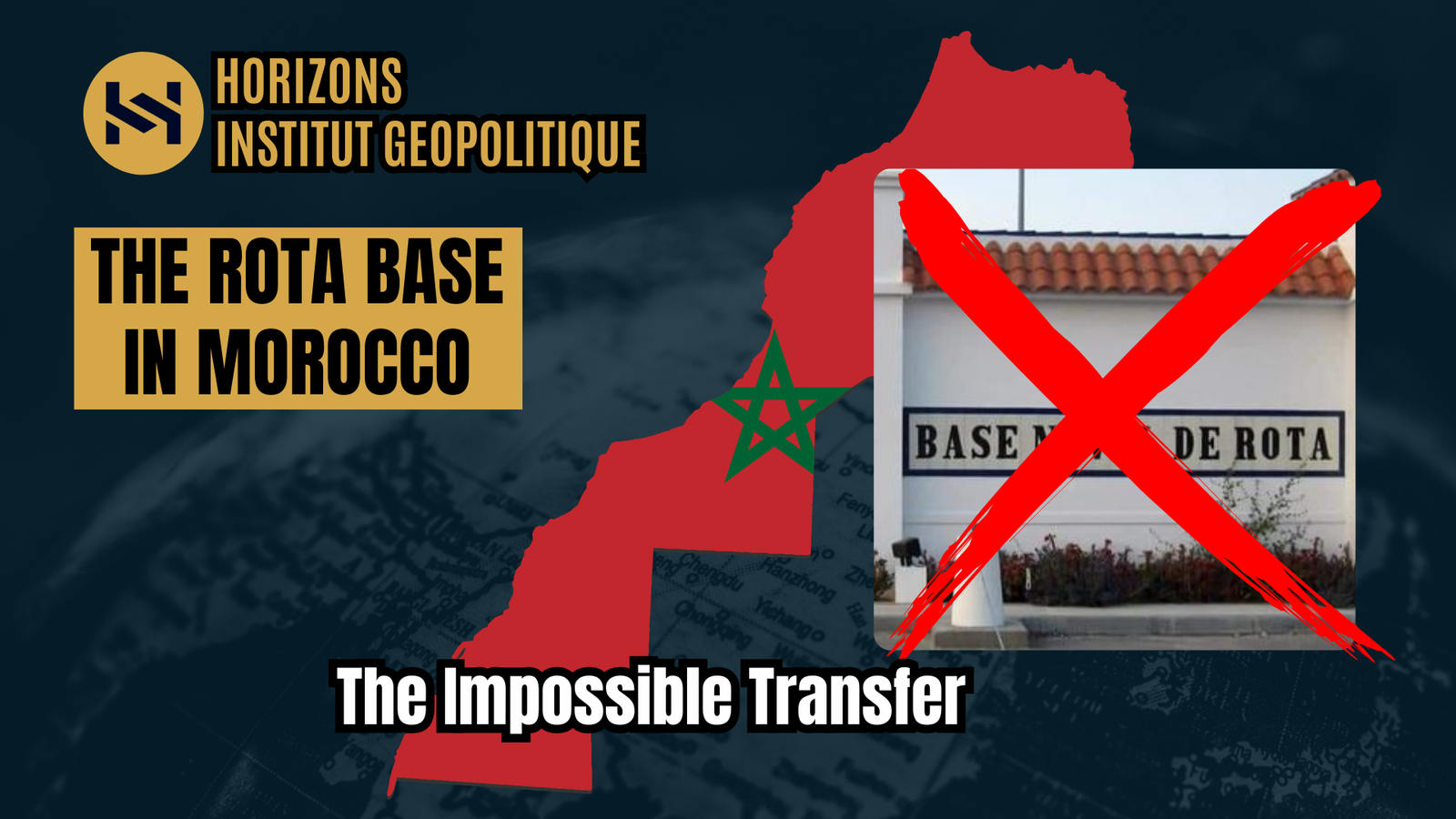
Following reports published by the Financial Times on April 16, suggesting that the Trump administration was considering transferring the American naval base in Rota (Spain) to Morocco, a wave of concern swept through Spanish diplomatic circles. However, an in-depth analysis of regional strategic dynamics and the political orientations of the stakeholders involved reveals that this possibility remains highly improbable, if not impossible. This analysis explores the structural factors that oppose such a transfer.
Persistent but unfounded rumors
The Financial Times reported that « the Trump administration was considering ‘dismantling’ the Rota base and transferring its units to the African country, » provoking strong reactions in Spain. This is not the first time such rumors have circulated, fueled by occasional tensions between Washington and Madrid.
However, these allegations were quickly denied by American sources. As reported by La Razón, a source at the American Embassy in Spain stated: « The extension of the defense cooperation agreement between the United States and Spain [signed on May 8, 2023] marked an important milestone in the relations between our two countries. […] The United States is grateful for the close cooperation of our Spanish hosts, who have offered extraordinary hospitality to American military personnel and their families for nearly seventy years. »
This same source assured that the American administration does not plan to reduce its presence at Rota and Morón, and that no transfer of the Rota base to Morocco is on the agenda.
Moroccan geostrategy: incompatible with permanent foreign bases
Morocco has maintained a consistent position regarding foreign military bases on its territory since the 1970s. This doctrine, a pillar of its national sovereignty, largely explains why a transfer of Rota to Moroccan soil remains improbable.
This Moroccan reluctance regarding the installation of permanent foreign bases is notably explained by the traumatic events of the attempted coup d’état in 1972. On August 16 of that year, F-5 aircraft piloted by rebel officers had taken off from the joint American-Moroccan air base in Kenitra to intercept and shoot down the royal Boeing carrying King Hassan II returning from France. The « consenting » neutrality of the CIA, which was aware of the plot without having warned the monarch, has profoundly marked Moroccan policy regarding foreign military presence. This historical experience led the kingdom to fundamentally review its national security doctrine and drastically limit foreign military presence on its soil.
As we analyzed in our report of November 22, 2024, « during World War II, American bases established as part of Operation Torch were a response to exceptional circumstances. During the Cold War, despite considerable pressure, Morocco maintained close military cooperation with the United States while systematically avoiding the installation of permanent bases since 1973. »
This position was maintained during the creation of AFRICOM in 2007, even though Morocco was considered an ideal potential site for its headquarters. The kingdom’s reluctance to host permanent foreign bases remains a constant in its foreign policy, directly linked to these painful historical lessons about the risks of compromising its sovereignty.
The « Abidjan Doctrine »: pillar of Moroccan influence in Africa
Accepting an American base on its territory would seriously compromise Morocco’s credibility in promoting the « Abidjan Doctrine, » the foundation of its strategy in Africa.
This doctrine, articulated by King Mohammed VI during his historic speech at the Ivorian-Moroccan economic forum in February 2014, advocates pragmatic South-South cooperation based on mutually beneficial economic partnerships and respect for African sovereignty.
As we analyzed in our report of April 19, 2025, this vision has gradually gained influence in American strategic circles to the point where « the American ‘Deep State’ has been ‘converted’ to the ‘Abidjan Doctrine’. » The installation of an American military base in Morocco would directly contradict the central principle of this doctrine: « Africa for Africans. »
American redeployment to the Indo-Pacific
The American strategy of redeployment to the Indo-Pacific constitutes another major obstacle to a possible relocation of the Rota base to Morocco.
The United States is currently strengthening its military presence in the Indo-Pacific region through initiatives such as Project Convergence Capstone 5, multinational naval exercises like Pacific Steller 2025, and reinforcement of deterrence capabilities in Japan.
This strategic reorientation towards Asia mobilizes significant financial and logistical resources, making a major investment in a new base in North Africa unlikely, especially as Rota already effectively fulfills its functions.
Massive investments in Rota
The Rota base is currently benefiting from a major extension project, as announced by the specialized site Infodefensa: « the navy is planning the construction of quays, a dock, and areas for service installations » to accommodate twice as many ships.
This expansion project, estimated at 300 million euros, is expected to last about eight years and is part of an agreement signed in May 2023 between Spain and the United States, which provides for increasing the capacity of the base to accommodate six destroyers by 2026.
As highlighted by Javier Ruiz, the mayor of Rota: « For now, I don’t see any real concern. And, from what little I know, both from the navy and from the American embassy, there is no sign of change. On the contrary, expansion projects are continuing. »
A new American strategy for Africa
The Trump administration has adopted a new approach in Africa that does not require the establishment of additional permanent military bases. This strategy prioritizes:
1. A lighter and more flexible presence: Rather than establishing new costly permanent bases, the United States now favors temporary access agreements and logistical facilities that do not involve a permanent foreign military presence.
2. Strengthening local partners: The Trump administration is focusing on developing the capabilities of African partners, as evidenced by recent military cooperation agreements signed by Morocco with several Sahel countries (Burkina Faso, Mali, Cameroon).
3. A possible EUCOM-AFRICOM merger: The Pentagon is considering merging the military commands for Europe (EUCOM) and Africa (AFRICOM) into a single entity based in Stuttgart, which would make the creation of a new major base in North Africa redundant.
4. Autonomous Moroccan installations: Morocco is developing its own naval capabilities, notably with the project of a large naval base in Dakhla, which « will extend over a large area and could accommodate the aircraft carrier USS George Washington (CVN-73), » according to a colonel of the Moroccan Royal Navy cited by El Español.
Queen Isabella of Castile’s testament: historical roots of Spanish anxiety
There is an explanation for this debate on the impossible transfer of the Rota base that has more to do with Spanish psychological and unconscious concerns than with informational reality.
Queen Isabella of Castile (Isabella the Catholic) indeed left a testament in which she explicitly addresses the question of the « Southern peril, » that is, the Muslim threat coming from North Africa, notably from Morocco. In this testament, she recommends that her successors pursue the conquest of North Africa and convert these territories to Christianity. She particularly insists on the importance of maintaining military pressure on the « Infidels in Africa » and preserving strategic places like Gibraltar, considered essential for the defense of the kingdom against Morocco and other Muslim powers in the south.
However, after the discovery of America, the priorities of Spanish sovereigns shifted to the New World, relegating the African ambitions recommended by Isabella to the background.
This historical dimension partly explains why rumors concerning a transfer of the Rota base to Morocco provoke such strong reactions in Spain. They reactivate fears deeply anchored in the Spanish collective imagination, inherited from centuries of complex relations with its southern neighbor.
This historical anxiety partly explains why the mere mention of a transfer of the Rota base to Morocco can cause such emotion in Spanish public opinion, well beyond contemporary strategic considerations.
Conclusion: a geopolitically unfounded rumor
The analysis of strategic, diplomatic, economic, and historical factors demonstrates that the transfer of the American naval base in Rota to Morocco remains a highly improbable hypothesis.
The Moroccan doctrine of non-installation of permanent foreign military bases, stemming notably from the traumatic experience of the 1972 coup d’état, the credibility of the « Abidjan Doctrine, » American redeployment to the Indo-Pacific, massive investments already engaged in Rota, and the new American strategy for Africa constitute structural obstacles to such a relocation.
The rumors concerning this transfer seem more to be media maneuvers aimed at exerting occasional pressure on Madrid, or a resurgence of fears deeply anchored in the Spanish collective imagination, than a strategic project seriously considered by Washington or Rabat.
In this context, American-Moroccan military cooperation will probably continue to develop according to modalities respecting the kingdom’s sovereignty and its strategic doctrine for Africa, favoring joint exercises like « African Lion » rather than the establishment of permanent bases.