Abdelhakim Yamani
Horizons Geopolitical Institute
April 26, 2025
A Deliberate Expulsion Policy Under the Guise of National Sovereignty
The intensification of mass expulsions of Nigerien migrants by Algeria in a April 2025 raises a fundamental legal question: are these simply diplomatic retaliatory measures or potential crimes against humanity? The unequivocal statement by Algerian President Tebboune on April 23, 2025, in Bechar— »I am ready to expel thousands per day, yes, thousands… We had agreements with Niger; they withdrew from them, they must face the consequences »—clearly reveals the political intention behind these expulsions.
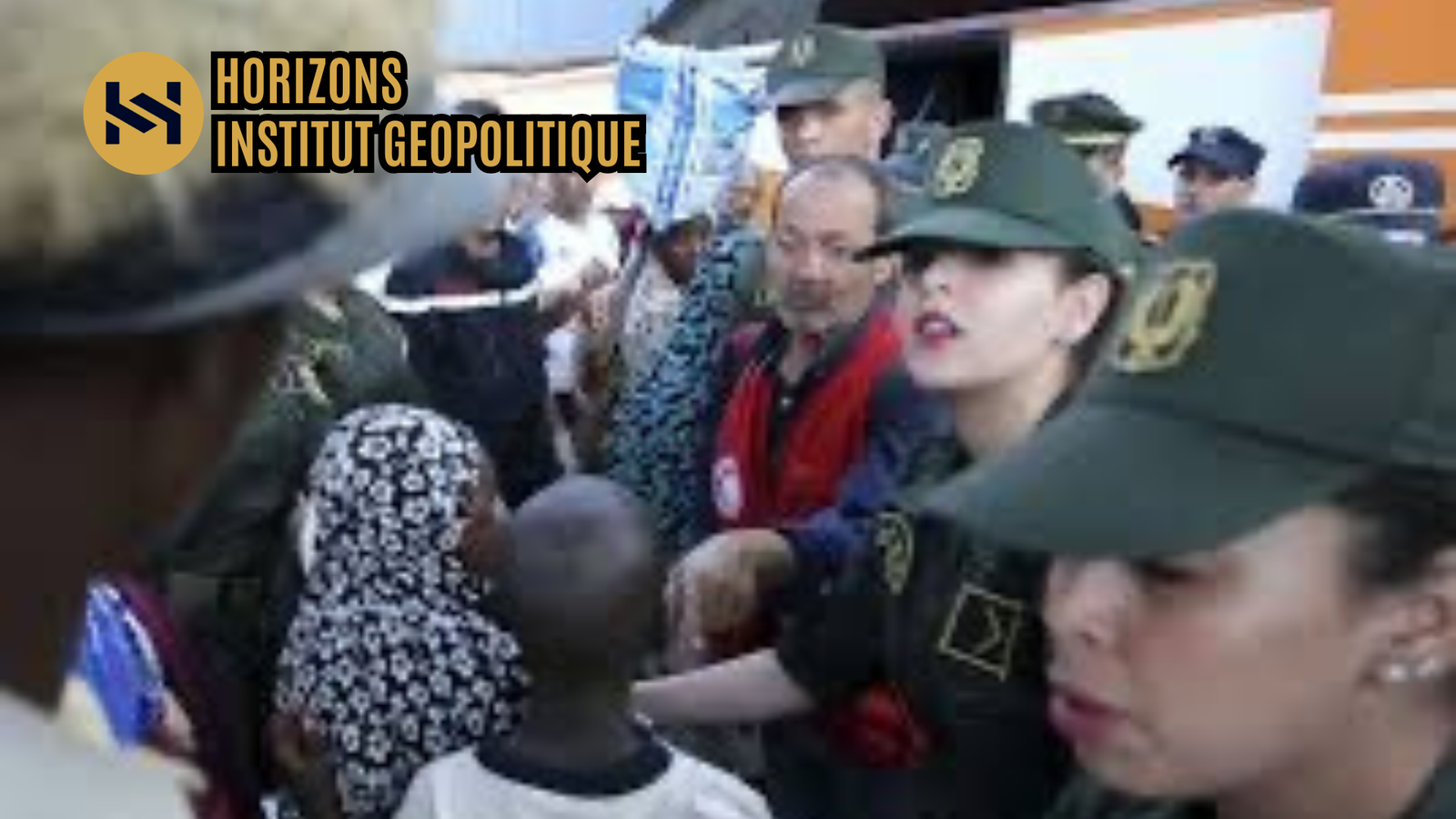
More than 4,000 migrants were expelled in April 2025, including approximately 2,750 Nigeriens, among them women and children. These expulsions are a continuation of an aggressive policy initiated in 2024, during which Algeria had already expelled over 31,000 migrants to Niger according to the NGO Alarme Phone Sahara.
The expulsion method is particularly concerning: migrants are abandoned at « Point Zero, » a desert area on the Algerian-Nigerien border, forced to walk 15 kilometers to Assamaka in extreme weather conditions, without water or food. Several deaths have been documented, including two bodies found on April 22, 2025, in the desert area between Point Zero and Assamaka.
The Thin Line Between Political Retaliation and International Crime
Retaliatory Measure: The Sovereignty Argument
Algerian authorities justify their actions as a legitimate response to Niger’s unilateral termination of bilateral agreements on migration management. From a legal perspective, retaliatory measures (unfriendly but lawful acts) are permitted in international law if they observe certain limitations.
However, as the United Nations International Law Commission emphasizes, « even when a State has the right to expel foreigners, this right cannot be exercised arbitrarily or for improper purposes, such as political pressure. » Using migrants as an instrument of diplomatic pressure thus constitutes a clear abuse of the right of expulsion.
Crime Against Humanity: The Constituent Elements
The Rome Statute of the International Criminal Court defines crimes against humanity as acts committed as part of a widespread or systematic attack directed against a civilian population. These acts include deportation or forcible transfer of population, defined as « forced displacement of the persons concerned by expulsion or other coercive acts from the area in which they are lawfully present, without grounds permitted under international law. »
The mass expulsions practiced by Algeria exhibit several characteristics that could bring them closer to this definition:
1. Widespread and systematic nature: More than 31,000 expulsions in 2024, followed by a new wave in 2025, demonstrate a deliberate and continuous policy.
2. Inhumane conditions: Abandoning vulnerable people in the desert without water or food constitutes cruel and inhuman treatment.
3. Discriminatory intent: The expulsions specifically target Nigeriens and nationals of other sub-Saharan countries.
4. Knowledge of consequences: Algerian authorities are fully aware of the deadly risks associated with these expulsions in desert areas.
Legal Risks for Tebboune and Algerian Officials
Faced with these flagrant violations of international law, President Tebboune and Algerian officials expose themselves to several types of prosecution:
1. Individual Responsibility Before International Justice
Tebboune’s public declaration constitutes compelling evidence of intent and knowledge—essential components of international criminal responsibility. If the expulsions were to be qualified as crimes against humanity, the Algerian president could theoretically be subject to an international arrest warrant.
Although Algeria has not ratified the Rome Statute, universal jurisdiction allows certain states to prosecute alleged perpetrators of international crimes, regardless of where these crimes were committed.
2. Responsibility of the Algerian State
Independent of individual responsibility, the Algerian state faces international responsibility for violation of multiple conventions it has ratified:
– The African Charter on Human and Peoples’ Rights
– The International Covenant on Civil and Political Rights
– The Convention against Torture and Other Cruel, Inhuman or Degrading Treatment or Punishment
This responsibility could result in complaints before United Nations treaty bodies or the African Commission on Human and Peoples’ Rights.
3. Diplomatic and Economic Sanctions
Beyond legal proceedings, Algeria exposes itself to:
– Formal condemnations by international bodies
– Regional diplomatic sanctions
– Economic pressure or restrictions on international aid
Precedents and International Jurisprudence
The legal qualification of mass expulsions is based on established international jurisprudence:
– The European Court of Human Rights has consistently condemned collective expulsions as violations of Article 4 of Protocol No. 4 to the European Convention on Human Rights.
– The African Commission on Human and Peoples’ Rights has already condemned states for mass expulsions, notably in the case of Union Inter-Africaine des Droits de l’Homme et al. v. Angola (1997), establishing that even in cases of irregular migrants, mass expulsions violate Article 12 of the African Charter.
– The International Criminal Tribunal for the former Yugoslavia has qualified certain mass expulsions as crimes against humanity, establishing that they can constitute acts of persecution when targeting a specific group.
Geopolitical Dimensions and Regional Implications
This legal-diplomatic crisis is unfolding in a tense regional context:
Rupture of the Algerian-Nigerien Axis
Relations between Algeria and Niger have deteriorated considerably since the July 2023 coup. The Nigerien junta has favored closer ties with Mali and Burkina Faso within the Alliance of Sahel States (AES), marginalizing Algeria’s traditional influence in the region.
Niger’s repeal in November 2023 of Law 2015-036 criminalizing migrant trafficking is perceived by Algiers as a deliberate provocation, facilitating migration flows northward.
European Union and Border Externalization
Algeria’s policy is part of a broader context of European border externalization. The Maghreb alliance (Algeria-Tunisia-Libya) launched in April 2024 to combat irregular immigration is directly encouraged by European policies.
As an Alarme Phone Sahara report highlights: « EU member states bear direct responsibility for what is happening at the Algerian-Nigerien border. » This European complicity raises the question of shared responsibility in human rights violations.
Conclusion: A Potential Judicial Turning Point
The mass expulsions of Nigerien migrants by Algeria could mark a turning point in the application of international humanitarian law to abusive migration policies. The boundary between legitimate diplomatic retaliation and crime against humanity lies in respect for the fundamental rights of the affected populations.
President Tebboune’s provocative declaration transforms what could have been presented as a simple sovereign migration policy into an explicit admission of political instrumentalization of expulsions. This public admission could prove legally costly for the Algerian regime.
Faced with this situation, three legal scenarios emerge:
– Qualification as crimes against humanity: triggering international prosecutions against Algerian officials
– Condemnation for human rights violations: diplomatic and economic sanctions
– Regional mediation: diplomatic resolution with guarantees of non-repetition and reparations for victims
Whatever happens, the mass expulsions of Nigeriens in April 2025 constitute a case study on the limits of the sovereign right of expulsion against the imperative requirements of international humanitarian law. The future will tell whether international justice is ready to qualify these acts as crimes against humanity or will merely consider them excessive retaliatory measures.