Horizons Geopolitical Institute
May 2025
Executive Summary
Since Abdelmadjid Tebboune’s rise to the presidency in December 2019, Algeria has experienced a spectacular deterioration in its international position. Within five years, the country has shifted from being an influential regional power to a quasi-isolated state, facing degraded relations with virtually all its neighbors. This analysis examines the mechanisms of this progressive isolation, its structural causes, and strategic implications for regional stability in the Maghreb and Sahel.
Introduction: The Algerian Paradox
The election of Abdelmadjid Tebboune in December 2019, in the context of popular contestation through the Hirak movement, was supposed to mark a renewal for Algeria. Yet five years later, the geopolitical record proves disastrous: total diplomatic rupture with Morocco, major tensions with France and Spain, disputes with the UAE and Niger, deteriorated relations with Sahelian countries, and even a progressive distancing from Russia, a historic partner.
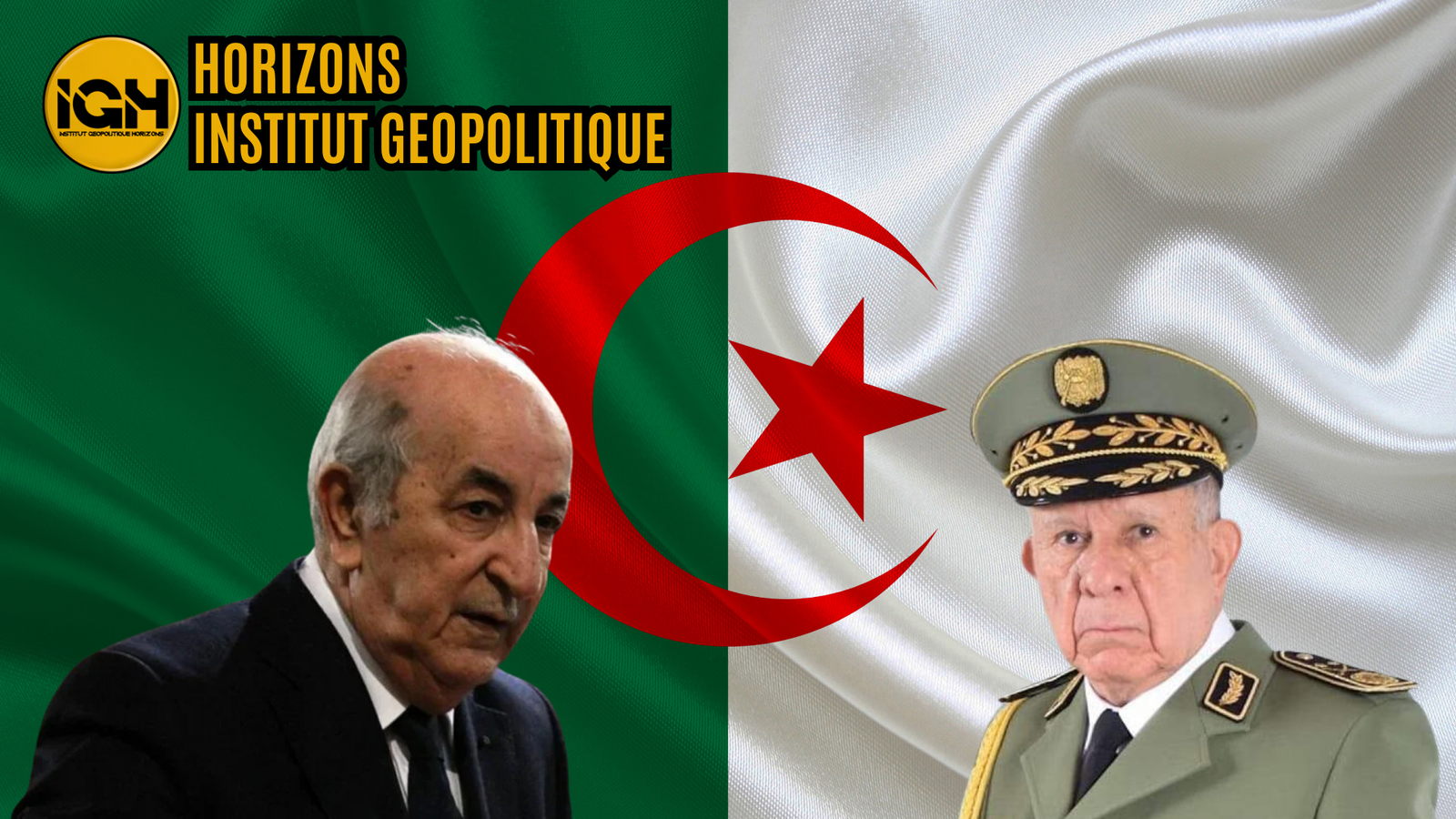
Tebboune is merely the visible face of a profoundly dysfunctional politico-military system. Behind the appearances of presidential power lies a regime fragmented by permanent clan struggles pitting the presidential clan against Bouteflika-era heirs, General Toufik’s networks (Mohamed Mediène), and various military factions. These internal rivalries, illustrated by the spectacular imprisonment of 155 senior officers at Blida military prison, paralyze decision-making and largely explain the incoherence of Algerian foreign policy.
This radical transformation of Algeria’s international position cannot be analyzed without understanding the internal fractures of a system where diplomacy becomes hostage to power balances between rival clans.
I. Foundations of Algeria’s Diplomatic Crisis: A System at War with Itself
Legitimacy Deficit and Clan Warfare
Tebboune’s rise to power occurred in a context of strong contestation, with a historically low participation rate (39.9%). But beyond this democratic legitimacy deficit, it is primarily the clan warfare within the politico-military system that paralyzes governmental action.
Algerian power is structurally fragmented among several rival clans:
- The Tebboune clan on one hand and the Chengriha clan on the other (each having their own networks, with predominance for the chief of staff)
- The « Toufik » generals’ clan (around ex-DRS chief Mohamed Mediène, a « comeback » figure imprisoned then acquitted, but whose associated generals do not form a homogeneous ensemble)
- Remnants of the Bouteflika clan and its economic relays
- Various competing military and security factions
A particularly revealing element of this institutional decomposition lies in the magnitude of confidential and highly confidential information leaks afflicting the Algerian establishment. These leaks benefit not only opposition activists established abroad (Anwar Malek, Hicham Aboud, etc.), but also allow analysis institutes like ours to access Algerian sources at the highest levels directly. This informational hemorrhage, unthinkable in a coherent system, perfectly illustrates the permanent internal warfare characterizing the Algerian regime.
This fragmentation translates into spectacular purges: 155 senior officers are currently imprisoned at Blida military prison (60 generals, 10 major generals, and 85 colonels), an unprecedented record in the country’s history. Among the most emblematic figures:
- Major General Abdelhamid Ghriss (former Secretary General of the Ministry of Defense)
- Major General Rachid Chouaki (former Director of Military Industries, died in prison in 2023)
- General Wassini Bouazza (former DGSI chief, demoted and imprisoned)
- Major General Hadj Laaroussi Djamel (Commander of the 2nd Military Region, died in detention in 2023)
- Three intelligence officers (including Noureddine Makri and Sid Ali Ould Zmirli) sentenced to ten years in prison for « conspiracy against institutions »
Institutional instability reaches surreal levels with « hierarchical yo-yo » cases: officers imprisoned then rehabilitated and returned to function. The most spectacular case is that of General Abdelkader Aït Ouarabi, known as « Hassan », sentenced to 5 years in prison in 2019, completely rehabilitated in 2021, then appointed in May 2025 as head of the General Directorate of Internal Security (DGSI), replacing General Abdelkader Haddad (« Nacer El-Djen ») who himself fell into disgrace. This waltz of leaders illustrates a system where internal power relations take precedence over any institutional logic.
Paralysis of the « Strategic Brain » and Institutional Anarchy
This clan warfare explains why, according to European intelligence service sources, the Algerian state’s « strategic brain » is « totally paralyzed. » Institutional instability reaches pathological levels: generals are imprisoned while in service, others die in detention (like Major Generals Rachid Chouaki and Hadj Laaroussi Djamel in 2023), and some make spectacular returns after incarceration.
This institutional anarchy transforms security and intelligence services into playgrounds for factional score-settling. The appointment of a former detainee as head of DGSI in May 2025 perfectly illustrates this institutional decomposition where competence and institutional loyalty criteria are subordinated to momentary clan balances.
Foreign policy decisions thus become hostage to these volatile internal power balances, with frequent changes at the head of diplomacy reflecting this chronic instability. In this context, no medium-term strategic coherence is possible.
Compensatory Obsession with Western Sahara
In this context of internal fragility, excessive focus on the Western Sahara dossier and unconditional support for Polisario serve as regime cement. This obsession becomes one of the few consensus points among rival clans, but also a strategic trap limiting the country’s diplomatic maneuvering room.
II. Chronicle of Programmed Isolation (2019-2025)
2019-2021: The Rupture’s Beginnings
From his arrival, Tebboune hardened his tone with Morocco, accusing Rabat of supporting the Movement for Kabylia’s Self-Determination (MAK). Discovery of Morocco’s use of Pegasus spyware against Algerian officials aggravated tensions, culminating in the unilateral rupture of diplomatic relations in August 2021.
2022-2023: Crisis Extension
The crisis rapidly extended to other partners. In March 2022, Algeria recalled its ambassador from Spain in reaction to Madrid’s support for the Moroccan autonomy plan for Sahara. Simultaneously, tensions with France intensified, fueled by disagreements over colonial history and French recognition of Sahara’s « Moroccanness. »
2024-2025: Generalized Isolation
2024 marked the extension of Algerian isolation. The dispute with the UAE reached its peak with public destabilization accusations. The crisis with Niger erupted around migrant treatment. In 2025, even the privileged relationship with Russia deteriorated, with Moscow favoring its new Sahelian partners over Alger.
III. Geographic Encirclement: Bilateral Relations Analysis
Hostile Maghreb
Morocco: Total rupture since 2021. Airspace closure, Maghreb-Europe gas pipeline shutdown, mutual accusations of espionage and destabilization.
Tunisia: Relations maintained but limited by Tunisian political instability and Algeria’s inability to play a stabilizing role.
Libya: Algerian influence marginalized facing Turkish, Russian, and Emirati presence. Alger struggles to weigh on Libyan conflict resolution.
Lost Sahel: Emirati Containment Strategy
Mali: Strained relations since military coups. Russian Wagner mercenaries’ presence directly competes with traditional Algerian influence, while the UAE methodically weaves its influence network.
Niger: Open diplomatic crisis in 2024 around migrant treatment, with ambassadors’ convocation and Niamey’s official complaint. More seriously, Niger now integrates into the Emirati containment strategy targeting Algeria, illustrated by Saddam Haftar’s visit to Niamey in May 2025 and his official decoration by the military regime.
Burkina Faso: Member of the Alliance of Sahel States (AES), the country participates in anti-Algerian geopolitical recomposition orchestrated by the UAE.
Mauritania: Mauritania distances itself from Polisario and reinforces cooperation with Morocco, reducing Algerian influence space and participating in the Royal Atlantic Initiative aimed at bypassing Algerian commercial corridors.
This Sahel transformation illustrates a systematic containment strategy against Algeria orchestrated by the UAE. Sheikh Shakhboot Bin Nahyan Al Nahyan’s diplomatic tour in the three AES capitals in May 2025, immediately followed by Saddam Haftar’s strategic mission to Niger, reveals the establishment of an Abu Dhabi-AES-Benghazi axis explicitly targeting Alger’s geopolitical encirclement.
The Emirati offensive in the Sahel deploys across several axes:
- Massive economic diplomacy: nearly $97 billion in investments promised in Africa
- Security cooperation: defense agreements and arms deliveries to military juntas
- Energy warfare: Emirati financing of the Africa Atlantic Gas Pipeline (AAGP) Nigeria-Morocco, definitively torpedoing the competing Algerian trans-Saharan gas pipeline project
- Alliance with Libyan LNA: potential control of strategic Madama base at the Libyan-Nigerian border
This geopolitical architecture transforms AES into the Sahelian link of an Atlantic-Gulf strategic axis that definitively marginalizes Algerian regional leadership ambitions, creating a genuine sanitary cordon around Alger.
Western Partners in Crisis
France: Relations at their lowest since independence. Cross-expulsions of diplomats in April 2025, tensions over colonial history and Western Sahara.
Spain: Prolonged diplomatic crisis since 2022, partially eased by late 2023 but without genuine reconciliation.
IV. Structural Factors of Isolation
Doctrinal Rigidity and Adaptation Incapacity
Algerian diplomacy under Tebboune is characterized by doctrinal rigidity preventing adaptation to geopolitical evolutions. Maintaining maximalist positions on Western Sahara, despite international power balance evolution, illustrates this adaptation incapacity.
Economic Fragilities and Energy Dependence
The Algerian economy remains massively dependent on hydrocarbons (over 95% of exports), limiting its economic influence capacities. This structural weakness reduces the country’s attractiveness as partner and limits diplomatic maneuvering margins.
Institutional Failures and Generalized Repression
Beyond military clan struggles, the entire Algerian institutional system shows decomposition signs. Frequent rotations at the Foreign Ministry head are only the visible part of generalized instability where 18 ministers and over thirty generals and senior officers are currently in prison.
This institutional instability combines with increased public freedom repression, creating a generalized climate of fear and mistrust where any discordant voice is perceived as existential threat. Detained officers’ families denounce deplorable detention conditions and constant judicial harassment, illustrating a regime at total war against its own institutions.
This regime collective paranoia, fueled by fear of new internal plots, directly reflects in its international diplomacy, transforming each foreign disagreement into a system survival question.
The Mistrust Spiral
Accumulating diplomatic crises creates a mistrust spiral progressively isolating Algeria. Each new dispute reinforces international perception of an unpredictable and unreliable country, led by a politico-military system in permanent war against itself. This image complicates existing crisis resolution and new tension prevention.
V. Strategic Consequences and Regional Implications
Marginalization in Regional Issues and Containment Offensive
Algerian isolation translates into growing marginalization in major regional issues, amplified by a methodical containment strategy orchestrated from outside. On Libya, Mali, or even Tunisia, Algeria is no longer considered an unavoidable actor, but this influence loss also results from coordinated geopolitical offensive.
The Emirati offensive perfectly illustrates this dynamic: the UAE exploits the geopolitical void left by Western withdrawal in the Sahel to build a sanitary cordon around Alger. The Abu Dhabi-AES-Benghazi axis, materialized by the May 2025 diplomatic sequence (Sheikh Shakhboot’s visit followed by Haftar’s mission), explicitly targets the encirclement of traditional Algerian influence in the Sahel.
This containment strategy deploys across several fronts:
- Energy warfare: Emirati financing of AAGP gas pipeline (Nigeria-Morocco via Atlantic) definitively neutralizes the competing Algerian trans-Saharan project
- Commercial reorientation: Royal Moroccan Initiative, supported by Emirates, offers AES countries Atlantic access bypassing Algerian corridors
- Security alliance: Emirati military cooperation with AES and Libyan LNA creates permanent presence at Algerian borders
- Diplomatic isolation: AES integration into Emirati-Moroccan orbit deprives Algeria of traditional Sahelian allies
This geopolitical recomposition exceeds simple bilateral rivalry: it illustrates the emergence of a new Sahelian order where traditional Algerian influence finds itself systematically contested by a sophisticated alliance transforming the Sahel into an anti-Algerian platform.
Security Vulnerability and Strategic Encirclement
Diplomatic isolation dramatically increases Algeria’s security vulnerability, particularly facing the emergence of sophisticated containment architecture. Deteriorating relations with neighbors complicates counter-terrorism cooperation and migration flow management, but above all, Algeria now faces genuine strategic encirclement.
This encirclement materializes through:
- To the North: tensions with Spain and rupture with France
- To the West: total rupture with Morocco and Royal Atlantic Initiative diverting Sahelian flows
- To the South: Emirati control of AES and alliance with Libyan LNA threatening to seize strategic Madama base
- To the East: marginalized influence in Libya facing Turkish-Emirati coalition
This geographic configuration creates gray zones conducive to trafficking and instability, but also forward bases for potential destabilization operations. Potential Madama control by Haftar’s forces, Emirates ally, would place a hostile military base just hundreds of kilometers from Algerian borders, transforming theoretical vulnerability into concrete security threat.
Impact on Regional Stability and Geopolitical Recomposition
Algerian isolation contributes to Maghreb fragmentation and complicates regional crisis resolution, but also participates in a broader geopolitical recomposition of West African space. The absence of constructive Algerian actor deprives the region of a traditional mediator, but this marginalization now fits into a new geography of influences.
The emerging new geopolitical architecture – Abu Dhabi-AES-Rabat axis reinforced by alliance with Haftar’s forces – durably redesigns the map of regional influences and West African economic flows. This recomposition transforms:
- Morocco into Atlantic hub for Sahelian exchanges
- Emirates into financier of this new South-South connectivity
- AES into Sahelian link of an energy and commercial corridor systematically bypassing Algeria
This new energy and commercial geography structurally marginalizes Algeria by creating alternative flows (AAGP gas pipeline, Atlantic commercial corridors, Emirati energy partnerships) depriving Alger of its natural outlets and traditional regional crossroads role.
The impact exceeds the Sahelian framework to affect the entire West African space, creating a new Sahelian geopolitical order connected to the Atlantic rather than Mediterranean, definitively marginalizing Algerian influence in its historic influence zone.
Internal Implosion Risks
External isolation could eventually weaken internal stability. The regime’s inability to achieve diplomatic successes, combined with economic difficulties, risks fueling a new cycle of social contestation.
Strategic Conclusion
Algeria’s geopolitical isolation under Tebboune results less from the president’s personality than from a profound systemic crisis of the Algerian politico-military regime. Tebboune is merely the visible face of an institutional iceberg undermined by permanent clan struggles paralyzing decision-making and generating erratic diplomacy.
The clan warfare – illustrated by 155 senior officers’ imprisonment – reveals a decomposing system where internal power balances prevail over national interest. This structural fragmentation, combined with compensatory Western Sahara obsession, doctrinal rigidity, and economic fragilities, has transformed Algeria into a quasi-pariah state, encircled by neighbors become hostile or wary.
But this isolation also results from a containment strategy methodically orchestrated from outside. The Emirati offensive in the Sahel, convergent with the Royal Moroccan Initiative, exploits the Algerian regime’s internal weaknesses to redraw regional geopolitics. This geopolitical architecture – Abu Dhabi-AES-Rabat-Benghazi axis – creates a genuine sanitary cordon around Alger, transforming diplomatic isolation into strategic encirclement.
This spectacular transformation illustrates how internal pathologies of a regime can rapidly destroy a country’s geopolitical influence, particularly when exploited by sophisticated external actors. It reveals the limits of diplomacy hostage to internal power balances and incapable of strategic anticipation facing determined adverse coalitions.
Strategic Recommendations
- Prior institutional stabilization: Any diplomatic improvement first requires pacifying internal clan struggles and stabilizing the decision-making process.
- Governance system reform: Power decentralization and institutionalizing coordination mechanisms are essential for coherent diplomacy.
- Counter-strategy against external containment: Algeria must develop coherent response to Emirati-Moroccan strategy, notably through partnership diversification and reactivating traditional diplomatic networks.
- Progressive and sequential de-escalation: Diplomatic crisis resolution must be approached gradually, prioritizing issues where compromise is possible.
- Urgent economic diversification: Reducing hydrocarbon dependence is crucial for restoring country attractiveness and resistance capacity to external pressures.
- National reconciliation: Democratic opening and reconciliation with civil society are necessary to restore legitimacy to the Algerian diplomatic project.
The alternative to this systemic transformation is clear: growing isolation that could eventually provoke regime implosion and contribute to lasting destabilization of the entire Maghreb-Sahelian region. Algeria today stands at a historic crossroads where it must choose between profound reform of its politico-military system or aggravated geopolitical marginalization in a regional environment recomposed by its adversaries.
This analysis relies on open sources and expert assessments. Conclusions engage only the Horizons Geopolitical Institute.