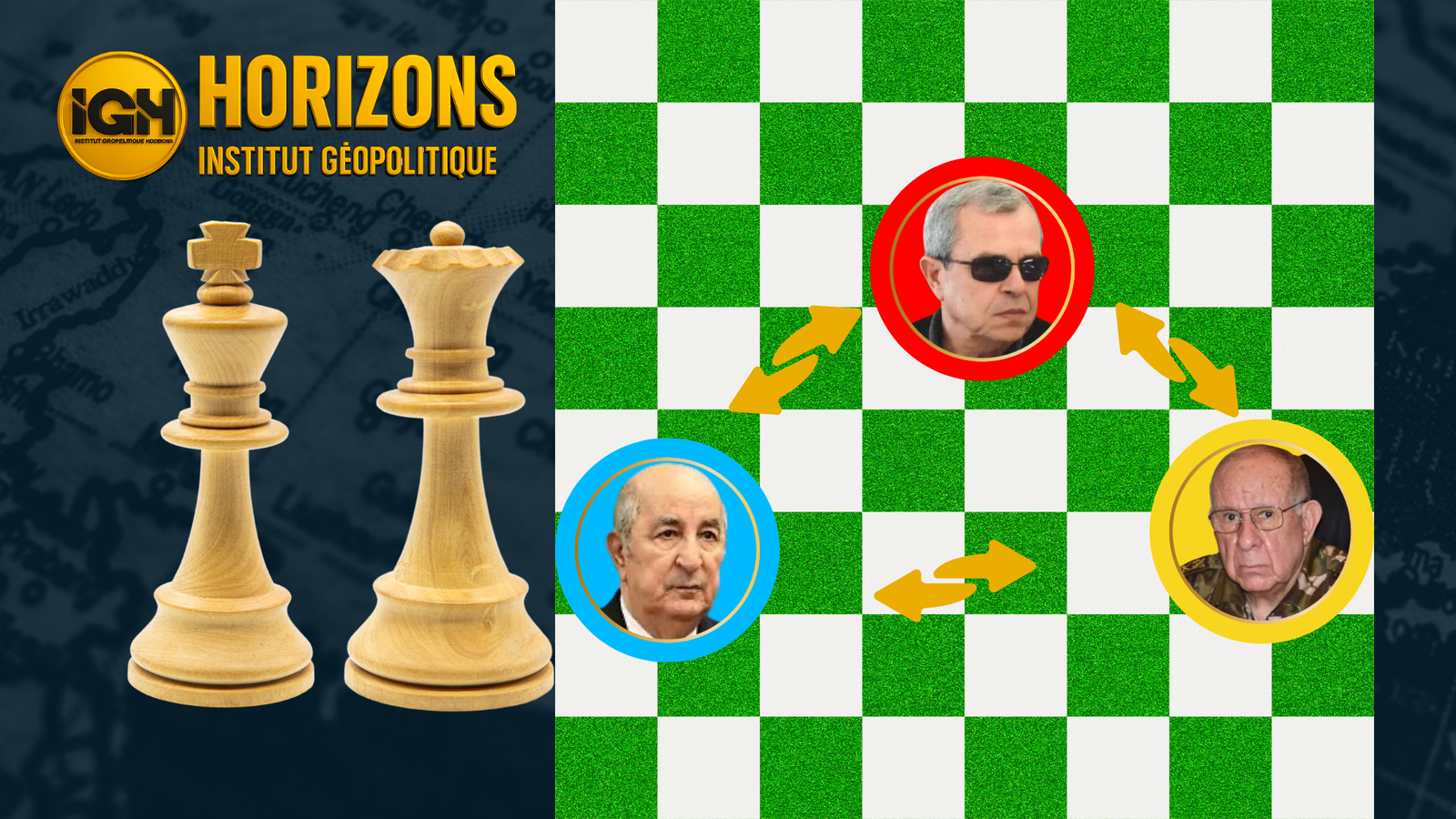
Interrogations at Antar Barracks, the Bencheikh Affair, and Geriatric Variables of a Precarious Equilibrium
IGH-RE-Maghreb-20250719 |
Institute of Geopolitical Horizons
Abdelhakim Yamani
July 19, 2025
Executive Summary
The recent interrogations of presidential advisors at Antar Barracks (July 16-17, 2025) and indications of a possible change in judicial status for Generals Oulhaj and Haddad reveal an accelerated reconfiguration of power dynamics at the top of the Algerian state. This dynamic unfolds in a context where the advanced age of key protagonists (Tebboune 79, Toufik 85, Chengriha 79) transforms every health episode into a potential destabilizing factor, making prospective analysis particularly challenging.
Introduction: Algeria Between Clan Wars and Geriatric Variables
Contemporary Algeria is experiencing an unprecedented political sequence characterized by the intersection of two critical dynamics: the exacerbation of tensions between different components of the state apparatus and the growing impact of the geriatric factor on system stability. The events of July 16-17, 2025, marked by interrogations of three close advisors to President Tebboune at Antar Barracks, constitute a striking revelation of these underlying dynamics.
These interrogations, far from being a mere judicial episode, are part of a broader logic of recomposing power relations within the Algerian system. They occur in a context where unconfirmed information regarding a possible transfer of Generals Oulhaj and Haddad from Blida military prison to house arrest suggests an acceleration of internal reconfigurations.
I. The Geriatric Variable: Ages and Vulnerabilities of Algerian Power
Mapping Ages at the Summit of State
Any strategy for evolving power relations in Algeria must integrate the geriatric dimension as a fundamental variable. The main protagonists of Algerian power present age profiles that transform every health episode into a potential destabilizing factor:
- Abdelmadjid Tebboune: 79 years old (born 1945), President of the Republic
- Saïd Chengriha: 79 years old (born 1945), Chief of Staff of the ANP
- Mohamed Mediène « Toufik »: 85 years old (born 1939), Former DRS Chief
- Salima Souakri: 75 years old (born 1949), President of the Constitutional Council
- General Hassan (Abdelkader Aït Ouarabi): 73 years old (born 1951), DGSI Director
⚠️ Analytical Alert
Recent information concerning a possible medical trip by General Toufik to Germany illustrates the inherent fragility of a system relying on octogenarians. The illness or death of any of these key actors could call into question the current precarious balance at any moment.
The Precarious Balance of a Gerontocracy
This concentration of octogenarians at the state summit transforms every hospitalization, every prolonged absence, every rumor of failing health into a potential destabilizing factor. The clan war no longer plays out solely on political alliances and betrayals, but also on the physical capacity of protagonists to maintain their influence.
II. Contradictory Signals: Between Reconfigurations and Presidential Resilience
Generals Oulhaj and Haddad: Unconfirmed Status Change
Simultaneously with the interrogations of Tebboune’s advisors, certain unverified media reports suggest a possible change in judicial status for Generals Oulhaj and Haddad. According to these sources, they may have left Blida military prison to be placed under house arrest. If confirmed, this information could indicate a gradual takeover by the Toufik clan, signaling an acceleration of internal reconfigurations.
This development, if proven accurate, would align with the logic of General Hassan’s return to grace as head of the DGSI, confirming a restoration of networks linked to the former all-powerful DRS chief.
Tebboune: Between Controlled Communication and Uncertain Chronology
Tebboune’s television appearance broadcast on July 18, 2025, adds another layer of complexity to the analysis. This media encounter, presented as recent by Algerian television, was actually pre-recorded and edited, with notable cuts betraying sophisticated montage. More significantly, the recording likely took place before the July 16-17 interrogations of presidential advisors.
This reversed chronology fundamentally transforms interpretation of the displayed presidential « serenity. » Far from constituting a response to recent pressures, this appearance would represent a preventive communication strategy, or even editorial calendar coincidence. Regarding the Western Sahara dossier, the reaffirmation of « full support for separatists » loses its conjunctural significance to align with usual diplomatic continuity.
This technical revelation underlines the sophisticated staging arsenal available to the Algerian presidency, further complicating the reading of real political signals.
III. Antar Barracks and the Bencheikh Affair: Symbols of Recomposition
The Three Advisors: Nerve Center of the Presidential System
The interrogation of Amirouche Hamadache, presidential private secretary, Kamel Sidi Saïd, responsible for presidential communication, and Abdelatif Belkaim, press advisor, was no coincidence. These three figures represent the nerve center of the presidential system: administration, communication, and media strategy.
Their simultaneous convocation to Antar Barracks suggests an investigative intent regarding internal mechanisms of presidential decision-making and communication, within the framework of the Farid Bencheikh affair that continues to reveal the scope of ongoing security reconfigurations.
Antar: Symbol of Algerian Intelligence
The choice of Antar Barracks as the interrogation venue retains considerable symbolic weight. Located in Ben Aknoun, this facility houses the Principal Operations Center (CPO) of the DGSI and constitutes the historical heart of Algerian intelligence. Summoning the president’s closest collaborators there represents a political signal of exceptional significance.
IV. Analytical Opacity: Challenges of Algerian Forecasting
💡 Critical Methodological Note
Recent events underscore the extreme difficulty for analysts to achieve reliable visibility on Algeria. The multiplication of contradictory signals – interrogations of presidential advisors on one side, Tebboune’s displayed serenity on the other – illustrates the structural opacity of the Algerian system and the limits of prospective analysis in this context.
This opacity results from several converging factors:
- Informational compartmentalization: Different clans control their own information and disinformation channels
- Unpredictable geriatric variable: The health status of octogenarian protagonists introduces fundamental uncertainty
- Permanent staging: Every public appearance may relate as much to communication as to reality, as illustrated by Tebboune’s pre-recorded and edited television intervention
- Misleading chronologies: Broadcasting pre-recorded events disrupts reading of causal sequences
- Contradictory sources: Unverified information multiplies without possibility of immediate verification
V. Evolution Scenarios in Maximum Uncertainty Context
Scenario 1: Toufik Clan Consolidation
General Hassan’s return to the DGSI, combined with the possible status change of Generals Oulhaj and Haddad, could signal gradual control by former DRS networks. This hypothesis implies weakening of the presidential clan, masked by controlled communication.
Scenario 2: Presidential Preventive Communication Strategy
The prior recording of Tebboune’s television intervention suggests an anticipated communication strategy rather than reaction to pressures. This hypothesis implies presidential clan planning capacity, but doesn’t exclude real weakening masked by sophisticated staging arsenal.
Scenario 3: Apparent Status Quo and Maintained Equilibrium
The Antar Barracks interrogations could constitute pressure without decisive follow-up, maintaining the current precarious balance. Uncertain event chronology would render invalid any interpretation in terms of immediate power relations.
Scenario 4: Geriatric Rupture and Forced Recomposition
The health status of one key protagonist (Toufik, Tebboune, Chengriha) could provoke brutal and unpredictable recomposition, opening an uncontrolled transition sequence.
Conclusion: Navigating Opacity
The events of July 16-18, 2025, perfectly illustrate analytical challenges posed by the contemporary Algerian system. The convergence of contradictory signals – judicial pressures on one side, presidential serenity on the other – unfolds in a context where the geriatric variable transforms every analysis into high-stakes prospective exercise.
The advanced age of main protagonists introduces fundamental unpredictability that renders traditional analytical frameworks obsolete. In this context, analytical humility becomes a cardinal virtue, and recognizing forecasting limitations, a methodological necessity.
IGH Strategic Recommendations
For analysts: Prioritize analysis of structural trends over punctual events, systematically integrating the geriatric variable into prospective scenarios.
For international partners: Maintain constant vigilance while preparing for brutal and unpredictable reconfigurations, without prematurely favoring any particular scenario.
For regional decision-makers: Develop flexible adaptation strategies facing chronic instability of the Algerian neighbor, avoiding risky bets on any particular clan.
IGH Methodological Note
This analysis integrates unconfirmed information regarding the status of Generals Oulhaj and Haddad, clearly identified as such. IGH prioritizes methodological transparency facing structural opacity of the Algerian system, rigorously distinguishing established facts from analytical hypotheses.
Institute of Geopolitical Horizons • Independent Strategic Analysis Center
Maghreb – Sahel – Atlantic Africa
Reference: IGH-RE-Maghreb-20250719