Institut Géopolitique Horizons IGH
No Result
View All Result
  • Login
  • Accueil
  • Actualités
  • Afrique
  • Maghreb
    • Maroc
    • Algérie
    • Sahel
    • Tunisie
    • Libye
    • Mauritanie
  • Documents
    • Communiqués de presse
    • Note d’Orientation Stratégique
  • Monde
  • Podcast
  • Qui sommes-nous?
S'abonner
Mon Compte
  • Accueil
  • Actualités
  • Afrique
  • Maghreb
    • Maroc
    • Algérie
    • Sahel
    • Tunisie
    • Libye
    • Mauritanie
  • Documents
    • Communiqués de presse
    • Note d’Orientation Stratégique
  • Monde
  • Podcast
  • Qui sommes-nous?
No Result
View All Result
Institut Géopolitique Horizons IGH
No Result
View All Result
Accueil Actualités

UK-Sahara: The Shockwave from Algiers to Tindouf

Institut Géopolitique Horizons by Institut Géopolitique Horizons
1 juin 2025
in Actualités, Algérie, Maroc
Reading Time: 9 mins read
95.8k
A A
0
Royaume-Uni – Sahara : L’Onde de Choc d’Alger à Tindouf

RELATED POSTS

Tunisie : Kaïs Saïed hospitalisé après un incident cardiaque

Maroc-France : Le Royaume, clé de voûte de l’Afrique atlantique

Gaza : le Maroc officialise sa participation à l’ISF

When London redraws Maghreb geopolitical balances
Horizons Geopolitical Institute
Abdelhakim Yamani
Sunday, June 1st, 2025
Executive Summary
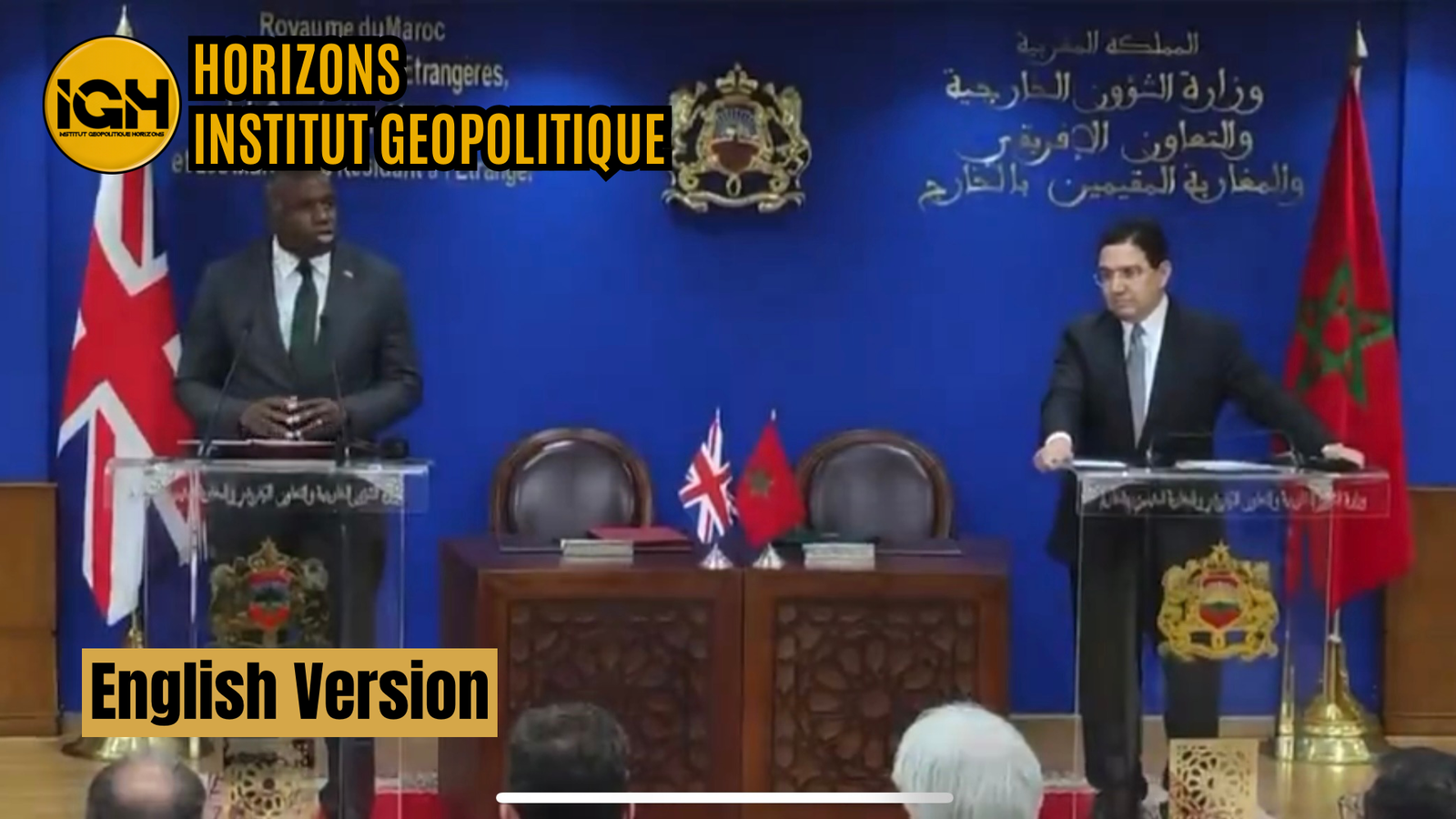
The official declaration by British Foreign Secretary David Lammy, delivered today Sunday June 1st, 2025 during his press conference in Rabat alongside his Moroccan counterpart Nasser Bourita, establishing UK support for the autonomy plan under Moroccan sovereignty, constitutes a major geopolitical turning point that shakes Algeria’s strategy in Western Sahara. As a permanent member of the Security Council and influential Commonwealth power, the United Kingdom de facto legitimizes Moroccan sovereignty, further isolating Algiers and weakening the Polisario’s position in the Tindouf camps.

The historic Rabat declaration: context and scope

Historic diplomatic moment:
The official visit of British Foreign Secretary David Lammy to Rabat, culminating in the signing of a joint communiqué with his Moroccan counterpart Nasser Bourita this Sunday June 1st, 2025, marked a decisive turning point in the British position on Western Sahara. In this official document, the United Kingdom declares that it « considers Morocco’s autonomy proposal, submitted in 2007, as the most credible, viable and pragmatic basis for a lasting resolution of the dispute » over the Moroccan Sahara, and that it « will continue to act bilaterally, including economically, regionally and internationally in line with this position to support resolution of the conflict ».

The diplomatic framework of the declaration

The choice of format – an official joint communiqué signed between the two foreign ministers at the headquarters of the Moroccan Ministry of Foreign Affairs – considerably amplifies the scope of the British message. This diplomatic formalization contrasts with the usual declarations published from London and demonstrates Britain’s willingness to publicly and solemnly display its alignment with the Moroccan position.

The physical signing of this official document by David Lammy alongside Nasser Bourita confers a particular legal and political dimension to this recognition, symbolically equaling President Emmanuel Macron’s declaration before the Moroccan Parliament in October 2024. The communiqué notably specifies that the United Kingdom « can consider supporting projects » in the Sahara, particularly within the framework of « UK Export Finance’s £5bn commitment to support new business across the country ».

Strategic context: towards a historic outcome

This British declaration comes in an explosive geopolitical context revealed by the Horizons Geopolitical Institute. Our exclusive revelations of May 24, 2025 concerning the preparation of a restricted international conference for summer 2025 find their first concrete validation today. The UK’s participation in the « Friends of Western Sahara Group » and its position as a permanent member of the Security Council make this recognition a major diplomatic signal announcing the definitive resolution of the conflict in October 2025.

The convergence of diplomatic signals

The recent declarations by Moroccan Ambassador Omar Hilale during the C24 seminar in Dili (May 21-23, 2025), qualifying the Autonomy Initiative as « the unique foundation for a lasting settlement », had prepared this British announcement. The diplomatic sequence is accelerating in accordance with our predictions on the international conference in preparation.

British geopolitical weight: much more than symbolic support

Key strategic point:
The United Kingdom is not just any actor on the international scene. Its position as a permanent member of the UN Security Council, its influence within the Commonwealth and its leadership in the Anglo-Saxon world confer considerable geopolitical weight to this declaration. The communiqué emphasizes that « as a Permanent Member of the UN Security Council, the United Kingdom agrees with Morocco on the urgent need to find a resolution to this long-held dispute, which would be in the interest of the parties », adding that « the time for a resolution and to move this issue forwards is long-overdue ».

This announcement is part of a broader dynamic of international recognition of the autonomy plan under Moroccan sovereignty. But unlike previous support, London’s resonates differently in world chancelleries. The communiqué specifies that the United Kingdom « recognises Morocco as a key gateway to Africa’s socio-economic development and reaffirms its commitment to deepening engagement with Morocco as a partner for growth across the continent ». The United Kingdom has considerable soft power, particularly with the 54 Commonwealth nations, representing nearly 2.5 billion inhabitants.

The Anglo-Saxon multiplier effect

The British position adds to the historic US support. Recall that as early as April 2025, Secretary of State Marco Rubio had declared that « the United States recognizes Moroccan sovereignty over Western Sahara and supports Morocco’s serious, credible and realistic autonomy proposal as the sole basis for a just and lasting solution ». This Anglo-American convergence, reinforced by French support for Moroccan sovereignty announced by President Macron, creates a coherent Western front confirmed by the British communiqué: « This new position of the United Kingdom, a permanent member of the UN Security Council, aligns with the strong stances expressed by many major powers, notably the United States, France, and Spain. »

Algiers facing the collapse of its diplomatic strategy

Strategic Alert
For Algeria, this British declaration represents a major diplomatic setback that adds to a series of recent failures in its management of the Sahrawi dossier. The strategy of internationalizing the conflict led for decades by Algiers now faces a wall of Western recognitions of the Moroccan plan. This announcement confirms our analysis of May 24, 2025 on the systemic isolation of Algiers, caught in a geopolitical vice between Emirati encirclement in the Sahel and Mauritanian militarization of the Lbriga zone.

Algeria, which has invested billions of dollars in supporting the Polisario and managing the Tindouf camps, sees its geopolitical strategy crumbling. British support for Morocco comes at a particularly delicate moment for the Algerian regime, facing considerable internal challenges and a persistent economic crisis.

Systemic diplomatic isolation

Convergence of Algerian failures:
The British position adds to the Polisario’s resounding failure during its visit to Nouakchott on May 30, 2025. Mauritanian President Mohamed Ould Cheikh El Ghazouani had then categorically refused to reverse the militarization of the Lbriga zone and recommended that the Polisario « seriously consider the Moroccan autonomy proposal ». This Mauritanian firmness had already confirmed our analysis on the growing isolation of Algiers and its proxy.
The Algerian position finds itself increasingly in the minority on the international scene. After the American (April 2025), French (support for Moroccan sovereignty by Macron), Israeli, Kenyan (May 2025), and now British recognitions, plus the diplomatic failure in Mauritania, Algiers can only count on a limited number of allies, mainly South Africa and some Latin American countries. This diplomatic erosion confirms our prediction of Algeria’s « systemic geopolitical decline » analyzed in our May 24 publication.

Tindouf: the shockwave in the camps

Key Point:
The British announcement resonates particularly strongly in the Tindouf camps, where Sahrawi refugees have lived for nearly 50 years. This new international recognition of the Moroccan plan, after the Polisario’s diplomatic failure in Mauritania at the end of May, further weakens the separatist discourse and questions the long-term viability of its strategy.

The Polisario Front, already weakened by internal divisions and declining international support, finds itself in an increasingly uncomfortable position. The resounding failure of its delegation in Nouakchott on May 30, 2025, where its « senior military officials » could not bend the Mauritanian position on the Lbriga zone, had already demonstrated the erosion of its regional influence.

Challenging the separatist narrative

The multiplication of international recognitions of the autonomy plan under Moroccan sovereignty, combined with regional diplomatic setbacks as in Mauritania, gradually erodes the legitimacy of the independence project. This evolution fits perfectly into the « gradual fragmentation » scenario that we had analyzed in our prospective study of May 24 on the systemic decline of Algeria and its proxy. The successive American, French, Kenyan and now British recognitions create irreversible momentum. The younger generations in the camps are beginning to openly question a strategy that has produced no tangible results in five decades.

Geopolitical implications for the Maghreb

This British declaration is part of a broader recomposition of Maghreb balances. It reinforces Morocco’s position as the West’s preferred strategic partner in the region, to the detriment of Algeria which sees its regional influence decline.

The timing of this announcement is not coincidental. It comes in a context of growing tensions between Rabat and Algiers, marked by the closure of the land border and the rupture of diplomatic relations. London seems to have chosen its side in this regional rivalry.

Impact on the Arab Maghreb Union

This growing polarization between Morocco and Algeria, amplified by international positions, further compromises the prospects for Maghreb integration. The Arab Maghreb Union (AMU), already moribund, moves even further away from any prospect of revival.

Evolution prospects: towards the October 2025 conference

Confirmed strategic trend:
The British recognition validates our exclusive revelations of May 24 concerning the restricted international conference planned for summer 2025. The United Kingdom, member of the « Friends of Western Sahara Group » with France, Russia, Spain and the United States, confirms the convergence of major powers around the autonomy plan under Moroccan sovereignty with a view to the definitive resolution of October 2025. The communiqué specifies that the United Kingdom is « ready, willing and committed to lend its active support and engagement to the Personal Envoy and the parties », thus emphasizing its driving role in the resolution process.

The domino effect already seems to be starting according to our predictions. This British recognition could catalyze other similar positions, particularly within the European Union where several countries are discreetly reassessing their position on Western Sahara.

The announced diplomatic acceleration

Our diplomatic sources confirm that this British declaration is part of the strategic calendar revealed on May 24: restricted international conference during summer 2025, formulation of a common recommendation to the Security Council, and adoption of a definitive resolution in October 2025. The diplomatic momentum is accelerating in accordance with our analysis on the « historic turning point » of 2025, the fiftieth anniversary of the Green March. Recall that the United States, as « pen-holder » at the Security Council for this dossier, has already clarified that the autonomy plan under Moroccan sovereignty constitutes « the unique basis » for conflict resolution.
Strategic Recommendations:

  • Monitor preparations for the summer 2025 international conference revealed by the Institute
  • Analyze the impact of this decision on UK-Morocco post-Brexit trade relations
  • Assess Algerian reactions to the acceleration of its diplomatic isolation
  • Anticipate consequences on internal stability of the Tindouf camps
  • Prepare analysis of the post-settlement period in October 2025 and its implications for Maghreb integration

Conclusion: validation of a historic geopolitical shift

The British declaration of support for the Moroccan autonomy plan fully confirms our exclusive revelations of May 24, 2025 on the preparation of an international conference with a view to the definitive resolution of the conflict in October 2025. This recognition by a permanent member of the Security Council validates the exceptional diplomatic momentum that we had analyzed.

Beyond its symbolic scope, this British position is part of the unprecedented international strategic convergence that we had identified: American and French recognitions, Polisario failure in Mauritania at the end of May, more than 116 states supporting the Autonomy Initiative according to the latest figures provided by Ambassador Hilale in Dili. The British communiqué explicitly reinforces this momentum by declaring that this position « reinforces the growing international momentum driven by His Majesty King Mohammed VI in favor of the Autonomy Plan under Moroccan sovereignty » and « also confirms the credibility of this initiative and the broad consensus backing it to reach a final resolution to the regional dispute over the Moroccan Sahara ».

This shockwave, which effectively spreads from Algiers to Tindouf, confirms our analysis on the progressive collapse of an anachronistic separatist strategy in the face of new geopolitical realities. The systemic isolation of Algeria and its proxy, between Emirati encirclement in the Sahel and Mauritanian firmness, perfectly illustrates the « geopolitical decline » scenario that we had exposed in our prospective analysis.

Major strategic validation
This British declaration constitutes the first concrete and public validation of our revelations on the summer 2025 international conference. It confirms that the year 2025, fiftieth anniversary of the Green March, is indeed shaping up as the moment of truth for the definitive resolution of this artificial conflict that is fifty years old. The official communiqué emphasizes that « settling this regional dispute would strengthen the stability of North Africa and the relaunch of the bilateral dynamic and regional integration », validating our analysis on the geopolitical stakes of this historic resolution.
© 2025 Horizons Geopolitical Institute – Do not reproduce without authorization
Tags: Abdelmadjid TebbouneAlgeriaalgiersAnalysisDavid Lammygeopolitical analysisMohammed 6Mohammed VIMoroccan autonomy planMoroccan SaharaMoroccoNasser BouritapolisarioRABATUnited Kingdomwestern sahara
Share35327Tweet22080Send
Institut Géopolitique Horizons

Institut Géopolitique Horizons

Related Posts

Tunisie : Kaïs Saïed hospitalisé après un incident cardiaque
Actualités

Tunisie : Kaïs Saïed hospitalisé après un incident cardiaque

18 juillet 2026
Maroc-France : Le Royaume, clé de voûte de l’Afrique atlantique
Actualités

Maroc-France : Le Royaume, clé de voûte de l’Afrique atlantique

16 juillet 2026
Gaza : le Maroc officialise sa participation à l’ISF
Dépêche analytique

Gaza : le Maroc officialise sa participation à l’ISF

16 juillet 2026
Sahel : la carte sécuritaire régionale se redessine
Actualités

Sahel : la carte sécuritaire régionale se redessine

13 juillet 2026
Iyad Ag Ghali, leader du JNIM, évacué pour soins en Algérie ?
Actualités

Iyad Ag Ghali, leader du JNIM, évacué pour soins en Algérie ?

13 juillet 2026
Mondial 2026, Maroc et « Affaire Hakimi »
Actualités

Mondial 2026, Maroc et « Affaire Hakimi »

22 juin 2026

Articles recommandées

  • All
  • Actualités
"Données démographiques et vide diplomatique : les enjeux du recensement marocain 2024"

Données démographiques et vide diplomatique : les enjeux du recensement marocain 2024

2 ans ago
Nominations Militaires en Mauritanie – Un Tournant Stratégique sous Tension

Nominations Militaires en Mauritanie – Un Tournant Stratégique sous Tension

2 ans ago
Algérie-France : Une Désescalade Impossible ?

Algérie-France : Une Désescalade Impossible ?

1 an ago
Load More

Articles phares

  • Mondial 2026, Maroc et « Affaire Hakimi »

    Mondial 2026, Maroc et « Affaire Hakimi »

    88440 shares
    Share 35376 Tweet 22110
  • Ce que Madrid, Washington, Oslo et Paris préparent vraiment pour le Conseil de sécurité

    88430 shares
    Share 35372 Tweet 22108
  • Iyad Ag Ghali, leader du JNIM, évacué pour soins en Algérie ?

    88408 shares
    Share 35363 Tweet 22102
  • Le « Scénario El Ouali » : Comment Brahim Ghali aurait éliminé son successeur

    88401 shares
    Share 35360 Tweet 22100
  • Sahel : la carte sécuritaire régionale se redessine

    88375 shares
    Share 35350 Tweet 22094
Twitter LinkedIn
Institut Géopolitique Horizons IGH

L’Institut Géopolitique Horizons (IGH)

Un centre d’expertise indépendant dédié à l’analyse géopolitique des régions du Maghreb, du Sahel et de l’Afrique atlantique. Fondé pour répondre aux besoins croissants de compréhension des dynamiques régionales, notre institut s’engage à produire des analyses rigoureuses et à favoriser le dialogue entre les acteurs de ces territoires.

Articles récents

  • Tunisie : Kaïs Saïed hospitalisé après un incident cardiaque 18 juillet 2026
  • Maroc-France : Le Royaume, clé de voûte de l’Afrique atlantique 16 juillet 2026
  • Gaza : le Maroc officialise sa participation à l’ISF 16 juillet 2026

Catégories

  • Actualités
  • Afrique
  • Afrique Atlantique
  • Algérie
  • Communiqués de presse
  • Dépêche analytique
  • Documents
  • Guerre Cognitive
  • Libye
  • Maghreb
  • Maroc
  • Mauritanie
  • Monde
  • Non catégorisé
  • Note d’Orientation Stratégique
  • Podcast
  • Sahel
  • Tribunes du Conseil scientifique et stratégique
  • Tunisie
  • غير مصنف

Welcome Back!

Login to your account below

Forgotten Password?

Retrieve your password

Please enter your username or email address to reset your password.

Log In
  • Login
No Result
View All Result
  • Accueil
  • Actualités
  • Afrique
  • Maghreb
    • Maroc
    • Algérie
    • Sahel
    • Tunisie
    • Libye
    • Mauritanie
  • Documents
    • Communiqués de presse
    • Note d’Orientation Stratégique
  • Monde
  • Podcast
  • Qui sommes-nous?

© 2026 Horizons.ma — Institut indépendant d'analyse géopolitique et stratégique. Prospective sur les enjeux géopolitiques | #Maghreb #Sahel #Afrique #Géopolitique #Stratégie

Ce site utilise des cookies dans le cadre de l’analyse de l’audience et de l’amélioration de ses services. En poursuivant votre navigation, vous acceptez l’utilisation de cookies conformément à notre Politique de confidentialité et de cookies.
-
00:00
00:00

Queue

Update Required Flash plugin
-
00:00
00:00