Executive Summary
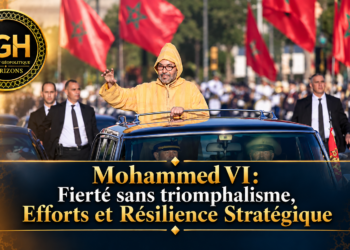
The analysis of Moroccan royal speeches on Africa from 2014 to 2025 reveals a coherent and evolving geopolitical construction. Starting from the founding speech in Abidjan (2014) to recent interventions in Marrakech and Nice (2025), this IGH study highlights an original geostrategic model: Morocco has developed an ambitious continental doctrine without ever explicitly claiming African leadership. This approach, which « ties the fate » of the Kingdom to that of the continent, revolves around structuring projects such as the African Atlantic Gas Pipeline, the Atlantic Initiative, and innovative financial mechanisms. The Moroccan approach, combining economic pragmatism and long-term vision, offers an alternative to traditional models of influence in Africa and establishes itself as a catalyst for continental transformation, challenging economic and financial architectures inherited from the post-colonial era.
Introduction
Over the span of a decade, Morocco has profoundly transformed its African policy, transitioning from a primarily bilateral and sectoral approach to a continental vision structured around transformative projects. This evolution takes place in a context of profound changes across the African continent and reconfiguration of global geopolitical balances. Morocco’s reintegration into the African Union in 2017, after a 33-year absence, marks a symbolic turning point in this renewed continental strategy.
The originality of the Moroccan approach lies in an apparent paradox: the Kingdom deploys an ambitious continental influence strategy while carefully avoiding claiming explicit leadership. This posture, which might seem contradictory at first glance, actually reveals a fine understanding of African political dynamics and a desire to avoid the pitfalls of hegemonic pretensions that have often aroused mistrust and resistance on the continent.
This analysis by the Geopolitical Horizons Institute (IGH) aims to examine the foundations, mechanisms, and implications of Morocco’s African geostrategy, drawing primarily on three major royal speeches: the Abidjan speech of February 2014, considered the foundation of what we will call the « Abidjan Doctrine, » the royal message to the Ibrahim Governance Weekend Forum in June 2025 in Marrakech, and the message to the « Africa for the Ocean » Summit in June 2025 in Nice. These three texts, spanning eleven years, offer a unique perspective on the evolution, coherence, and deepening of the Moroccan vision for Africa.
I. Conceptual Foundations: The Abidjan Doctrine and Its Evolution (2014-2025)
A. The Abidjan Speech (2014): Founding Act of a New African Vision
On February 24, 2014, during the Ivorian-Moroccan Economic Forum in Abidjan, King Mohammed VI delivered a speech that marked a fundamental break with the traditional paradigms of North-South and intra-African relations. This text, which constitutes the now established « Abidjan Doctrine, » lays the conceptual foundations for a new African geopolitical approach.
The revolutionary element of this speech lies in the following statement: « Africa must take charge of itself; it is no longer a colonized Continent. That is why Africa must trust Africa. It needs less assistance and requires more mutually beneficial partnerships. »1 This declaration explicitly breaks with the paternalistic rhetoric that has long characterized international relations in Africa to lay the foundations for authentic South-South cooperation based on reciprocity and mutual interest.
The Abidjan Doctrine is structured around several key principles:
- Primacy of South-South cooperation: The speech places intra-African partnerships at the heart of continental development.
- Economic pragmatism: « Cooperation, previously based on trust relationships and historical ties, is today increasingly founded on efficiency, performance, and credibility. »1
- Citizen-centered development: « There are projects which, although of lesser scope, are of particular importance. Because they directly affect citizens. »1
- Respect for sovereignty: « These challenges can only be met through cooperation, solidarity between African peoples, and respect for the sovereignty and territorial integrity of States. »1
B. Conceptual Evolution: Marrakech and Nice (2025)
Eleven years after the founding speech in Abidjan, two royal messages from June 2025 mark a significant evolution of the Moroccan doctrine. The message to the Ibrahim Governance Weekend Forum (Marrakech, June 1, 2025) and the one addressed to the « Africa for the Ocean » Summit (Nice, June 9, 2025) reveal a maturation and deepening of the initial vision.
The Marrakech message introduces a more precise conceptualization of Morocco’s role: « Morocco now asserts itself as a strategic catalyst for South-South partnerships and thus plays a natural bridge role between the different regions of the continent and the countries of the South. »2 The notion of « strategic catalyst » advantageously replaces that of « leader » or « regional power, » avoiding hegemonic connotations while affirming an active and transformative role.
The Nice message complements this vision by introducing the maritime and oceanic dimension: « If African seas and oceans are rich, they are also vulnerable. Strategic, but under-optimized. Promising, but still poorly protected. This paradox compels us to move from a logic of potentiality to a logic of appropriation. »3 This statement illustrates the transition from a primarily conceptual vision (2014) to a more operational and sectoral approach (2025).
C. Constants and Evolutions in the Royal Vision
Comparative analysis of the three speeches reveals both fundamental constants and significant evolutions in the Moroccan doctrine:
| Principles | Abidjan 2014 | Marrakech/Nice 2025 |
|---|---|---|
| South-South Partnerships | Founding principle, but still general | Structured around concrete projects (AAGP, Atlantic Initiative) |
| Financial Autonomy | Indirectly mentioned | Central and detailed: « Our continent is called upon to greater mobilization of its domestic resources »2 |
| Resource Valorization | Focus on agriculture and fisheries | Integrated vision: « The time has come for Africa to take full advantage of its enormous wealth »2 |
| Morocco’s Positioning | Privileged partner | « Strategic catalyst » and « natural bridge » |
This evolution reveals a remarkable conceptual maturation: where the Abidjan speech laid the philosophical foundations, the 2025 messages propose a complete operational architecture. We notably observe the transition from a primarily political vision to an approach fully integrating economic, financial, and environmental dimensions.
II. Instruments and Mechanisms of a Continental Influence Strategy
A. Structuring Projects as Geopolitical Vectors
Morocco’s African geostrategy revolves around major infrastructure projects that go far beyond the purely technical dimension to assert themselves as genuine vectors of geopolitical influence. These structuring projects constitute the concrete translation of the doctrinal vision and serve as anchoring points for Morocco’s continental strategy.
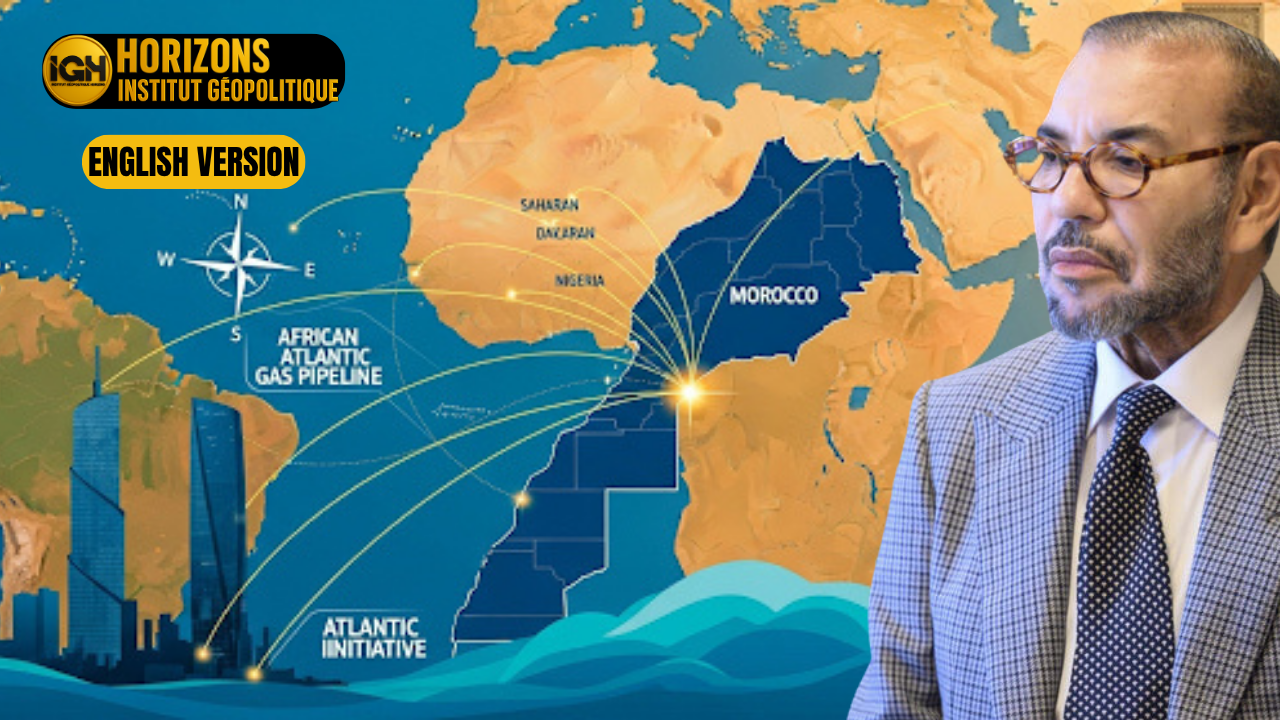
The African Atlantic Gas Pipeline (AAGP) perfectly embodies this approach. Presented as « a true corridor of integration and economic development »2, this pharaonic project connecting Nigeria to Morocco across West Africa represents much more than an energy infrastructure. It constitutes a structuring axis of the West African space and positions Morocco as a strategic node between Africa and Europe. The AAGP illustrates Morocco’s ability to conceptualize transcontinental projects that redesign Africa’s economic geography.
The Atlantic Initiative for Sahel States’ access to the Atlantic Ocean complements this architecture of influence. By proposing « to lay the foundations for a new model of regional cooperation »2, Morocco addresses a fundamental geopolitical issue: the landlocked situation of Sahelian countries. This initiative transforms a geographical constraint into an opportunity for regional integration and positions the Kingdom as a strategic facilitator for countries traditionally oriented toward other poles of influence.
The Process of African Atlantic States (also called the Rabat Process) completes this mechanism by institutionalizing cooperation among countries on the African Atlantic coast. This mechanism, presented as having « the vocation to make this facade a zone of strategic dialogue, collective security, mobility, and economic integration »3, establishes a formal framework for the exercise of Moroccan influence on this crucial geopolitical space.
These three major initiatives share common characteristics that reveal the coherence of the Moroccan strategy:
- They revolve around structuring geographical issues (Atlantic corridor, access to the sea)
- They combine economic and geopolitical dimensions
- They position Morocco as an indispensable articulation node
- They transcend linguistic divides and colonial heritages in Africa
B. Institutional and Financial Architecture
The Moroccan strategy is not limited to physical infrastructures but also integrates a sophisticated financial and institutional dimension. The royal message from Marrakech highlights two major instruments that constitute the pillars of this architecture:
The Mohammed VI Investment Fund is presented as « a true financial catalyst capable of stimulating private investment, supporting SMEs, promoting technological innovation, and driving a dynamic of sustainable development »2. Initially created as a post-Covid recovery tool, this fund has gradually expanded its scope to become an instrument of economic projection on a continental scale.
Casablanca Finance City (CFC) complements this mechanism by positioning itself as « a major regional financial hub, channeling considerable financial flows to our Continent »2. This financial center, which notably houses the Africa 50 fund of the African Development Bank, aspires to become the privileged entry point for investments in Africa, directly competing with established hubs like Dubai, London, or Paris.
These financial mechanisms are part of a broader vision aimed at transforming the African financial architecture. The Marrakech message explicitly advocates for « the reduction of high interest rates imposed on African countries in international financial markets, access to concessional financing at low interest rates, strengthening the capacities of regional financial institutions […], improving Africa’s representation, in all its diversity, within the international financial system »2.
C. Economic Diplomacy: From Multilateralism to Shared Value Creation
Morocco’s geostrategy integrates a sophisticated approach to economic diplomacy that goes beyond traditional frameworks. It revolves around several complementary axes:
Sectoral expertise as a vector of influence: « The expertise accumulated by Morocco in strategic sectors such as renewable energies, sustainable agriculture, financial services, and transport infrastructures constitutes a key factor for the development of synergies on a continental scale »2. This approach transforms national successes into levers of regional influence.
Continental economic integration as a strategic objective: « The economic integration of the continent is no longer an option, but an imperative necessity in a globalized world where Africa’s share in global trade does not exceed 3% »2. Morocco positions itself as a facilitator of this integration, particularly through the African Continental Free Trade Area (AfCFTA).
The transformation of natural resources into a vector of endogenous development: « The time has come for Africa to take full advantage of its enormous wealth, to create added values, to generate revenues intended to finance its development »2. This vision breaks with the traditional extractive model to promote integrated African industrialization.
This multidimensional approach constitutes a significant advancement beyond the classic models of North-South cooperation and even South-South cooperation. It illustrates Morocco’s ambition to redefine the paradigms of African development by offering an alternative to dominant frameworks.
III. The Moroccan Geopolitical Paradox: Influence Without Leadership Claims
A. Analysis of Discursive Positioning: The Explicit Absence of Hegemonic Pretension
One of the most remarkable aspects of Morocco’s African geostrategy lies in its discursive positioning. Linguistic and rhetorical analysis of the three royal speeches reveals a fundamental constant: the complete absence of explicit claims to continental or regional leadership. This characteristic radically distinguishes the Moroccan approach from the postures adopted by other African regional powers.
This rhetorical prudence manifests itself through several discursive strategies:
- Systematic use of inclusive formulations (continental « we » rather than Moroccan « we »)
- Mobilization of facilitation metaphors (« catalyst », « bridge ») rather than direction
- Constant evocation of « co-development » and « shared prosperity »
- Notable absence of any comparison with other regional powers
This discursive strategy is not fortuitous. It demonstrates a fine understanding of African political sensitivities and a desire to avoid the pitfalls that have often compromised the ambitions of other regional powers. By carefully avoiding any explicit hegemonic posture, Morocco circumvents the resistance that continental leadership claims usually arouse.
B. The Strategy of « Tying Its Fate » to the African Continent
IGH Note: This strategy of influence without leadership claims constitutes an innovative geopolitical model that we propose to qualify as « implicit leadership » or « catalytic power. » It deserves special attention from geopolitical analysts as it could prefigure new forms of regional influence in a multipolar world.
Beyond the absence of leadership claims, the Moroccan strategy is characterized by an approach that we will qualify as « tying its fate » to the African continent. This formulation, which might seem excessive at first glance, nevertheless translates a profound geostrategic reality: Morocco deliberately associates its future prosperity and security with those of the African continent as a whole.
This approach manifests itself through several concrete elements:
- The establishment of institutional mechanisms that create structural interdependencies (AAGP, economic corridors)
- The development of a geoeconomic vision that positions Morocco as an articulation point between Africa, Europe, and America
- The integration of Sahelian issues into Moroccan national security
- The constant affirmation that « The Kingdom of Morocco, faithful to its constructive vision of South-South cooperation and driven by its unwavering commitment to inclusive and sustainable growth, in the well-understood interest of African peoples »2
This strategy of « tying its fate » radically transforms the traditional perception of North-South relations in Africa. It substitutes for the logic of vertical and asymmetric influence an approach of horizontal integration where Morocco becomes a stakeholder in the continental destiny rather than a simple external actor pursuing narrow national interests.
C. Comparison with Other Models of Regional Influence
To fully grasp the originality of the Moroccan approach, it is instructive to compare it with the influence models deployed by other African regional powers:
| Characteristics | Moroccan Model | Traditional Models |
|---|---|---|
| Rhetoric | Inclusive, avoiding any leadership claims | Explicit affirmation of status (regional power, leadership) |
| Instruments | Structuring projects creating interdependencies | Institutional influence, diplomatic pressures, military interventions |
| Temporal Vision | Long-term, transformative | Short-medium term, reactive |
| Relationship to the Continent | Integration, linked destiny | Direction, sphere of influence |
This comparison highlights the singularity of the Moroccan approach. Where other African regional powers have often favored affirmative postures and classic instruments of influence, Morocco has had the intelligence to develop an innovative integrative geostrategy, open to all and without placing itself in a competitive approach that would lead to competition or rivalry. This alternative model based on integration and long-term structural transformation represents a major innovation in intra-African relations.
IV. Geopolitical Challenges and Perspectives
A. Structural Obstacles and Regional Competition
Despite its conceptual coherence and strategic originality, Morocco’s African geostrategy faces several potential structural obstacles:
The limits of national resources constitute a factor to consider. With a GDP of 144.4 billion dollars in 20234 (0.14% of the world economy) and a GDP per capita of 3,403 dollars, Morocco has financial resources that, considered in isolation, might seem limited for carrying continental-scale projects. However, the Moroccan geostrategy avoids this risk by positioning itself as a « facilitator » or « interested initiator » rather than as the sole financier, by opening integration to all powers that adhere to its vision.
⚠️ IGH Note: Morocco’s intelligent approach, which avoids a traditional hegemonic posture in favor of a catalyst position, allows it to deploy continental influence far greater than what its economic size might suggest. By creating multilateral mechanisms where other actors can invest, the Kingdom limits the risks of overextending its capacities while remaining the conceptual architect of the initiatives.
Regarding relations with other African powers, the Moroccan approach is particularly innovative. Rather than engaging in direct competition with other major regional actors such as South Africa, Nigeria, or Egypt, Morocco has developed an inclusive geostrategy that creates spaces for cooperation open to all. This non-competitive posture transforms potential rivals into partners and minimizes institutional resistance.
It should also be noted that the Abidjan Doctrine includes a military component, also inclusive and integrative, which IGH will address later in a restricted distribution publication. This security dimension completes Morocco’s geostrategic architecture by proposing defensive cooperation mechanisms that strengthen continental interdependencies.
B. Reactions of Established Powers
One of the major successes of the Moroccan strategy has been to « upstream lock » its African geostrategy by establishing strategic partnerships with various world powers. The latter have largely adhered to the Moroccan doctrinal vision and recognized the kingdom’s new positioning as a continental pivot state. These partnerships, like the African approach, are systematically based on a win-win logic.
The European Union perceives Morocco as a strategic bridge to Africa and a factor of regional stabilization. The advanced EU-Morocco partnership, regularly deepened, now explicitly integrates an African dimension, recognizing the interface role played by the Kingdom.
The United States has strengthened its strategic alliance with Morocco, notably through the historic recognition of Moroccan sovereignty over the Western Sahara5. This decision is part of a broader vision that identifies Morocco as a pivot of stability in a Sahelian region facing multiple security challenges.
China is progressively integrating Moroccan initiatives into its Belt and Road Strategy. Morocco’s geographical positioning and integrative vision offer obvious synergies with Chinese ambitions in Africa, as evidenced by growing investments in Moroccan port infrastructures.
This ability to obtain the adherence of the main world powers constitutes a major asset of the Moroccan geostrategy. It allows the Kingdom to mobilize considerable international resources in service of its continental vision, while limiting the risks of opposition or contestation.
C. Medium-term Evolution Scenarios
IGH identifies three main scenarios for the evolution of Morocco’s African strategy by 2030:
Scenario 1: Consolidation and Deepening
- Effective realization of structuring projects (AAGP, Atlantic Initiative)
- Strengthening of financial mechanisms (Mohammed VI Fund, CFC)
- Progressive institutionalization of cooperation frameworks
- Transformative impact on the African economic architecture
- Estimated probability: High (60%)
Scenario 2: Selective Adaptation
- Strategic prioritization of the most promising initiatives
- Development of targeted international partnerships
- Adaptation to continental geopolitical evolutions
- Maintenance of significant but more targeted influence
- Estimated probability: Medium (35%)
Scenario 3: Constrained Reconfiguration
- Significant slowdown of structuring projects
- Emergence of competing initiatives carried by other actors
- Deterioration of the international economic context
- Refocusing on sub-regional priorities
- Estimated probability: Low (5%)
IGH now considers scenario 1 as the most probable. Morocco’s ability to mobilize diverse international support, combined with the inclusive approach that avoids the risk of overextension, creates favorable conditions for the consolidation of its continental vision. Recent diplomatic developments concerning the Western Sahara issue also strengthen the Kingdom’s strategic position and its ability to project influence.
Among the factors that could limit this positive dynamic, IGH identifies certain internal challenges such as the progressive aging of the Moroccan population and the absence of powerful media groups capable of carrying the Moroccan narrative on a continental scale. These aspects, although secondary, deserve particular attention in the future deployment of the Kingdom’s African strategy.
Conclusion
Synthesis: The Originality of an Innovative Geopolitical Approach
Morocco’s African geostrategy, as it unfolds from the Abidjan Doctrine (2014) to the Atlantic Initiative (2025), constitutes an original geopolitical model that deserves the attention of international analysts. Its originality lies in the combination of several distinctive characteristics:
- A continental ambition without explicit leadership claims
- An integrative approach that « ties the fate » of the Kingdom to the African continent
- A long-term transformative vision rather than a reactive one
- Economic pragmatism coupled with political vision
- A coherent articulation between structuring projects and innovative financial mechanisms
This approach radically differs from traditional models of influence in Africa, whether carried by external powers or continental actors. It offers an alternative to both post-colonial frameworks and regional hegemonic ambitions that have often aroused mistrust and resistance.
Implications for African Geopolitical Reconfiguration
The Moroccan strategy significantly contributes to the geopolitical reconfiguration of the African continent in several areas:
Transformation of intra-African relations: By favoring integration and interdependence rather than domination, the Moroccan model inspires new forms of regional cooperation transcending traditional divides.
Reform of the financial architecture: Moroccan proposals for greater African financial autonomy and better representation of the continent in international bodies accelerate the evolution of a global financial system still largely dominated by Western powers.
Redefinition of North-South relations: By developing ambitious South-South cooperation and asserting itself as a « bridge » between Africa and the rest of the world, Morocco contributes to the emergence of a new paradigm of international relations in Africa.
Strategic Recommendations
💡 IGH Recommendations:
For Morocco:
- Strengthen strategic communication mechanisms to promote the Moroccan vision on a continental scale
- Deepen the institutionalization of Atlantic initiatives to ensure their sustainability
- Further develop the cultural and societal dimensions of cooperation to complement the economic and political architecture
- Maintain the subtle balance between continental ambition and absence of hegemonic claims
For African partners:
- Seize the integration opportunities offered by Moroccan initiatives
- Actively contribute to the definition and governance of structuring projects
- Explore potential synergies between national projects and the Moroccan continental vision
For international actors:
- Support structuring initiatives with adapted financing mechanisms
- Recognize the legitimacy and added value of the Moroccan approach
- Support proposals for reform of the international financial architecture carried by Morocco
The success of Morocco’s African strategy will depend on its ability to transform concepts and projects into concrete achievements directly benefiting populations. The emphasis placed on « projects directly affecting citizens » in the Abidjan speech must remain an operational compass to ensure that this ambitious vision produces tangible effects on human development at the continental scale.
Ultimately, the Abidjan Doctrine and its evolution towards an integrating continental paradigm represent a major innovation in contemporary African geopolitics. This approach, which combines strategic vision and operational pragmatism, could prefigure new models of regional influence adapted to the realities of a rapidly transforming multipolar world.
Footnotes
- Full text of HM the King’s speech at the Moroccan-Ivorian Economic Forum in Abidjan, February 24, 2014.
- Message from HM King Mohammed VI to participants at the 2025 edition of the « Ibrahim Governance Weekend » Forum, Marrakech, June 1, 2025.
- Message from HM King Mohammed VI to participants at the « Africa for the Ocean » Summit, Nice, June 9, 2025.
- Economic data, Morocco’s GDP 2023, World Bank and IMF.
- American proclamation recognizing Moroccan sovereignty over the Western Sahara, December 2020, confirmed by the current administration.
IGH Methodological Note
This analysis is primarily based on the comparative study of the three royal speeches mentioned, supplemented by economic and strategic data from open sources. Prospective evaluations (scenarios, probabilities) result from a geopolitical analysis methodology combining a systemic approach and trend analysis. The conceptual qualifications (« Abidjan Doctrine », « strategy of tying its fate », « catalytic power ») are analytical constructions by IGH aimed at synthesizing complex geopolitical phenomena.
© 2025 Geopolitical Horizons Institute (IGH) – Do not reproduce without authorization