By Abdelhakim Yamani,
Horizons Geopolitical Institute
May 3, 2025
English Version
A Crisis With Stakes Beyond the Media Framework
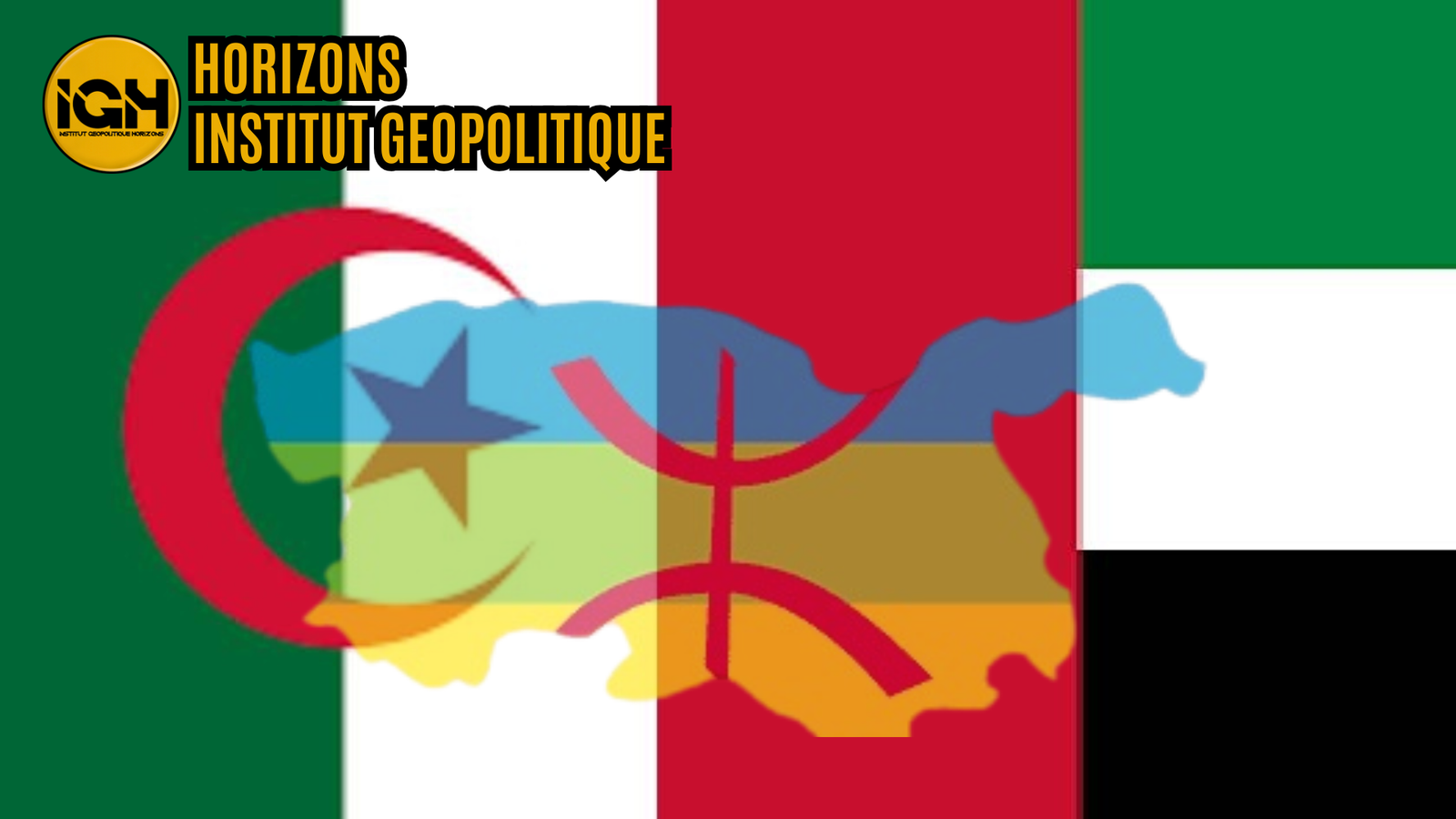
The violent media offensive by Algerian television against the United Arab Emirates on May 2, 2025, was surprising in its exceptional virulence. While the controversial interview of Algerian historian Mohamed Lamine Belghit on Sky News Arabia was presented as the official trigger, our investigations reveal an entirely different dimension to this diplomatic crisis.
Exclusive Revelation: Contacts Between MAK and the Emirates
According to exclusive information gathered by the Horizons Geopolitical Institute, the real catalyst for this crisis appears to be the discovery by Algerian intelligence services of contacts established between circles close to Mohammed Bin Zayed (MBZ) and the Movement for Kabyle Self-Determination (MAK).
According to our sources, Algerian authorities strongly suspect the existence of a communication channel between influential Emirati figures and the Kabyle independence movement, which Algeria classified as a terrorist organization in 2021.
Algerian Intelligence Services on High Alert
Our investigations reveal that for several months, Algerian foreign intelligence services have been actively attempting to infiltrate MAK’s leadership circles to monitor their international contacts. According to a source close to Algerian services, « The Algerian DGDSE has recently strengthened surveillance of MAK’s international activities, following initial suspicions of contacts with foreign powers. »
This significant mobilization of intelligence resources demonstrates the importance Algiers places on this perceived threat. According to our Kabyle sources, « Algerian foreign intelligence services are vainly attempting to collect intelligence through infiltrations of MAK’s leadership and more specifically the entourage of our leaders responsible for relations with Gulf countries. »
These infiltration attempts reportedly intensified in recent months, particularly after an initial confidential report reached the Algerian presidency in early 2025, mentioning « concerning indications of contacts between unofficial MAK representatives and Emirati personalities. »
Detailed History of the MAK-Emirates Rapprochement
Our various interviews over the past 24 hours allow us to reconstruct the precise chronology of this rapprochement between the Kabyle independence movement and the United Arab Emirates:
Initial Approaches (mid-2023)
Initial contacts were reportedly established via British intermediaries, particularly parliamentarians known for their sympathy toward the Kabyle cause. These first exploratory discussions aimed to establish discreet communication channels.
The New York Meeting (March 2024)
The real turning point occurred in March 2024, during a meeting organized on the sidelines of a conference on minority rights in New York. This meeting, held in a Manhattan hotel, reportedly brought together two MAK representatives, three Emirati personalities (including a diplomat posted in Washington), as well as Saudi and Bahraini emissaries. According to our source within the independence movement, « this meeting established a roadmap for discreet but ongoing cooperation. »
Regular Meetings in London (June-December 2024)
Following the New York meeting, more regular contacts were established, mainly in London, considered a neutral platform. A MAK personality confided to us that « the Kabyle-Emirati rapprochement dialogue was facilitated by several British elected officials favorable to the Kabyle cause. » London reportedly became the hub for these exchanges, with at least four documented meetings between June and December 2024.
Potential Financial and Logistical Support (early 2025)
According to our sources, these discussions gradually evolved toward the mention of potential Emirati support for MAK. While we could not independently confirm the existence of concrete financial support, several concordant sources mention « promises of logistical support » and « commitments to relay Kabyle concerns in international forums. »
Confirmation by MAK Leaders
MAK leaders, contacted directly by our institute, have attested to the existence of « advanced contacts with certain Arab country, » specifically the UAE according to other consulted sources. A personality from the independence movement, speaking anonymously, described the evolution of these relations: « At first, it was simply an exchange of viewpoints. Gradually, our Emirati interlocutors showed increasing interest in our cause, seeing parallels with other self-determination movements they support in the region. »
According to this same source, discussions recently took on a more concrete dimension: « During our last meeting in March 2025, the Emirati emissaries were particularly receptive to our arguments concerning the Kabyles’ right to self-determination. They expressed their willingness to explore ways to support our cause on the international stage. »
The Reaction of Algerian Services
Faced with these developments, Algerian intelligence services reportedly implemented a multi-level strategy:
1. Intensified surveillance of MAK personalities, both in Algeria and abroad
2. Mobilization of the Algerian diplomatic network to observe the activities of Emirati representatives
3. Media influence operation aimed at discrediting MAK and its international supporters
4. Strengthened security measures in the Kabyle regions of Algeria
A confidential report was reportedly transmitted to the Algerian presidency (probably) in late April 2025, establishing a direct link between certain Emirati personalities close to power and MAK leaders. This report was likely the trigger for Algiers’ virulent reaction against Abu Dhabi.
The Contradictions of Algerian Policy on Self-Determination
This crisis highlights one of the fundamental contradictions in Algerian foreign policy. While Algeria presents itself as a champion of defending peoples’ right to self-determination by actively supporting separatist movements in Southern and Northern Morocco, it has always categorically refused to apply this same principle to the Kabyle people.
This variable-geometry position illustrates the contradictions in Algerian diplomatic doctrine, which uses the right to self-determination as a selective geopolitical instrument rather than a universal principle. By supporting the Polisario Front in Western Sahara and historically promoting the Palestinian question, while firmly repressing Kabyle autonomist aspirations, Algiers demonstrates a differentiated application of the principles it defends on the international stage.
This contradiction has not escaped MAK leaders, who regularly denounce what they consider a « double standard » in Algeria’s approach to peoples’ rights. According to our sources, these arguments are among the most convincing to their Emirati interlocutors, who are sensitive to this apparent hypocrisy in Algeria’s position.
An Absolute Red Line for Algiers
To understand Algiers’ disproportionate reaction, one must grasp the crucial importance of territorial integrity in Algerian security doctrine. Since independence, national unity has been a fundamental pillar of power legitimacy. Kabylia, a Berber-speaking region in northern Algeria, is considered an integral and non-negotiable part of the national territory.
The MAK, founded in 2001 by Ferhat Mehenni, advocates for Kabylia’s self-determination. Its classification as a terrorist organization in 2021 illustrates the extreme sensitivity of the Algerian authorities on this issue. Any foreign support, real or perceived, for this movement is interpreted as a direct attack on Algerian national sovereignty.
The Historical Context of Algerian-Emirati Tensions
This crisis is part of a progressive deterioration in relations between the two countries, marked by several major friction points:
Divergences on Libya (2020-2022)
Algeria supported the UN-recognized Government of National Unity, while the UAE militarily and financially backed Marshal Haftar. In 2023, the UAE reportedly actively blocked the appointment of former Algerian minister Sabri Boukadoum as UN special envoy to Libya.
Normalization with Israel (2020)
The UAE’s signing of the Abraham Accords was perceived by Algiers as a betrayal of the Palestinian cause, a historical position of Algeria on the international stage.
Suspicions of Interference in the Sahel (2023-2024)
Algeria accused Abu Dhabi of financing armed groups in Mali and contributing to regional instability, particularly through its alleged support for the Wagner group, constituting a direct threat to its national security.
The Tebboune Statements Crisis (April 2024)
Without explicitly naming the UAE, the Algerian president denounced a « small country » financing destabilization operations in the region, provoking an Emirati diplomatic reaction.
The Kabyle Equation: A Multiplier of Tensions
In this already tense context, Algerian suspicions of contacts between Abu Dhabi and MAK act as a multiplier, transforming a geopolitical rivalry into an acute diplomatic crisis. For Algiers, these presumed contacts fit into a broader pattern of regional destabilization orchestrated by the UAE, perceived as seeking to weaken Algerian influence in its immediate environment.
This « Kabyle equation » is all the more explosive as it echoes similar accusations made against Morocco, which led to the rupture of diplomatic relations between Algiers and Rabat in 2021. Algeria had then accused the Moroccan kingdom of supporting MAK, crossing a fundamental red line.
Perspectives and Possible Scenarios
In the short term, several scenarios are emerging:
A Controlled Escalation
Algeria could maintain media pressure while avoiding a complete rupture of diplomatic relations, seeking to obtain discreet guarantees from Abu Dhabi regarding its contacts with MAK.
A Diplomatic Rupture
If new evidence were to confirm substantial UAE support for MAK, Algeria could take the step of breaking diplomatic relations, following the model of its break with Morocco in 2021.
Conclusion
The « Kabyle equation » now constitutes an essential variable in the complex relationship between Algeria and the United Arab Emirates. Beyond disagreements on Libya, Moroccan Sahara, or normalization with Israel, it is the existential question of Algerian territorial integrity that is now at stake.
This new dimension of the diplomatic conflict illustrates the increasing complexity of alliance games in the region, where Gulf powers seek to extend their influence by cultivating relationships with various political actors, including opposition movements. For Algiers, these developments constitute a direct threat to its national sovereignty and regional influence.
In the grand chessboard of the Middle East and North Africa, the Kabyle question thus becomes a strategic piece whose importance far exceeds the framework of a simple bilateral dispute between Algiers and Abu Dhabi. It is part of a deeper reconfiguration of regional balances at work since the Arab Spring of 2011.