I. Genesis and Evolution of a Doctrine: From Abidjan 2014 to Marrakech 2025
The Doctrinal Foundation of Abidjan (February 2014)
The speech delivered by King Mohammed VI at the Moroccan-Ivorian Economic Forum on February 24, 2014, in Abidjan constitutes the birth certificate of what the Horizons Geopolitical Institute (IGH) has termed the « Abidjan Doctrine »1. This foundational text establishes the conceptual pillars of the Moroccan approach according to IGH’s analysis:
This apparently simple formulation actually revolutionizes African diplomatic rhetoric by breaking with Western paternalism and laying the foundations for authentic South-South cooperation, according to IGH’s comparative analysis.
The Six Pillars of the « Abidjan Doctrine » According to IGH: A Coherent Geopolitical Architecture (2014-2025)
Abidjan 2014: « Africa must trust Africa. It needs less assistance and requires more mutually beneficial partnerships. »
Marrakech 2025: « Morocco now asserts itself as a strategic catalyst for South-South partnerships and plays the role of a natural bridge between different regions of the continent. »
Abidjan 2014: « Cooperation, once based on trust and historical ties, is today increasingly founded on efficiency, performance, and credibility. »
Marrakech 2025: Four concrete guidelines for African development financing replace theoretical discourse.
Abidjan 2014: « There are projects that, although smaller in scale, are particularly important because they directly affect citizens. »
Marrakech 2025: « Our continent is called upon to mobilize its domestic resources more » and « Africa cannot rely solely on Official Development Assistance. »
Abidjan 2014: « These challenges can only be met through cooperation, solidarity among African peoples, and respect for the sovereignty and territorial integrity of states. »
Marrakech 2025: Call for « improving Africa’s representation in all its diversity within the international financial system. »
Abidjan 2014: « The sustainable development of the African continent requires the creativity and dynamism of the private sector to focus on promising areas. »
Marrakech 2025: « The time has come for Africa to fully capitalize on its enormous wealth, create added value, and generate revenues to finance its development. »
Abidjan 2014: Still embryonic concept, focus on « triangular cooperation as an innovative tool. »
Marrakech 2025: Complete architecture: Mohammed VI Fund, Casablanca Finance City, « innovative development financing mechanisms. »
• Temporal continuity: 11 years of consistency in fundamental orientations
• Logical progression: From philosophy (2014) to instruments (2025)
• Concrete implementation: Return to AU (2017), creation of FM6I (2020), infrastructure projects
• International recognition: Evolving partner support, installation of Africa 50 fund in Casablanca
The Marrakech Expansion (June 2025)
The royal message of June 1, 2025, at the Ibrahim Governance Weekend operates a qualitative transformation of the initial doctrine2. Where Abidjan 2014 laid the political and philosophical foundations, Marrakech 2025 unveils the economic and financial architecture. IGH observes this evolution as remarkable strategic maturation.
II. The Geopolitical Audacity of a Relative Power
The Paradox of Morocco’s Position
IGH identifies Morocco as a unique geopolitical case study: with a GDP of $144.4 billion in 20233 (0.14% of the global economy) and a GDP per capita of $3,403, it openly challenges the international financial order dominated by powers with budgets equivalent to its entire economy.
This situation raises a fundamental question that IGH poses: how can a country ranked among Africa’s major economies4 legitimately claim to redefine the continental financial architecture? Analysis of economic data reveals this audacity:
- Relative economic size: Morocco weighs less than certain multinationals according to available data
- African position: Behind South Africa, Egypt, Algeria, and Nigeria according to IMF data5
- Modest growth: 3.4% in 2023, forecast of 2.9% in 20246, far from continental leaders
Foundations of This Strategic Audacity According to IGH
This apparent disproportion actually conceals a sophisticated strategy that IGH identifies as relying on several distinctive assets:
Morocco exploits its situation as a « natural bridge » between Europe, Africa, and South America. This position grants it geopolitical added value that transcends its economic size according to IGH’s analysis.
The kingdom benefits from political stability and multi-secular diplomatic experience that make it a credible interlocutor despite its relative economic limitations.
In the absence of a credible African alternative, IGH observes that Morocco occupies a geopolitical void that traditional powers have neglected.
III. Financial Architecture: From Concrete Instruments to Continental Ambition
The Mohammed VI Fund: Catalyst for New African Finance
The 2025 speech reveals the maturity of Moroccan financial instruments, particularly the Mohammed VI Investment Fund, created in 20207.
Casablanca Finance City: Continental Hub Under Construction
The Moroccan strategy relies on Casablanca Finance City (CFC), which hosts the AfDB’s Africa 50 fund8 and attracts major international financial actors. IGH estimates that CFC generates a network effect that far exceeds the size of the Moroccan economy.
The Four Pillars of the Marrakech Paradigm According to IGH
The 2025 royal speech structures its vision around four axes that IGH qualifies as revolutionary:
Reducing dependence on official development assistance and mobilizing domestic resources.
Improving governance and business climate as prerequisites for development.
Boosting intra-African trade through the African Continental Free Trade Area.
Local transformation of raw materials and creation of regional value chains.
IV. Challenges and Limitations of the Moroccan Approach
Structural Constraints Identified by IGH
Moroccan ambition faces several major obstacles that IGH identifies as questioning the viability of this strategy:
- Resource limitations: A national budget facing continental needs estimated by international institutions at hundreds of billions
- Regional competition: South Africa, Egypt, and Nigeria have superior means
- International skepticism: Bretton Woods institutions remain circumspect about non-Western alternatives
Geopolitical Risks
The multiplication of initiatives (Atlantic Initiative, Rabat Process, Atlantic African Gas Pipeline) may exceed the kingdom’s real capacities and create impossible expectations to satisfy according to IGH’s analysis.
V. Geopolitical Impact and Future Implications
Disruption of the Established Order
The Moroccan approach constitutes, according to IGH, a subtle but real challenge to Western hegemony in Africa. By proposing concrete alternatives to traditional mechanisms, Morocco opens a breach in the monopoly of Bretton Woods institutions.
Reaction of Established Powers
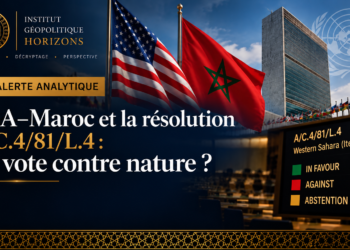
Traditional powers observe this Moroccan rise with attention. Recent developments in international positions on the Western Sahara question9 can be interpreted as an attempt to channel this ambition rather than suffer it.
For Morocco: IGH recommends prioritizing institutional consolidation before geographical expansion; developing strategic partnerships with other African middle powers.
For African partners: Objectively evaluate Moroccan proposals without yielding to enthusiasm or a priori skepticism.
For Western powers: Understand that the emergence of African alternatives is inevitable and adapt their strategy accordingly.
Strategic Conclusion
From the Abidjan Doctrine to the Marrakech Paradigm, Morocco has undergone a remarkable transformation of its African economic diplomacy. In eleven years, the kingdom has moved from generalist political discourse to a concrete institutional and financial proposition.
The credibility test of this doctrine lies in its capacity to produce tangible results beyond rhetoric. If Morocco succeeds in demonstrating the effectiveness of its alternative financial mechanisms, it could create an inspiring precedent for other middle powers and accelerate the recomposition of the global geoeconomic architecture, according to IGH projections.
Footnotes
1 Full text of HM the King’s speech at the Moroccan-Ivorian Economic Forum in Abidjan, February 24, 2014, reproduced in this document.
2 Message from HM King Mohammed VI to participants in the 2025 edition of the « Ibrahim Governance Weekend » Forum, Marrakech, June 1, 2025, read by Mr. André Azoulay, Advisor to His Majesty, reproduced in this document.
3 Economic data, Morocco’s GDP 2023, World Bank and IMF, convergent sources consulted via web research.
4 African economic rankings based on available public data and comparative institutional analyses.
5 International Monetary Fund, « World Economic Outlook April 2024, » data consulted via web research, June 2025.
6 World Bank, « Morocco Economic Monitor Summer 2024: Morocco’s economy proves resilient but private sector faces challenges, » July 2024, consulted via web research.
7 Official information on the creation of the Mohammed VI Investment Fund, 2020, and public statements by its Director General Mohamed Benchaâboun.
8 Ministry of Economy and Finance of the Kingdom of Morocco, « Casablanca Finance City hosts the Africa 50 infrastructure investment fund in Africa, » information confirmed by web research.
9 International diplomatic developments reported in specialized press and public official sources, 2024-2025.