A methodological validation exercise of a geopolitical analytical framework
By the Analysis Team – Geopolitical Institute Horizons
Executive Summary
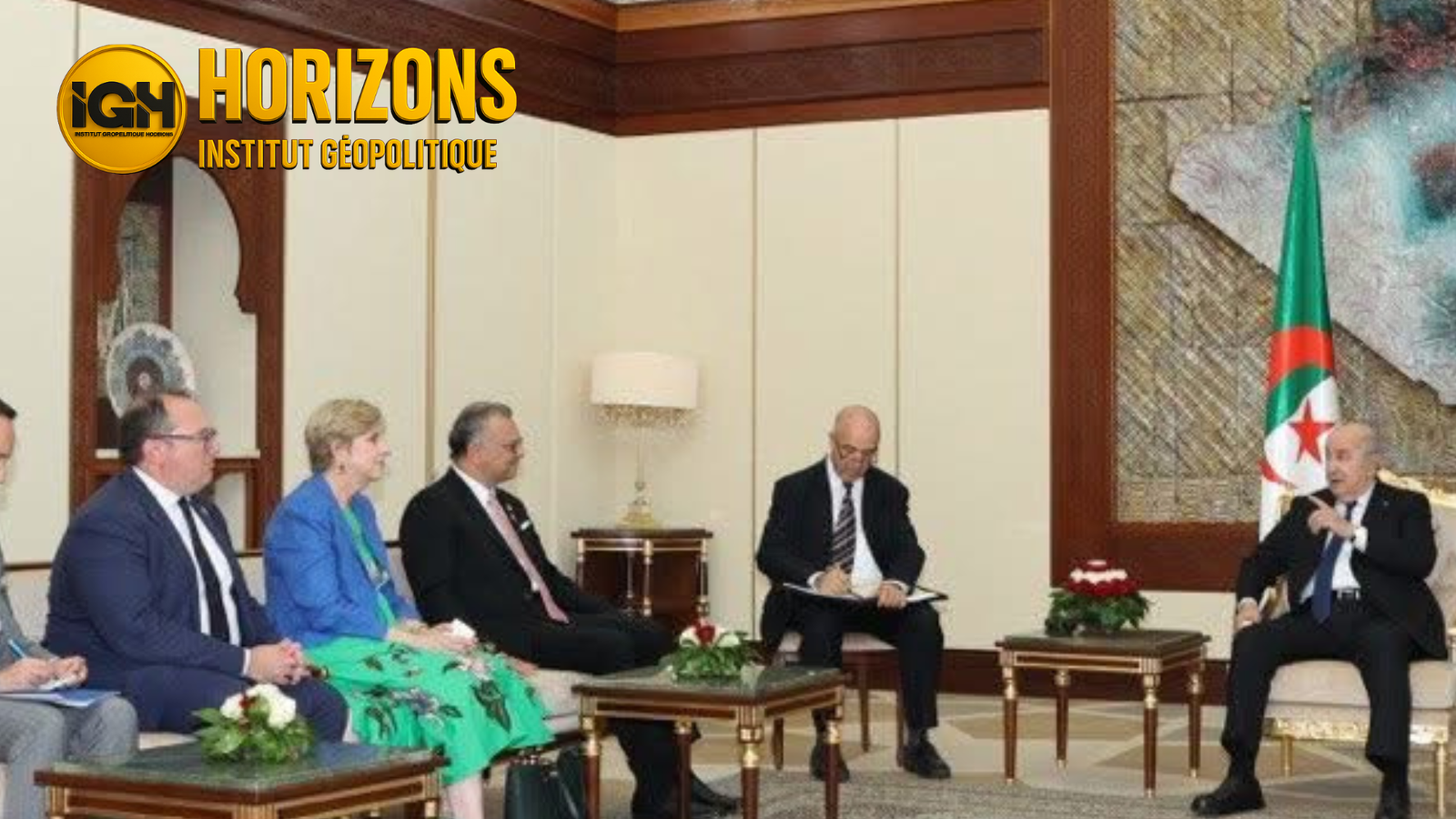
Massad Boulos’s visit to Algeria (July 27, 2025) provides an opportunity for a pedagogical exercise comparing our analytical anticipations from July 2025 with observed factual elements. This approach, without claiming infallibility, allows us to assess the relevance of certain hypotheses while revealing the inherent limitations of prospective analysis. The analysis highlights the mechanisms of translation between geopolitical logics and diplomatic formulations, while underscoring the persistence of major uncertainties regarding actors’ true intentions.
Introduction: Objectives and Limitations of the Exercise
Massad Boulos’s visit to Algiers on July 27, 2025 constitutes an interesting case study for evaluating the robustness of our analytical framework developed in publication IGH-NS-Maghreb-20250704. This confrontation between anticipations and observed reality does not aim to claim any prescience, but rather to understand the mechanisms by which certain geopolitical trends translate – or fail to translate – into diplomatic practice.
💡 Methodological Clarification
What this analysis can provide: Better understanding of diplomatic mechanisms and underlying geopolitical logics.
What it cannot claim: To prove the absolute validity of our hypotheses or predict future developments with certainty. The exercise remains one of critical and nuanced evaluation.
Contextual Elements: Joshua Harris’s Unpublicized Presence
One factual element deserves attention: Joshua Harris’s presence during the meetings in Algiers, information not mentioned in official communiqués but confirmed by our sources. Harris, architect of the initial 2023 mission under the Biden administration, embodies a form of continuity in the American approach to the Maghreb.
This continuity suggests that certain American strategic orientations transcend political alternations, although it would be premature to see confirmation of an immutable strategy. Administrations can maintain certain dossiers while modifying approaches or priorities.
⚠️ Interpretive Note
Harris’s absence from official communications may stem from different logics: desire for discretion, avoidance of domestic political controversies, or simple diplomatic protocol. Several interpretations remain plausible.
Confrontation Exercise: Anticipations and Observed Formulations
Our July analysis had identified several possible axes of American mediation. Let us examine to what extent these hypotheses do or do not find echo in the observed diplomatic formulations:
| Analytical Hypothesis (IGH – July 2025) | Observed Diplomatic Formulation (27/07/2025) | Degree of Correspondence |
|---|---|---|
| « Urgent economic reform » – Dismantling of the rentier economy | « Consolidation of fair trade », « energy transition », « facilitation of bilateral investments » | High |
| « Clear cooperation on terrorism » – Security subordination | « Strengthening security partnership », « intelligence sharing », « defeat of terrorism » | High |
| « Recognition of Western Sahara’s Moroccan sovereignty » | « Exchange of views on the American position of 2020 », « possible evolutions of this position » | Partial |
| « Normalize with Morocco » – Bilateral reconciliation | « Coordination on continental dossiers », « structure long-term partnership » | Partial |
| « Distance from Russia » – Geopolitical realignment | « Diversify partnerships », « play a key regional role » [defensive Algerian formulation] | Low |
💡 Methodological Reading
The high degree of correspondence on economic and security dimensions suggests that these axes effectively constitute priorities in the American approach. The partial correspondence on geopolitical questions reveals the complexity of the dossier and expected resistances. The low correspondence on geopolitical realignment confirms the existence of structural « red lines » on the Algerian side.
1. Economic Dimension
Our hypothesis: Pressure for liberalization of the Algerian economy and distancing from the rentier model.
Observed formulations: « Consolidation of fair trade », « energy transition », « facilitation of bilateral investments ».
Assessment: The diplomatic terms effectively suggest interest in evolution of the Algerian economic model, without revealing the degree of pressure exerted or concrete modalities envisaged.
2. Security Cooperation
Our hypothesis: Seeking enhanced security integration, particularly in counter-terrorism.
Observed formulations: « Strengthening security partnership », « intelligence sharing », « defeat of terrorism ».
Assessment: The vocabulary used corresponds to our anticipations, but the real scope of American demands remains difficult to evaluate based solely on public communiqués.
3. Western Sahara Question
Our hypothesis: Pressure for evolution of the Algerian position toward recognition of Moroccan sovereignty.
Observed formulations: « Exchange of views on the American position of 2020 », « possible evolutions of this position ».
Assessment: The formulation is more ambiguous than our anticipations. The expression « possible evolutions » could suggest either pressure on Algeria, or conversely a possible revision of the American position.
💡 Methodological Lesson
This exercise illustrates the difficulty of interpreting diplomatic language. The same formulation can mask very different intentions. Interpretive caution is required, especially since real stakes are often negotiated outside public communications.
Diplomatic Silences: What Do the Unspoken Elements Reveal?
Analysis of omissions in official communiqués can be as instructive as that of explicit mentions. Several subjects evoked in our July analysis appear in no official document:
• No mention of Israel or normalization with the Hebrew state
• Silence on the Polisario and its place in the regional equation
• Absence of reference to Tindouf camps and their future
These silences can be interpreted in several ways: either these subjects are considered too sensitive to be addressed publicly, or they are not part of the immediate priorities of this mediation phase, or they have been set aside due to Algerian opposition.
⚠️ Interpretive Caution
The absence of a subject in public communications does not necessarily mean it was not discussed privately. Conversely, its presence in our analysis does not guarantee that it actually constitutes an American priority. Diplomacy often functions by stages and subjects of increasing complexity.
Algerian Reaction Signals
Algerian declarations, while formulated in consensual diplomatic language, reveal certain guidelines of the official position:
The mention of the « will to diversify partnerships » can be read as a reaffirmation of the principle of non-alignment, faced with possible American pressure for exclusive rapprochement. Similarly, insistence on Algeria’s « key regional role » suggests a desire to preserve a margin of geopolitical autonomy.
These elements could indicate a form of diplomatic resistance to the most constraining aspects of a possible American roadmap, without constituting frontal rejection of dialogue.
Critical Assessment of the Exercise
This confrontation between anticipations and observations reveals both the possibilities and limitations of prospective analysis in geopolitics:
Elements of Convergence
Certain thematic axes (economy, security, regional questions) effectively correspond to domains highlighted in official communications. This convergence suggests that our analytical framework identified real geopolitical trends, even if their concrete translation remains to be specified.
Zones of Uncertainty
Other aspects of our analysis (normalization with Israel, Polisario questions) find no direct echo in public communications. This does not necessarily invalidate these hypotheses, but reminds us that geopolitical analysis cannot claim to grasp the entirety of dynamics at work.
Structural Limitations
The exercise reveals difficulties inherent in interpreting diplomatic language. Consensual formulations can mask profound disagreements as well as real convergences. Only future developments will clarify the true intentions of the actors.
💡 Methodological Teaching
This confrontation illustrates the importance of distinguishing between structural trends (generally more predictable) and tactical modalities (more volatile and dependent on immediate power relations). Geopolitical analysis excels more in identifying the former than in predicting the latter.
Evolution Perspectives
Beyond this specific visit, several evolution scenarios remain plausible for American mediation in the Maghreb:
Continued dialogue: Parties maintain diplomatic contacts while preserving their fundamental positions, in a logic of mutual exploration of room for maneuver.
Sectoral agreements: Progress could be recorded on certain specific dossiers (economic, security cooperation) without overall geopolitical transformation.
Progressive stagnation: The absence of substantial concessions from both sides could lead to process exhaustion, without formal rupture but without significant advances.
Conclusion
This confrontation between prospective analysis and observed reality constitutes a useful pedagogical exercise for understanding both the possibilities and limitations of geopolitical anticipation. While some of our analytical axes find echoes in recent developments, others remain in the realm of hypothesis.
The exercise above all reminds us of the importance of maintaining a critical and nuanced approach in analyzing international dynamics. Geopolitical evolutions result from complex interaction between strategic intentions, structural constraints, and conjunctural opportunities. Their anticipation can only be approximate and must always leave room for uncertainty and revision.
The Geopolitical Institute Horizons will continue to follow developments in this dossier, seeking less to confirm its initial hypotheses than to understand the real mechanisms at work in this attempt to reconfigure Maghrebi equilibria.
Recommendations
For observers: Maintain sustained attention to future developments, avoiding hasty conclusions based on a single diplomatic sequence. Monitor particularly the next stages of the Boulos tour.
For analysts: Use this example to refine methodologies for confronting hypotheses with observations. The exercise can be applied to other case studies to improve the quality of prospective analysis.
For decision-makers: Keep in mind that diplomatic processes of this magnitude generally unfold over time. Avoid expectations of immediate results while remaining attentive to signals of evolution.
IGH Methodological Note
This analysis confronts our hypotheses developed in July 2025 with factual elements from the Boulos visit. The exercise aims to evaluate the relevance of our analytical framework without claiming exhaustiveness or infallibility. Sources used include official communiqués, public declarations, and information gathered by our regional correspondent networks.
© 2025 Geopolitical Institute Horizons (IGH)