Boulkassoum Oumarou Cissé
PhD Candidate in International Relations
Researcher at the Geopolitical Institute Horizons Niamey
April 26, 2025
A Silent Humanitarian Crisis
On the invisible line of desert separating Algeria from Niger, a human tragedy repeats itself relentlessly. Under a crushing sun, sub-Saharan Africans are pushed back without resources, sometimes injured, sometimes traumatized, always abandoned. What is unfolding in these desert expanses is nothing less than a deliberate humanitarian catastrophe, orchestrated by a state and its security forces.
For several years, damning reports have denounced these practices. But in recent weeks, the phenomenon has taken on an even more dramatic dimension. Algeria, faced with multiple diplomatic tensions, is multiplying mass expulsions of sub-Saharan migrants, in total disregard of international humanitarian law.
The recent statement by Algerian President Tebboune, on April 23, 2025, in Bechar, leaves no doubt about the political intentionality of these expulsions: « I am ready to expel thousands per day, yes, thousands… With Niger we had agreements; they withdrew from them, they must face the consequences. » These words transform a humanitarian tragedy into an explicit admission of political instrumentalization of human lives.
The NGO Alarme Phone Sahara meticulously documents this catastrophe: more than 31,000 migrants expelled to Niger by Algeria in 2024, already more than 7,000 since the beginning of 2025. Figures that exceed all records and reveal a deliberate policy of mass expulsion.
« Point Zero »: The Antechamber of Hell
What humanitarian reports soberly designate as « Point Zero » has become the epicenter of unspeakable suffering. Located in the middle of the desert, approximately 15 kilometers from Assamaka, the first Nigerien locality, this place has become the theater of forced abandonments, in conditions that defy imagination.
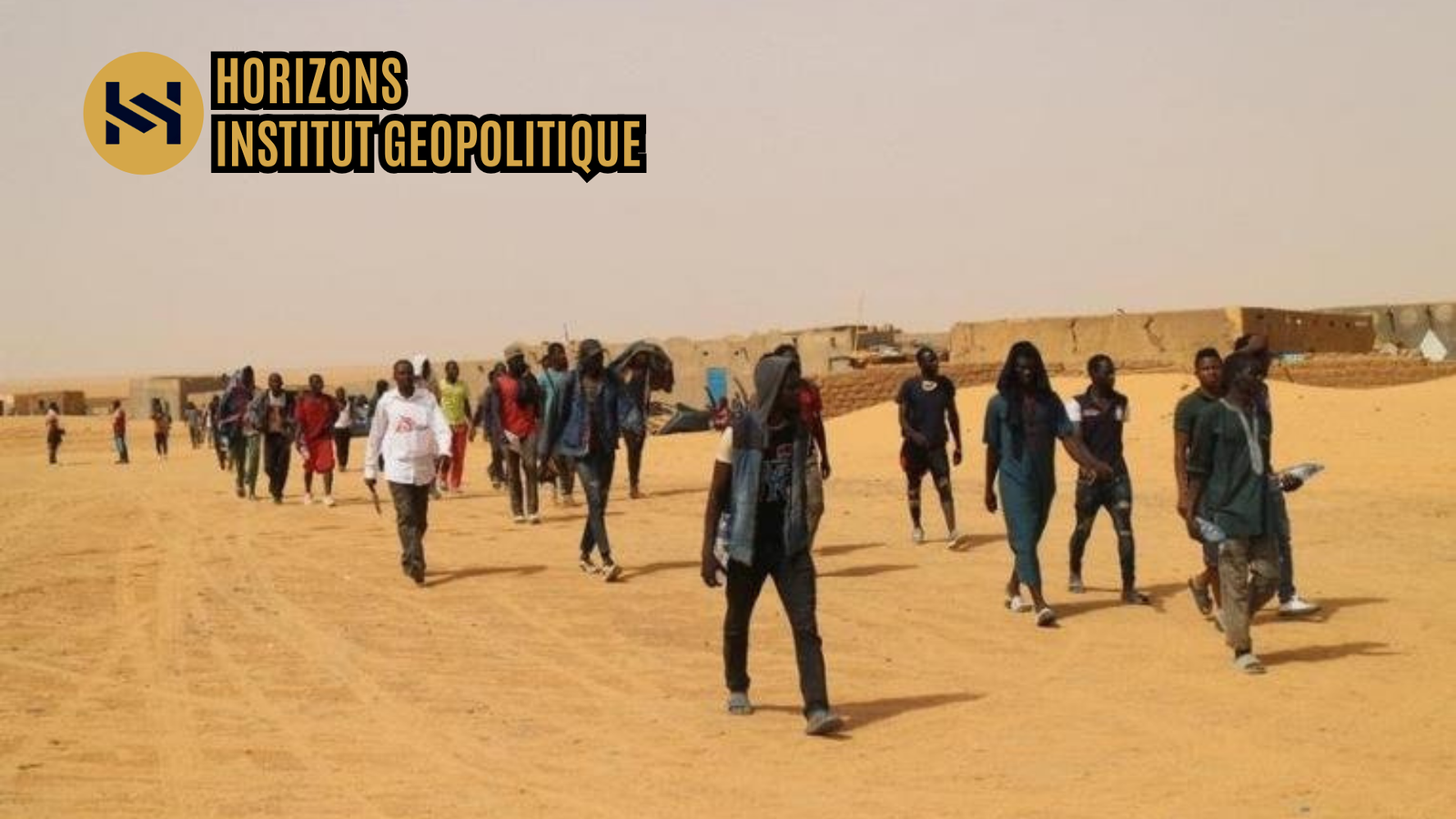
Migrants are brutally dropped in this desert zone, stripped of their belongings, without water or food, and forced to walk for hours under deadly heat. Many never reach their destination. According to testimonies collected by Alarme Phone Sahara teams, several bodies have been discovered between Point Zero and Assamaka in April 2025 alone.
Survivors generally arrive in a state of advanced dehydration, often injured, traumatized, and in complete destitution. Despite the heroic efforts of the few organizations present on site, particularly the tricycle teams of Alarme Phone Sahara who try to rescue the most vulnerable, the means of assistance remain dramatically insufficient in the face of the scale of the crisis.
Testimonies of Horror
On April 24, 2025, Niger Radio and Television (RTN) gave voice to the survivors of this tragedy. Their accounts, chilling, leave no room for doubt.
A Guinean migrant recounts being savagely beaten by Algerian law enforcement. According to him, citizens of member countries of the Alliance of Sahel States (AES) are systematically targeted. He also testifies to the mysterious disappearance of his Hausa friend, arrested and never seen again. « When I showed my Guinean ID card, they laughed and hit even harder, » he explains, his face still swollen.
A Beninese woman, her head shaved, recounts the sexual violence she suffered after her arrest. Dehumanized, humiliated, she remains deeply marked by this barbarity. « They locked several of us in a dirty cell. At night, the guards would come. They would choose among us. Those who resisted were beaten in front of the others. Afterward, they shaved our heads, as if to mark us, » she testifies, her gaze lost in an invisible horizon.
A young Guinean man, despite his duly registered consular card, explains that he was pushed back, beaten up, exhibiting on his face the scars of unspeakable brutality. « I was legal, I had been working in construction for two years. They came to arrest us at the site one morning. When I showed my papers, the officer tore them up in front of me saying ‘here are your papers now’, » he recounts, showing a deep scar on his left cheek.
As for Nigerien migrants, they report being completely stripped: money, phones, identity documents… everything is torn from them. « Even our shoes, they took them. They made us walk barefoot on the burning sand, » testifies a mason from Zinder.
These practices recall the darkest hours of contemporary history – systematic humiliation, dehumanization, targeted violence – and raise the question of their legal qualification under international law.
A Humanitarian Bomb in the Making
As the number of expelled migrants increases, the situation is dangerously tightening in the Nigerien border areas, particularly in Assamaka. Improvised reception camps are overflowing. Humanitarian aid, already insufficient, is on the verge of exhaustion.
The figures recently communicated by Assamaka security officials are edifying: between April 1 and 21, 2025, no fewer than 2,753 Nigerien nationals, including 308 minors and 196 women, were expelled from Algeria via so-called « official » convoys. These data do not even take into account the thousands of other sub-Saharan migrants left to fend for themselves, abandoned outside any formal framework.
In the same period, an additional 2,222 people were expelled in so-called « unofficial » convoys – including 146 Nigeriens and 2,076 nationals of other sub-Saharan African countries. All were forced to walk through the desert from Point Zero.
The village of Assamaka, a small desert outpost with limited resources, finds itself overwhelmed. The expelled, often injured, sick, traumatized, pile up in the dusty streets, without adequate shelter, with limited access to drinking water and essential medical care.
The IOM (International Organization for Migration) manages several reception centers in the region, but their capacities are largely exceeded. Moreover, admission to these centers is conditioned on the acceptance of a « voluntary return » to the country of origin – a condition that many refuse, thus creating a floating population of migrants stuck in a legal and humanitarian limbo.
Without rapid intervention, the Sahel risks experiencing one of the greatest humanitarian crises in its recent history. And the main victims will once again be the most vulnerable: women, children, the elderly.
The Deadly Shadow of the Desert
The human toll of this expulsion policy is particularly macabre. Alarme Phone Sahara has documented several deaths directly linked to recent expulsions:
– On March 2, 2025, a Malian migrant died upon arriving in Assamaka following a beating received in Algeria by law enforcement.
– On April 19, 2025, an Ivorian national died from his injuries and dehydration.
– On April 22, 2025, the bodies of two migrants were found in the desert area between Point Zero and Assamaka.
These documented deaths likely represent only the visible part of a much heavier toll. How many migrants die silently in the vastness of the desert, with no witness to report their end? How many bodies never found, buried by the shifting sands of the Sahara?
The extreme desert conditions transform each expulsion into a potential death sentence. Daytime temperatures exceeding 45°C, sharp drop in the thermometer at night, total absence of water and food, rugged terrain: each kilometer becomes a challenge for survival, particularly for vulnerable people – children, pregnant women, the elderly or sick.
An Obvious Geopolitical Dimension
These mass expulsions cannot be understood without their geopolitical context. They are part of a profound reconfiguration of relations between the Sahel countries and their Maghreb neighbors.
The emergence of the Alliance of Sahel States (AES) grouping Niger, Mali, and Burkina Faso, all three led by military juntas, has considerably modified the regional balance. These countries have broken with their traditional Western partners and are developing a common vision of sovereignty, creating a bloc that escapes Algiers’ traditional influence.
The repeal in November 2023 by Niger of Law 2015-036 criminalizing migrant trafficking was perceived as a provocation by Algeria, which sees it as an encouragement to irregular immigration to its territory.
Tebboune’s declaration of April 23, 2025, explicitly confirms this political dimension: mass expulsions are used as a diplomatic weapon against Niger, in retaliation for its exit from bilateral agreements. Migrants thus become hostages in a power struggle between states, sacrificed on the altar of geopolitical tensions.
In parallel, the Maghreb alliance (Algeria-Tunisia-Libya) launched in April 2024 to combat irregular immigration, directly encouraged by European border externalization policies, has intensified pressure on migrants. This increased coordination between Maghreb countries has made migration routes more dangerous and pushbacks more systematic.
Algeria Faces Its Responsibilities
The deafening silence of Algerian authorities on these practices is unacceptable. The international community, like African countries, can no longer turn a blind eye.
International law is clear: no one can be collectively expelled without individual examination of their situation; no one can be exposed to inhuman or degrading treatment. The African Charter on Human and Peoples’ Rights, which Algeria has ratified, explicitly prohibits mass expulsions based on nationality.
Given the scale and systematic nature of the violations, the question of their legal qualification as crimes against humanity legitimately arises. The Rome Statute defines crimes against humanity as acts committed as part of a widespread or systematic attack directed against a civilian population, including notably the deportation or forcible transfer of population.
A Call to Action
It is urgent to hold Algeria accountable, to protect expelled migrants, and to put in place regional mechanisms for prevention and assistance.
International organizations such as UNHCR, IOM, and the International Committee of the Red Cross must obtain immediate and unhindered access to border areas and detention centers in Algeria.
The African Commission on Human and Peoples’ Rights should open an investigation into these practices and demand that Algeria end them immediately.
European states, whose border externalization policies indirectly encourage these practices, bear a moral responsibility and should condition their cooperation with Algeria on respect for the fundamental rights of migrants.
Finally, emergency humanitarian aid must be deployed to Assamaka and other crossing points, to save lives and restore dignity to the victims of these expulsions.
Ignoring this tragedy would be a historic fault. And letting innocents die in the desert would be a crime against humanity. Beyond political divisions and geostrategic interests, it is humanity itself that is at stake in the burning sands of the Sahara.