Horizons Geopolitical Institute
8 may 2025
A Strategic Analysis by the Geopolitical Institute Horizons
Executive Summary
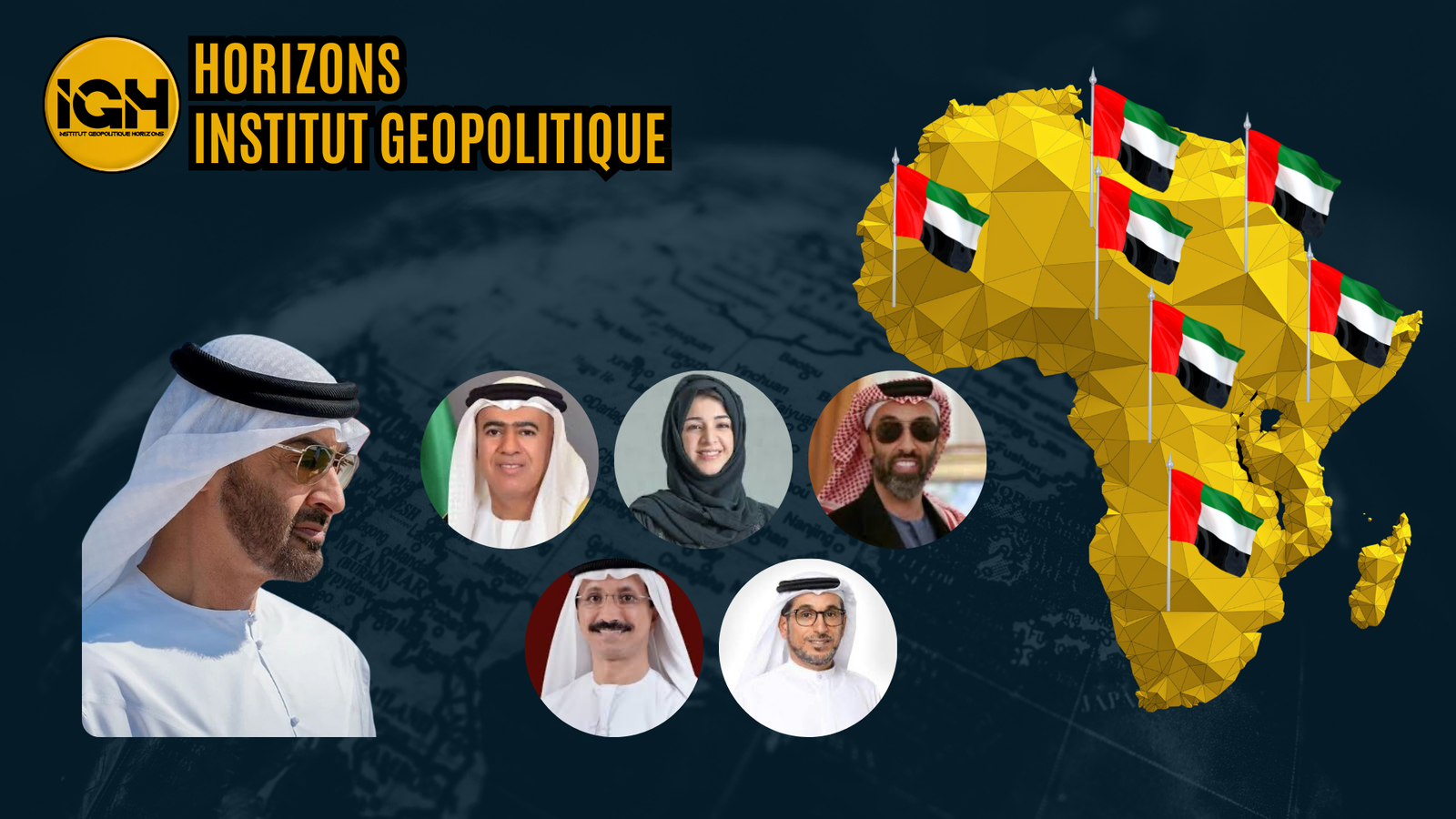
Discreet yet ambitious, the United Arab Emirates has progressively woven a web of influence across the African continent. Far from neocolonial approaches, the Emirati strategy relies on a hybridization of soft and hard power, articulated around logistical hubs, financial leverage, and diplomatic networks.
Through ports, military bases, agricultural investments, media outlets, and security cooperation, Abu Dhabi seeks to shape a strategic depth that extends beyond its immediate environment. In Africa, the stake is twofold: securing vital axes for its global interests and establishing itself as a pivotal power of the South, capable of dialoguing as an equal with major Western, Asian, and African powers.
This report aims to decipher this strategy with rigor and nuance, analyzing the underlying logic, the tools mobilized, the rivalries at play, and medium-term projections.
1. Fundamental Logic of the Emirati Strategy in Africa
Genesis of a Geopolitical Ambition
The Emirati geostrategy in Africa was born from a series of historical and geopolitical ruptures. The Arab Spring of 2011 constituted a pivotal moment, highlighting the fragility of Arab regimes facing popular uprisings and the rise of political Islam. Under the impetus of Mohammed bin Zayed (MBZ), Abu Dhabi developed a defensive, then offensive posture in the face of this regional reconfiguration.
This strategy is part of a long-term vision of economic diversification, initiated in the 2000s but considerably accelerated since 2011. Between 2012 and 2022, the UAE invested more than $60 billion in Africa, positioning itself as the 4th largest foreign investor on the continent, behind China, the European Union, and the United States. This trend has further intensified over the period 2019-2023, with $110 billion in investments, including $72 billion dedicated to renewable energy.
Multidimensional Strategic Objectives
In Africa, this posture has translated into a policy articulating three major objectives:
1. Creating logistical bridgeheads in strategic maritime spaces: the Red Sea, Gulf of Guinea, Indian Ocean. This control of maritime and commercial flows ensures the Emirates a role as an essential power in global exchanges.
2. Securing solid diplomatic partners capable of supporting Emirati foreign policy in multilateral forums, thus reinforcing the geopolitical weight of a state of modest size but with global ambitions.
3. Building an image of a benevolent power through targeted investment policies in vital sectors: health, agriculture, education, energy. This approach helps legitimize the Emirati presence among African populations and elites.
Africa is therefore not an ancillary terrain in this strategy but a vital space in the Emirates’ quest for strategic autonomy in the face of uncertainties in the Gulf and global geopolitical reconfigurations.
2. Mapping Zones of Influence
The Emirati strategy in Africa unfolds according to a logic of concentric circles, with varying intensity depending on the regions and interests at stake.
Horn of Africa: The Strategic Epicenter
The Horn of Africa constitutes the priority projection zone for the UAE. This region is of crucial importance for several reasons:
– Control of straits and maritime routes: the Emirati presence in Assab (Eritrea) and Berbera (Somaliland) ensures mastery of flows crossing the Red Sea and the Gulf of Aden, vital axes of world trade.
– Military projection: these port infrastructures have a dual dimension, civil and military. The Assab base notably served as a logistical platform for operations in Yemen until recently.
– Security influence: Sudan has long been a key partner of the Emirates, particularly through support for the Rapid Support Forces (RSF) of General Mohammed Hamdan Daglo. This complex relationship illustrates the Emirati desire to shape regional security balances.
East Africa: The Priority Corridor
East Africa represents a natural expansion axis for the UAE, which has considerably strengthened its economic and political presence there:
– Strategic investments: development of solar parks and modernization of the port of Mombasa in Kenya, financing of industrial corridors in Ethiopia ($1.2 billion in 2024), geothermal projects in Uganda.
– Economic partnerships: the Comprehensive Economic Partnership Agreement (CEPA) signed with Kenya in January 2025 illustrates this approach aimed at creating privileged economic relations.
– Diplomatic influence: multiplication of official visits, development of embassies and cultural representations.
North Africa and Sahel: The Emerging Arc of Influence
This zone constitutes a secondary but rapidly developing front of the Emirati strategy:
– Flagship projects: in Egypt, the $35 billion investment in the Ras El-Hekma smart city project by ADQ testifies to Emirati ambition.
– Regional security: in 2017, the UAE contributed $30 million to the financing of the G5 Sahel joint force, establishing itself as an actor in regional stabilization.
– Moderate religious influence: promotion of an Islam compatible with economic development and hostile to Islamist movements, particularly in the Maghreb and Sahel.
Western and Central Africa: The New Frontier
These regions represent more recent expansion zones, centered on specific sectoral interests:
– Strategic resources: investments in cobalt and copper exploitation in the Democratic Republic of Congo ($3.5 billion planned by 2026).
– Port infrastructure: development of the port of Ndayane in Senegal by DP World, strengthening the Emirati hold on the African Atlantic facade.
– Agricultural sector: land acquisitions in Nigeria, Ghana, and Namibia to guarantee food security for the Emirates.
3. Levers of Power: Investments, Bases, Partnerships
The projection of Emirati power in Africa relies on a strategic triangle combining economic, security, and influence tools.
Port and Logistics Diplomacy
At the heart of the Emirati strategy is the control of port and logistics infrastructure, the true backbone of their continental influence:
– DP World and Abu Dhabi Ports Group: these entities control terminals in 15 African countries, forming a network of strategic commercial infrastructures.
– Dual-use infrastructure: ports such as Berbera (Somaliland) or Bosaso (Somalia) combine commercial functions and military cooperation agreements, including the modernization of bases and financing of local navies.
– Development corridors: these ports are integrated into broader projects of corridors associating roads, railways, and special economic zones.
Sovereign Funds and Strategic Investments
The second pillar relies on financial power projected through sovereign funds and targeted investments:
– Masdar: this fund specialized in renewable energy has launched major solar and wind projects, particularly in Kenya and Egypt, concretizing the UAE’s commitment to develop 15 gigawatts of clean energy in Africa by 2030.
– ADIA, Mubadala, ADQ: these sovereign funds intervene in strategic sectors such as telecommunications, real estate, health, and banking services.
– Food security: with 90% of their food imported, the Emirates have adopted a strategy of acquiring agricultural land in Sudan, Mali, Morocco, and Nigeria.
Military and Security Cooperation
The third pillar relies on a discreet but effective military presence:
– Strategic bases: beyond the Horn of Africa installations, the UAE has developed military cooperation agreements with several countries on the continent.
– Training and equipment: the Emirati armed forces train African special units and provide military equipment, particularly in Mauritania, Sudan, and Libya.
– Fight against political Islam: this cooperation aims to contain Islamist movements in Africa by promoting a security model inspired by the Egyptian approach.
Religious and Educational Soft Power
Finally, a fourth lever completes this global strategy:
– Promotion of moderate Islam: the UAE finances religious centers and mosques promoting an Islam compatible with economic development and hostile to the Muslim Brotherhood.
– Philanthropic initiatives: the Mohamed bin Zayed Foundation for Humanity and initiatives like Erth Zayed Philanthropies conduct actions in health, education, and social development.
– Digital diplomacy: the Emirates deploy an influence strategy via social networks and media, directly reaching young and connected populations on the continent.
4. Rivalries and Geopolitical Balances
The Emirati presence in Africa is part of a complex game of rivalries and alliances, where the UAE seeks to maximize its influence against other regional and global powers.
Regional Rivalries: The Anti-Qatar and Turkey Axis
The African strategy of the Emirates is deeply marked by their regional rivalries:
– Confrontation with Qatar: the diplomatic rupture of 2017-2021 between the UAE and Qatar had direct repercussions in Africa, with competition for religious, media, and economic influence, particularly in Somalia and Sudan.
– Competition with Turkey: the two powers pursue competing objectives in Libya, Somalia, and the Horn of Africa, reflecting opposing geopolitical visions and ideological models.
– Tensions with Iran: the Emirati presence in the Horn of Africa aims in particular to counter Iranian influence in the region and secure vital maritime routes.
Relations with Global Powers
The Emirates have developed a balanced strategy vis-à-vis the major powers present in Africa:
– Complementarity with China: Emirati infrastructures often integrate into the corridors of the New Silk Roads, in a logic of pragmatic cooperation.
– Growing rivalry with France: particularly in the Sahel and North Africa, where the UAE seeks to establish itself as an alternative to traditional partners.
– Strategic partnership with Russia: particularly in the Central African Republic and Libya, where the two powers sometimes coordinate their efforts.
The Emirati-Saudi-Egyptian-Israeli Axis
The Emirates have progressively constituted an informal axis with Saudi Arabia, Egypt, and, more recently, Israel. This strategic alliance manifests itself in Africa through:
– Coordination of influence policies: particularly in the fight against Islamist movements and in the stabilization of certain regions.
– Economic complementarity: Emirati investments often complement those of partners in this axis, creating regional synergies.
– Occasional tensions: as illustrated by the Emirati-Saudi rivalry in Sudan, where the two countries support opposing factions, showing the limits of this alliance.
5. Prospective: What Scenarios by 2030?
By 2030, three main trajectories are emerging for Emirati influence in Africa, each depending on internal and external factors.
Scenario 1: Consolidation of the Red Sea – Sahel – Atlantic Corridor
This scenario, the most probable, would see the Emirates strengthen their presence along a strategic axis crossing Africa from east to west:
– Intensification of port investments: development of a coherent network of ports under Emirati control, from the Red Sea to the Atlantic Ocean.
– Deployment of an integrated energy strategy: with an emphasis on renewable energy and green hydrogen, sectors where the UAE seeks to establish itself as a world leader.
– Deepening of security partnerships: reinforcement of indirect military presence and cooperation agreements with Sahel states.
Scenario 2: Rising Rivalries and Strategic Adjustment
A second scenario would see the emergence of constraints limiting Emirati expansion:
– Intensification of rivalries with Turkey and Russia: particularly in Libya and the Sahel, complicating the projection of Emirati power.
– Growing resistance from African powers: emergence of a front of African countries more demanding regarding foreign investments and attentive to their sovereignty.
– Adaptation of the Emirati strategy: reorientation towards more balanced and less interventionist partnerships, privileging economic cooperation over direct political influence.
Scenario 3: Strategic Partnership for Sustainable Co-Development
This scenario would see the emergence of a more symbiotic relationship between the UAE and Africa:
– Transition to a sustainable investment model: focus on projects with high social and environmental added value, aligned with African development priorities.
– Technological and educational partnership: development of joint centers of excellence in agricultural innovation, energy transition, and digital economy.
– Strategic alliance on the international scene: enhanced diplomatic coordination on global climate, commercial, and security issues.
6. Strategic Recommendations
For African States
Faced with the rising power of the Emirates, African states could adopt the following strategies:
– Leverage competition between investors: use Emirati interest to negotiate better conditions with other international partners.
– Demand skills transfers: condition investments on substantial training and technological transfer programs.
– Develop specialized negotiation capacities: train dedicated teams to understand Emirati strategies and practices to optimize partnerships.
– Promote joint ventures: privilege partnerships where local companies retain significant participation in projects.
Perspectives for Optimizing Strategic Partnerships
The analysis of current dynamics suggests that powers investing in Africa could considerably strengthen the impact and sustainability of their presence through certain innovative approaches:
– The ecosystem of influence: the most successful actors on the African continent seem to be those who forge links with the entire societal spectrum – universities, think tanks, media, and civil society – thus creating a more resilient ecosystem of influence than mere support for political elites.
– Long-term anchoring: recent history demonstrates that investments backed by a vision of inclusive stability better resist political alternations and regional crises than those based on overly personalized alliances.
– Cultural resonance: the partnerships that resonate most strongly are often those that manage to subtly enhance pre-existing historical, religious, and commercial affinities, thus building legitimacy perceived as natural rather than imposed.
– Climate leadership: in a continent particularly vulnerable to climate change, actors capable of bringing expertise and financing in renewable energy could capitalize on recognized expertise to establish themselves as essential partners in African sustainable development.
Conclusion
The Emirati geostrategy in Africa reveals a power in full mutation, capable of projecting its influence well beyond its immediate environment. This strategy combines ambition, flexibility, and realism, adapting to local contexts while pursuing coherent global objectives.
In a multipolar world where lines of influence become more fluid, the United Arab Emirates has positioned itself as an essential actor in Africa, drawing a presence that transcends the simple economic relationship to encompass security, cultural, and diplomatic dimensions.
African states, for their part, are progressively becoming arbiters capable of choosing their partners and negotiating more balanced conditions. This new paradigm opens the way to potentially more mutually beneficial relations if both parties manage to overcome historical asymmetries.